
IBDP Chemistry HL Paper 1B- Data-Based Question- New Syllabus
Question
A teacher gave the class an experimental assignment to determine the concentration of aqueous sodium hydroxide, \( \mathrm{NaOH} \), using \(2.00\,\mathrm{mol\,dm^{-3}}\) hydrochloric acid, \( \mathrm{HCl} \), a thermometer and laboratory glassware.
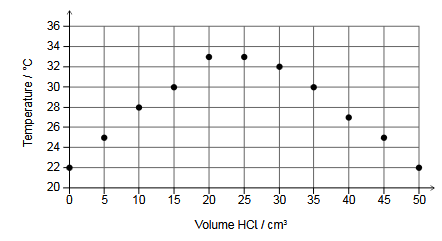
(a) Student A used a \(50\,\mathrm{cm^3}\) measuring cylinder to make the following mixtures of the two solutions in a \(125\,\mathrm{cm^3}\) conical flask and measured the highest temperature for each mixture.
| Volume HCl / \( \mathrm{cm^3} \) ± \(0.5\,\mathrm{cm^3}\) | \(0.0\) | \(5.0\) | \(10.0\) | \(15.0\) | \(20.0\) | \(25.0\) | \(30.0\) | \(35.0\) | \(40.0\) | \(45.0\) | \(50.0\) |
|---|---|---|---|---|---|---|---|---|---|---|---|
| Volume NaOH / \( \mathrm{cm^3} \) ± \(0.5\,\mathrm{cm^3}\) | \(50.0\) | \(45.0\) | \(40.0\) | \(35.0\) | \(30.0\) | \(25.0\) | \(20.0\) | \(15.0\) | \(10.0\) | \(5.0\) | \(0.0\) |
| Temperature / \( ^\circ\mathrm{C} \) ± \(1\,^\circ\mathrm{C}\) | \(22\) | \(25\) | \(28\) | \(30\) | \(33\) | \(33\) | \(32\) | \(30\) | \(27\) | \(25\) | \(22\) |
(i) Suggest one health and safety risk.
\(\boxed{\hspace{8cm}}\)
(ii) Use a ruler to draw straight lines of best fit through the increase and the decrease in temperature to show where they intersect.
\(\boxed{\hspace{8cm}}\)
(iii) The enthalpy change of the neutralization, \( \Delta H \), in \( \mathrm{kJ\,mol^{-1}} \), may be found from the temperature rise, \( \Delta T \), and the volume, \(V\), of HCl in mixtures where HCl is the limiting reagent, using the expression:
\(\Delta H=\dfrac{50.0\times4.18\times\Delta T}{2.00\times V}\)
Determine the percentage uncertainty in the temperature rise, using the precision with which the temperature was measured.
\(\boxed{\hspace{8cm}}\)
(iv) State two assumptions that are made when using the formula in part (a)(iii) to calculate the enthalpy of neutralization.
\(\boxed{\hspace{10cm}}\)
(b) Student B used a slightly different technique, transferring \(25.00\,\mathrm{cm^3}\) of NaOH to a \(125\,\mathrm{cm^3}\) conical flask, using a pipette, and then adding the HCl, \(5.00\,\mathrm{cm^3}\) at a time from a burette, measuring the steady temperature at each step.
| Volume HCl / \( \mathrm{cm^3} \) ± \(0.05\,\mathrm{cm^3}\) | \(0.00\) | \(5.00\) | \(10.00\) | \(15.00\) | \(20.00\) | \(25.00\) | \(30.00\) | \(35.00\) | \(40.00\) | \(45.00\) | \(50.00\) |
|---|---|---|---|---|---|---|---|---|---|---|---|
| Temperature / \( ^\circ\mathrm{C} \) ± \(1\,^\circ\mathrm{C}\) | \(22\) | \(25\) | \(28\) | \(30\) | \(32\) | \(32\) | \(31\) | \(30\) | \(29\) | \(29\) | \(28\) |
(i) Suggest, giving your reason, which student has the preferable method from a green chemistry perspective.
\(\boxed{\hspace{10cm}}\)
(ii) State, giving your reason, which student has the more precise results.
\(\boxed{\hspace{10cm}}\)
(iii) Deduce whether this difference in precision would significantly affect the uncertainty of the NaOH concentration calculated from the point at which the lines intersect.
\(\boxed{\hspace{10cm}}\)
(iv) Comment on how the recorded temperature varies, with volume of HCl, for the two methods.
\(\boxed{\hspace{10cm}}\)
(v) Suggest why, when Student A added \(45\,\mathrm{cm^3}\) of HCl the temperature only rose to \(25^\circ\mathrm{C}\), but when Student B added \(45\,\mathrm{cm^3}\) HCl, the temperature rose to \(29^\circ\mathrm{C}\).
\(\boxed{\hspace{10cm}}\)
(vi) Deduce, giving the reason, for which volume reading the temperature would be most affected by heat loss to the surroundings.
Student: \(\boxed{\hspace{2cm}}\) Volume reading: \(\boxed{\hspace{3cm}}\)
Reason: \(\boxed{\hspace{8cm}}\)
(vii) Suggest a change to the apparatus that would reduce this heat loss.
\(\boxed{\hspace{10cm}}\)
(viii) Suggest another advantage of the modification made in part (b)(vii).
\(\boxed{\hspace{10cm}}\)
▶️ Answer/Explanation
(a)(i) Correct Answer:
Hydrochloric acid and sodium hydroxide are corrosive and can cause burns or damage to the skin and eyes.
Appropriate eye protection should therefore be worn and contact with the solutions avoided.
(a)(ii) Correct Answer:
Draw two straight lines of best fit, one through the increasing-temperature points and one through the decreasing-temperature points. The lines should be extended until they intersect.
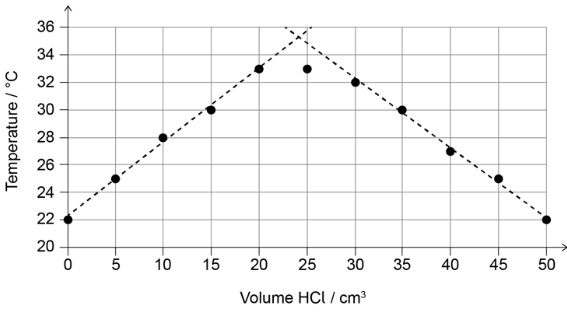
The intersection occurs at approximately \(25\,\mathrm{cm^3}\) of HCl and \(35\,^\circ\mathrm{C}\).
(a)(iii) Correct Answer: \( \boxed{18\%} \)
The temperature measurements have an uncertainty of \( \pm1\,^\circ\mathrm{C} \). Since the temperature rise is calculated from a final and initial temperature, the absolute uncertainty in the temperature rise is
\(\Delta(\Delta T)=1+1=2\,^\circ\mathrm{C}\)
From the graph, the temperature rise is approximately
\(\Delta T=33-22=11\,^\circ\mathrm{C}\)
Therefore, the percentage uncertainty is
\(\dfrac{2}{11}\times100=18.2\%\)
Hence, \( \boxed{18\%} \).
(a)(iv) Correct Answer:
Two suitable assumptions are:
• The specific heat capacity of the solution is the same as that of water, approximately \(4.18\,\mathrm{J\,g^{-1}\,K^{-1}}\).
• The density of the solution is approximately \(1.00\,\mathrm{g\,cm^{-3}}\), so the mass of \(50.0\,\mathrm{cm^3}\) of solution is approximately \(50.0\,\mathrm{g}\).
Another acceptable assumption is that no heat is lost to the surroundings and that all heat released by the reaction is absorbed by the solution.
(b)(i) Correct Answer: \( \boxed{\text{Student B}} \)
Student B uses less reagent because only \(25.00\,\mathrm{cm^3}\) of NaOH is used, whereas Student A uses a total of \(50.0\,\mathrm{cm^3}\) of solution in each mixture.
Therefore, Student B produces less chemical waste and is preferable from a green chemistry perspective.
(b)(ii) Correct Answer: \( \boxed{\text{Student B}} \)
Student B uses a burette and a pipette, which measure volumes more precisely than the measuring cylinder used by Student A.
Therefore, Student B obtains more precise volume measurements and hence more precise results.
(b)(iii) Correct Answer:
No. The uncertainty in the volume measurement is much smaller for Student B, but the uncertainty in the volume corresponding to the intersection is mainly determined by the scatter and uncertainty of the temperature measurements.
Therefore, the improved precision of the volume measurements would not significantly affect the uncertainty in the NaOH concentration obtained from the intersection.
(b)(iv) Correct Answer:
Both methods show a similar general trend at low volumes of HCl: the temperature increases as more HCl is added.
The temperature reaches a maximum near the equivalence point and then decreases as further HCl is added.
At larger volumes of HCl, Student A generally records lower temperatures than Student B, indicating a greater effect of heat loss in Student A’s method.
(b)(v) Correct Answer:
At \(45\,\mathrm{cm^3}\) of HCl, Student B still has \(25.00\,\mathrm{cm^3}\) of NaOH available, whereas Student A has only \(5.0\,\mathrm{cm^3}\) of NaOH.
Therefore, more moles can react in Student B’s mixture, releasing more heat and giving a higher temperature.
(b)(vi) Correct Answer: \( \boxed{\text{Student B, }50\,\mathrm{cm^3}} \)
The \(50\,\mathrm{cm^3}\) reading is most affected because the solution has been reacting and exposed to the surroundings for the longest time.
Consequently, the greatest amount of heat has had time to escape to the surroundings.
(b)(vii) Correct Answer:
Replace the glass conical flask with a polystyrene cup or another better-insulated container.
This reduces heat transfer between the reacting solution and the surroundings.
(b)(viii) Correct Answer:
A polystyrene cup has a lower heat capacity than the glass flask, so less heat is absorbed by the container itself.
Therefore, more of the heat released by the reaction is transferred to the solution, giving a larger and more measurable temperature change.