Home / IB DP / IB Physics 2026, 2027 & 2028 / IB Physics SL / A.1 Kinematics SL Paper 1 |IBDP Physics SL 2025 | Exam Style Questions

IBDP Physics- A.1 Kinematics- IB Style Questions For SL Paper 1A -FA 2025

Question

Instantaneous velocity is defined as below
(A) displacement / time taken
(B) rate of change of position.
(C) distance moved / time taken
(D) rate of change of distance.
▶️ Answer/Explanation
Detailed solution

1. Define Velocity:
Velocity is a vector quantity. It is defined as the rate of change of displacement (or position) with respect to time.

2. Distinguish Instantaneous vs Average:
Average velocity is total displacement over total time. Instantaneous velocity is the limit of this ratio as the time interval approaches zero, i.e., the derivative of position with respect to time.

3. Evaluate Options:

  • (A) Displacement / time taken = Average Velocity.
  • (B) Rate of change of position = Instantaneous Velocity (\(v = \frac{ds}{dt}\)).
  • (C) Distance / time = Average Speed.
  • (D) Rate of change of distance = Instantaneous Speed.

Answer: (B)

Question

A block of mass \(2.0\,\mathrm{kg}\) accelerates uniformly at a rate of \(1.0\,\mathrm{m\,s^{-2}}\) when a force of \(4.0\,\mathrm{N}\) acts on it. The force is doubled while resistive forces stay the same. What is the block’s acceleration?
(A) \(4.0\,\mathrm{m\,s^{-2}}\)
(B) \(3.0\,\mathrm{m\,s^{-2}}\)
(C) \(2.0\,\mathrm{m\,s^{-2}}\)
(D) \(1.0\,\mathrm{m\,s^{-2}}\)
▶️ Answer/Explanation
Detailed solution

Initially, the net force on the block is
\(F_{\text{net,1}} = ma = 2.0 \times 1.0 = 2.0\,\mathrm{N}\).
With an applied force of \(4.0\,\mathrm{N}\), the resistive force is
\(R = 4.0 – 2.0 = 2.0\,\mathrm{N}\).

When the applied force is doubled, \(F_2 = 8.0\,\mathrm{N}\) and the resistive force remains \(2.0\,\mathrm{N}\).
So the new net force is
\(F_{\text{net,2}} = 8.0 – 2.0 = 6.0\,\mathrm{N}\).

Hence the new acceleration is
\(a_2 = \dfrac{F_{\text{net,2}}}{m} = \dfrac{6.0}{2.0} = 3.0\,\mathrm{m\,s^{-2}}\).

Answer: (B)

Question

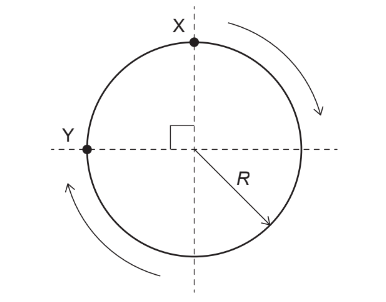
A car travels clockwise around a circular track of radius \(R\). What is the magnitude of displacement from \(X\) to \(Y\)?
A.1 Kinematics SL Paper 1
(A) \(R \dfrac{3\pi}{2}\)
(B) \(R \dfrac{\pi}{2}\)
(C) \(R\sqrt{2}\)
(D) \(R\)
▶️ Answer/Explanation
Detailed solution

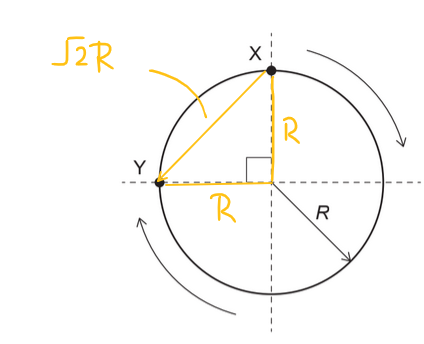
The displacement from \(X\) to \(Y\) is the straight-line distance (the chord), not the distance travelled along the track.

From the diagram, \(X\) and \(Y\) are \(90^\circ\) apart around the circle, so the radii to \(X\) and \(Y\) are perpendicular. This forms a right-angled triangle with legs \(R\) and \(R\).
Therefore, the displacement magnitude is
\(XY = \sqrt{R^2 + R^2} = R\sqrt{2}\).
Answer: (C)

Scroll to Top