Home / IB DP / IB Physics 2026, 2027 & 2028 / IB Physics SL / IBDP Physics- A.2 Forces and momentum- IB Style Questions For SL Paper 1A

IBDP Physics- A.2 Forces and momentum- IB Style Questions For SL Paper 1A -FA 2025

Question

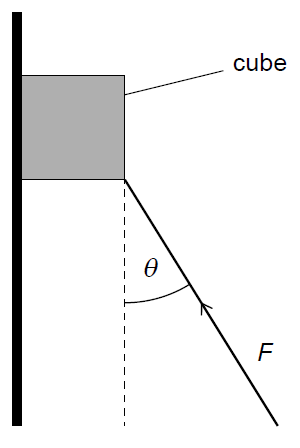
A force is applied to a cube of mass \(m\), causing it to accelerate upward while moving along a vertical frictionless surface. The force has magnitude \(F\) and is directed at an angle \(\theta\) to the vertical. What is the magnitude of the acceleration of the cube?
(A) \(\frac{(F \cos \theta – mg)}{m}\)
(B) \(\frac{(F \sin \theta – mg)}{m}\)
(C) \(\frac{(F \cos \theta – g)}{m}\)
(D) \(\frac{(F \sin \theta – g)}{m}\)
▶️ Answer/Explanation
Detailed solution

1. Analyze forces in the vertical direction:

  • Upward force: The vertical component of the applied force \(F\). Since \(\theta\) is measured from the vertical, this component is \(F \cos \theta\).
  • Downward force: The weight of the cube, \(mg\).

2. Apply Newton’s second law:
\(\Sigma F_y = ma\)
\(F \cos \theta – mg = ma\)

3. Solve for the acceleration \(a\):
\(a = \frac{F \cos \theta – mg}{m}\)
Answer: (A)

Question

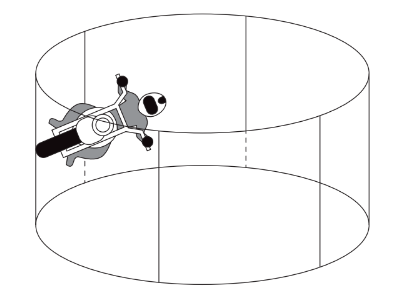
A stuntman rides a motorcycle on the inside surface of a vertical cylinder.
A.2 Forces and momentum SL Paper 1
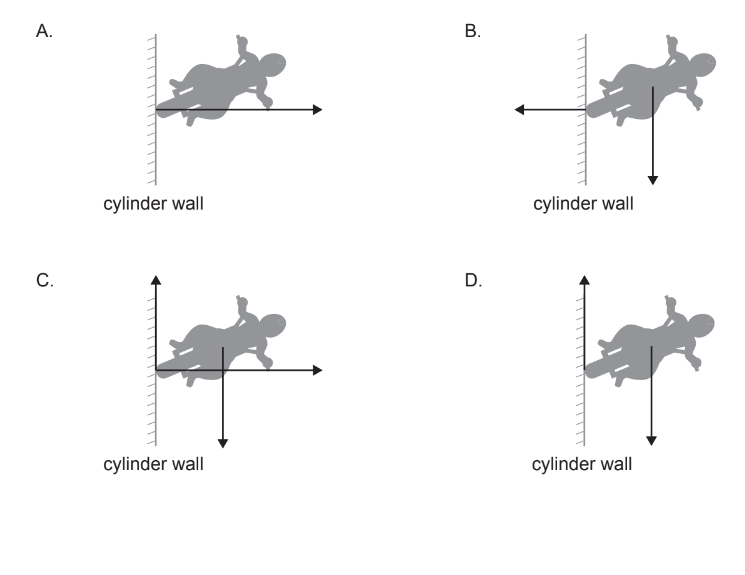
Which is the correct free-body diagram showing all the forces acting on the cyclist at that position?
A.2 Forces and momentum SL Paper 1
▶️ Answer/Explanation
Detailed solution

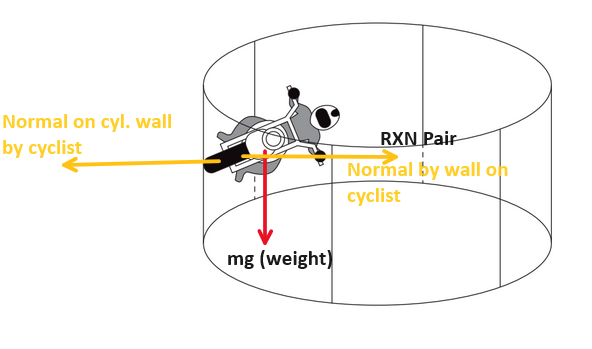
The forces acting on the cyclist are: the weight acting vertically downward, the normal reaction from the wall acting horizontally towards the centre of the cylinder, and the frictional force acting vertically upward to balance the weight.
A.2 Forces and momentum SL Paper 1

Answer: (C)

Question

A tennis ball is dropped from rest from a height. It hits the ground and bounces back to a lower height. Air resistance is negligible.
What is correct about the collision of the tennis ball with the ground?
(A) Elastic because momentum of the system is conserved
(B) Elastic because the kinetic energy of the system is conserved
(C) Inelastic because momentum of the system is not conserved
(D) Inelastic because the kinetic energy of the system is not conserved
▶️ Answer/Explanation
Detailed solution

In an elastic collision, the total kinetic energy of the system is conserved. Here, the ball rebounds to a lower height, so it leaves the collision with less kinetic energy than it had just before impact.

Some kinetic energy is transformed into other forms of energy during the collision (for example, internal energy/heat and sound), so kinetic energy is not conserved.

Answer: (D)

Scroll to Top