Home / IB DP / IB Physics 2026, 2027 & 2028 / IB Physics SL / IBDP Physics- B.1 Thermal energy transfers- IB Style Questions For SL Paper 1A

IBDP Physics- B.1 Thermal energy transfers- IB Style Questions For SL Paper 1A -FA 2025

Question

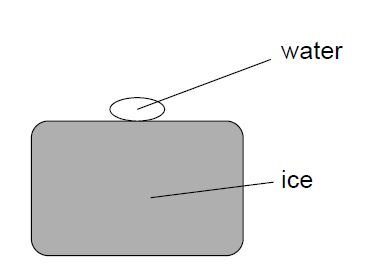
A block of ice with mass \(M\) is initially at its melting point. A smaller quantity of water of mass \(m\), at a temperature of \(T^{\circ}\text{C}\), is poured onto the upper surface of the ice and stays there.
The specific latent heat of fusion of ice is \(L\) and the specific heat capacity of water is \(c\). How much ice melts as a result?
(A) \(\frac{mcT}{L}\)
(B) \(\frac{mLT}{c}\)
(C) \(\frac{McT}{L}\)
(D) \(\frac{MLT}{c}\)
▶️ Answer/Explanation
Detailed solution

1. Energy Balance Principle:
The heat lost by the cooling water equals the heat gained by the melting ice.

2. Heat Lost by Water:
Water cools from \(T\) to \(0^{\circ}\text{C}\) (since it’s on ice at melting point).
\(Q_{lost} = mc\Delta T = mc(T – 0) = mcT\).

3. Heat Gained by Ice:
Let \(m_{melt}\) be the mass of ice that melts.
\(Q_{gained} = m_{melt}L\).

4. Solve for Mass Melted:
\(m_{melt}L = mcT\)
\(m_{melt} = \frac{mcT}{L}\).
Answer: (A)

Question

The temperature of an object changes from \(\theta_1\,^\circ\text{C}\) to \(\theta_2\,^\circ\text{C}\). What is the change in temperature measured in kelvin?
A. \(\left(\theta_2-\theta_1\right)\)
B. \(\left(\theta_2-\theta_1\right)+273\)
C. \(\left(\theta_2-\theta_1\right)-273\)
D. \(273-\left(\theta_2-\theta_1\right)\)
▶️ Answer / Explanation

A change in temperature is the same in kelvin and in degrees Celsius:
\[ \Delta T(\text{K}) = \Delta T(^\circ\text{C}) = \theta_2 – \theta_1 \]
Adding \(273\) is only needed when converting an absolute temperature, not a temperature difference.

Answer: A

Question

The temperature of a gas increases from \(100\,\text{K}\) to \(330\,\text{K}\). What is the change in temperature of the gas in degrees Celsius?
A. \(503\)
B. \(230\)
C. \(-43\)
D. \(-230\)
▶️ Answer / Explanation

A change in temperature has the same numerical value in kelvin and in degrees Celsius:
\[ \Delta T(^\circ\text{C}) = \Delta T(\text{K}) \]
Hence,
\[ \Delta T = 330 – 100 = 230 \]

The change in temperature is \(230\,^\circ\text{C}\).

Answer: B

Scroll to Top