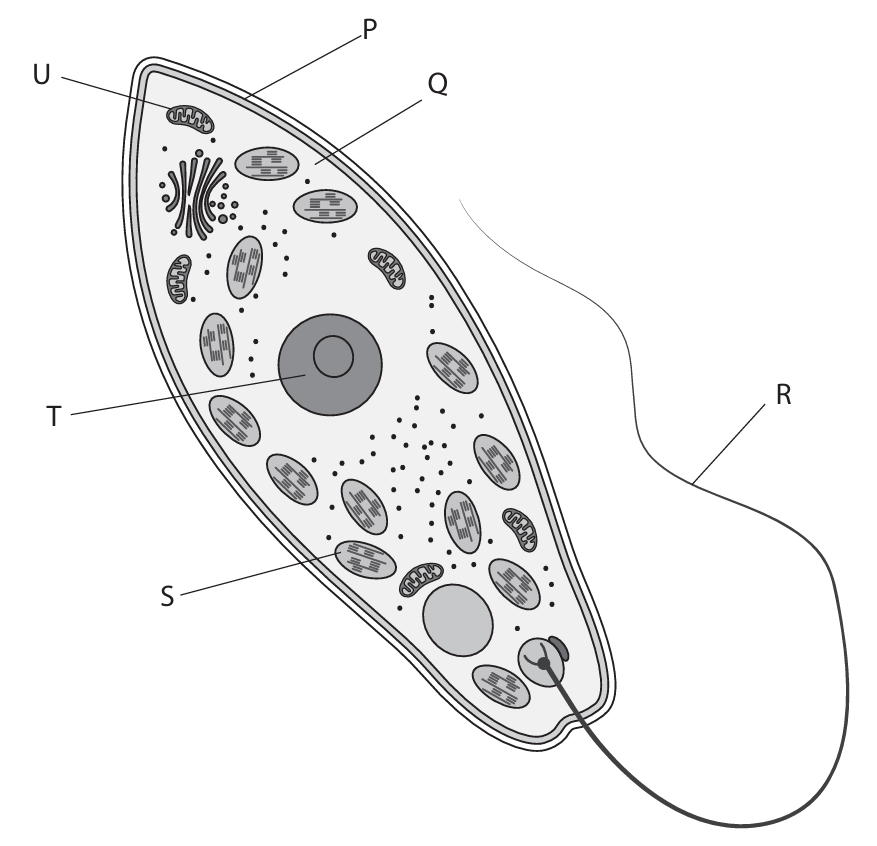
Euglena is a microorganism that lives in water. The diagram shows Euglena with some structures labelled.

(a) (i) Which group contains Euglena?
A) bacteria
B) fungi
C) protocysts
D) viruses
(a) (ii) Which structure is the site of respiration?
A) P
B) R
C) T
D) U
(a) (iii) Which structure contains chromosomes?
A) P
B) Q
C) R
D) T
(a) (iv) Which structure is the cell membrane?
A) P
B) Q
C) R
D) U
(b) Euglena has some structures that are found in plant cells but not in animal cells. Which labelled structure is found in plant cells but not in animal cells?
A) P
B) Q
C) S
D) T
(c) Some of the labelled structures are known as organelles. State what is meant by the term organelle.
(d) Explain which two labelled structures allow Euglena to move through water. Refer to the diagram and your own knowledge in your answer.
Most-appropriate topic codes (Edexcel IGCSE Biology):
• 2(b): Cell structure — parts (a)(ii), (a)(iii), (a)(iv), (b), (c)
• 2(f): Respiration — part (a)(ii)
• 2(b): Cell differentiation and specialized cells — part (d)
▶️ Answer/Explanation
(a)(i) C (protocysts)
A is not the answer as Euglena is not in bacteria
B is not the answer as Euglena is not in fungi
D is not the answer as Euglena is not in viruses
(a)(ii) D (U)
A is not the answer as P is the membrane
B is not the answer as R is the flagellum
D is not the answer as T is the nucleus
(a)(iii) D (T)
A is not the answer as P is the membrane
B is not the answer as Q is the cytoplasm
C is not the answer as R is the flagellum
(a)(iv) A (P)
B is not the answer as Q is the cytoplasm
C is not the answer as R is the flagellum
D is not the answer as U is the mitochondrion
(b) C (S)
A is not the answer as P is the cell membrane
B is not the answer as Q is the cytoplasm
D is not the answer as T is the nucleus
(c) • structure / part of a cell with particular function / purpose / role (s) /eq
(d) An explanation that makes reference to three of the following:
• mitochondria / U (1)
• (mitochondrion) respiration / releases energy / provides ATP / eq (1)
• flagellum / R / tail / eq (1)
A teacher uses Benedict’s solution to investigate the concentration of glucose in four flavoured waters, A, B, C and D.
This is the teacher’s method.
Step 1 add 5 cm3 of flavoured water to a boiling tube
Step 2 add 5 cm3 of Benedict’s solution to the boiling tube
Step 3 keep the boiling tube at 70°C for five minutes
Step 4 record the colour of the solution
The teacher uses this method for each of the four flavoured waters.
The table shows the teacher’s results.
| Flavoured water | Colour of the solution after heating for five minutes |
|---|---|
| A | yellow |
| B | brick red |
| C | blue |
| D | green |
(a) (i) Give one variable that the teacher controls in the investigation.
(ii) Give a method that the teacher could safely use to keep the boiling tube at 70°C for five minutes in step 3.
(b) An athlete wants to drink flavoured water to help them run a long-distance race.
Explain which flavoured water, A, B, C or D, would be most suitable for the athlete to drink during the race.
(c) Some flavoured waters do not contain glucose.
Suggest why this may be an advantage for some people.
Most-appropriate topic codes (Edexcel IGCSE Biology):
• 2(e): Nutrition in humans – balanced diet and energy requirements – part (b)
• 2(f): Respiration – energy release from glucose – part (b)
• Appendix 6: Suggested practical investigations – testing for glucose – parts (a)(i), (a)(ii)
▶️ Answer/Explanation
(a)(i) One variable that the teacher controls is: temperature/70°C or time/5 minutes or volume of water/5 cm³ or volume of Benedict’s solution/5 cm³.
(a)(ii) A safe method to keep the boiling tube at 70°C for five minutes is to use a water bath set at 70°C.
(b) Flavoured water B would be most suitable for the athlete because:
- It has turned brick red with Benedict’s solution, indicating the highest concentration of glucose.
- Glucose is needed for respiration to release energy.
- This energy is required for muscle contraction during running.
- This enables the athlete to run faster or for longer periods.
(c) Flavoured waters without glucose may be advantageous because:
- They contain fewer calories/less energy, which helps prevent weight gain or obesity.
- They reduce the risk of tooth decay or are better for people with diabetes who need to control blood glucose levels.
Plant cells use photosynthesis to produce carbohydrates.
(a) Give the energy conversion that occurs during photosynthesis.
from …… energy to …… energy
(b) A student investigates whether carbon dioxide is needed for photosynthesis.
(i) Firstly, the student needs to remove all the starch from the plant’s leaves. Explain how the student could do this.
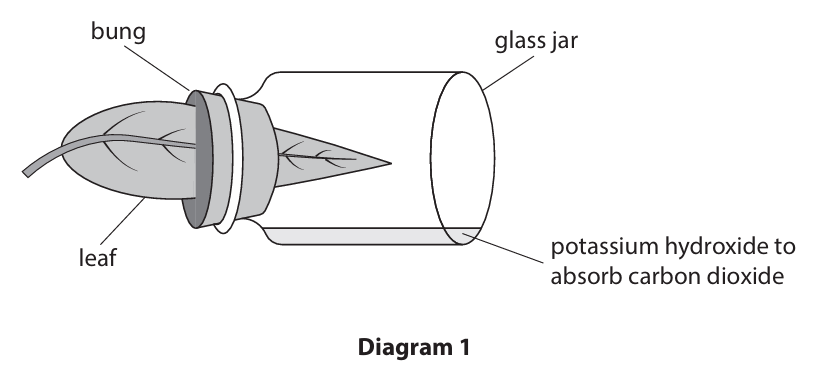
(ii) After the starch has been removed from the leaves, the student uses the apparatus in diagram 1 to prevent carbon dioxide from reaching part of one of the leaves.

The student places the apparatus in the light for 24 hours, and then tests the leaf for starch.
Complete and label diagram 2 to show the results of the starch test.

(c) Plants need mineral ions as well as carbon dioxide and water.
Give the functions of two named mineral ions that a plant needs.
(d) The concentration of mineral ions in the soil is often lower than the concentration in the plant.
Waterlogged soil does not contain air.
Explain why plants in waterlogged soil cannot absorb mineral ions.
Most-appropriate topic codes (Edexcel IGCSE Biology):
- 2(e): Nutrition – Flowering plants — parts (a), (b), (c)
- 2(d): Movement of substances into and out of cells — part (d)
- 2(f): Respiration — parts (b), (d)
- 3(h): Transport – Flowering plants — parts (c), (d)
- Appendix 5: Suggested practical investigations — part (b)
▶️ Answer/Explanation
(a) Energy conversion during photosynthesis:
from light/solar energy to chemical energy
(b)(i) To remove all starch from the plant’s leaves:
• Keep the plant in darkness for 12/24/48 hours
• This allows all starch to be used up in respiration
(b)(ii) Diagram 2 results:
• Left side (outside flask): black/blue/starch present
• Right side (inside flask): yellow/orange/brown/no starch
The part exposed to carbon dioxide (outside flask) tests positive for starch, while the part without carbon dioxide (inside flask) tests negative.
(c) Functions of two named mineral ions:
Nitrate ions: needed for amino acids/proteins/enzymes/DNA
Magnesium ions: needed for chlorophyll/chloroplasts/photosynthesis
Other acceptable pairs:
• Iron: for chlorophyll/chloroplasts/photosynthesis/respiration
• Phosphate: for DNA/ATP/cell membranes
• Calcium: for cell walls/cell membranes
• Potassium: for water balance/enzymes/photosynthesis/respiration
(d) Why plants in waterlogged soil cannot absorb mineral ions:
• Mineral ions are absorbed by active transport
• Waterlogged soil has no/less oxygen
• Therefore, there is no/less respiration
• Resulting in no/less energy/ATP for active transport
Insect pests can eat and damage crop plants.
The cottony cushion scale insect is a pest that feeds on orange trees.
(a) This insect feeds from the phloem of the trees, reducing crop yield.
(i) Name two substances carried in the phloem.
(ii) Explain why insects feeding from the phloem can reduce crop yield from the orange trees.
(b) Farmers can reduce insect pests by using chemical pesticide or biological control.
Insects called ladybugs can be used as a method of biological control as they feed on the scale insects.
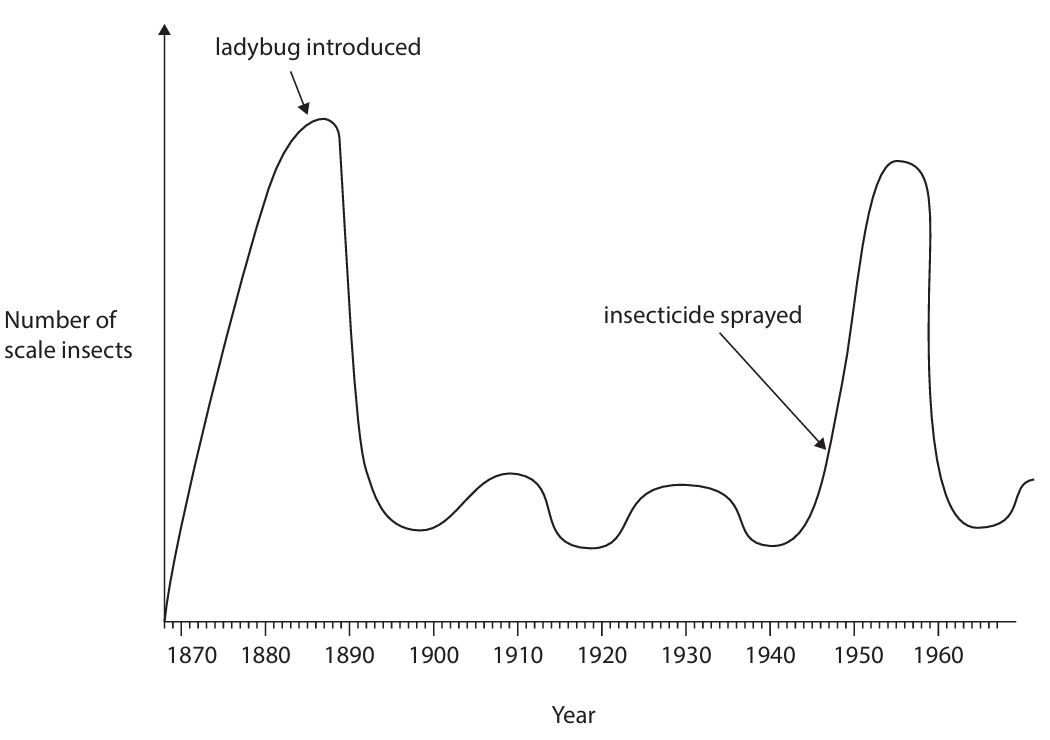
The graph shows how the number of scale insects changes after the introduction of ladybugs.
The graph also shows how the number of scale insects changes after being sprayed with an insecticide, a pesticide that kills insects.

(i) Discuss the effects that the introduction of ladybugs, and the use of insecticides, has on the numbers of scale insects.
Use information from the graph and your own knowledge to help with your answer.
(ii) Give three advantages of using biological control instead of pesticides to control pests.
Most-appropriate topic codes (Edexcel IGCSE Biology):
- 3(h): Transport — part (a)
- 6(a): Food production — parts (b)(i), (b)(ii)
- 5(d): Human influences on the environment — parts (b)(i), (b)(ii)
- 5(b): Feeding relationships — part (b)(i)
- 2(e): Nutrition — part (a)(ii)
▶️ Answer/Explanation
(a)(i) Two substances carried in the phloem:
1. Sucrose/sugars (1)
2. Amino acids (1)
Marking guidance: ignore glucose; allow water/plant hormones/named plant hormone
(a)(ii) Explanation why insects feeding from phloem reduce crop yield:
An explanation that makes reference to three of the following:
- No/less respiration/no/less energy (1)
- No/less protein (1)
- No/less growth/new cells (1)
- Less fruit production/fewer oranges/smaller fruit (1)
Marking guidance: No credit for less sugar amino acid or glucose; Ignore less crops/less yield
(b)(i) Discussion of effects on scale insect numbers:
An answer that makes reference to five of the following:
- Reduce (quickly/steeply) after ladybug introduced (1)
- As the ladybugs feed on scale/pests (1)
- Scale insects numbers go up and down/fluctuate/oscillate (1)
- Some pests required for ladybugs to feed on/scale insects never completely wiped out (1)
- Insecticide release causes (rapid) increase in scale insects/pests (1)
- As (more) ladybugs killed (than scales/pests) (1)
- Fewer scale insects are eaten/less predation (1)
- Insecticide becomes less effective/disperses/ladybugs recover/ladybugs develop resistance (1)
- Scale insects/pest numbers drop (1)
- Ladybugs/biological control more effective than insecticide/kill more pests (1)
(b)(ii) Three advantages of biological control instead of pesticides:
An explanation that makes reference to four of the following points:
- Lasts longer/does not need reapplication (1)
- Specific/does not affect food chain/other organisms (1)
- No residue on crop/not eaten by humans/does not affect humans (1)
- No bioaccumulation/biomagnification (1)
- Pest does not become resistant (1)
Marking guidance: allow converse; ignore cheaper alone; ignore pollution alone; allow contaminate crops; ignore immune
(a) Inheritance involves genomes, genes and alleles.
(i) State what is meant by the term genome.
(ii) Explain the difference between a gene and an allele.
(b) In horses, black hair is caused by a dominant allele, B. The recessive allele, b, codes for brown hair.
A heterozygous black-haired male horse breeds with a heterozygous black-haired female horse.
(i) Draw a genetic diagram to show the genotypes of the parents, the gametes they can produce and the genotypes and ratio of phenotypes of their possible offspring.
(ii) Calculate the probability that the first offspring will be male and have black hair.
(c) In horses, eye colour is also controlled by a single gene with two alleles.
The dominant allele causes brown eyes and the recessive allele codes for blue eyes.
A farmer has a male horse with brown eyes.
Explain how the farmer could determine the genotype of this male horse.
Most-appropriate topic codes (Edexcel IGCSE Biology):
- 4(b) Inheritance: Genomes, genes and alleles — part (a)
- 4(b) Inheritance: Monohybrid inheritance and genetic diagrams — part (b)(i)
- 4(b) Inheritance: Probability calculations in genetics — part (b)(ii)
- 4(b) Inheritance: Determining genotypes using test crosses — part (c)
- 4(b) Inheritance: Dominant, recessive, homozygous, heterozygous — parts (a), (b), (c)
- Appendix 3: Mathematical skills — probability calculations — part (b)(ii)
▶️ Answer/Explanation
(a)(i) The genome is the entire DNA of an organism / complete set of genes / all of genetic material of an organism.
(ii) Explanation of the difference:
- A gene is a section of DNA that codes for a specific protein/polypeptide
- An allele is an alternative form/version of a gene
(b)(i) Genetic diagram:
Parents: Bb × Bb
Gametes: B, b (from male) and B, b (from female)
Offspring genotypes:
- BB (homozygous black) – 25%
- Bb (heterozygous black) – 50%
- bb (brown) – 25%
Phenotype ratio: 3 black : 1 brown
(ii) Probability calculation:
Probability of black hair = 0.75
Probability of male = 0.5
Probability = 0.75 × 0.5 = 0.375 or 37.5% or 3/8
(c) Explanation to determine genotype:
The farmer should:
- Cross the brown-eyed male horse with a blue-eyed female (homozygous recessive)
- If any offspring have blue eyes, then the male is heterozygous (Bb)
- If all offspring are brown-eyed, repeat the cross to obtain more foals
- If never have blue-eyed offspring, then the male is homozygous (BB)
- Alternative method: Look at parents of male horse – if one parent is blue-eyed (bb) then male horse must be Bb/heterozygous
Some scientists investigate the effect of temperature on the growth of maize seedlings.
The scientists keep the seedlings in two rooms, A and B.
- in room A, they keep the temperature between 10°C and 30°C for 120 days
- in room B, they keep the temperature between 10°C and 30°C for 82 days and above 30°C for 38 days.
The scientists measure the leaf area in square centimetres for each seedling every 20 days.
(a) (i) Calculate the percentage of the total days that the temperature in room B is between 10°C and 30°C.
(ii) Explain why the scientists allow the temperature to vary within a range in each room.
(iii) Give the dependent variable in this investigation.
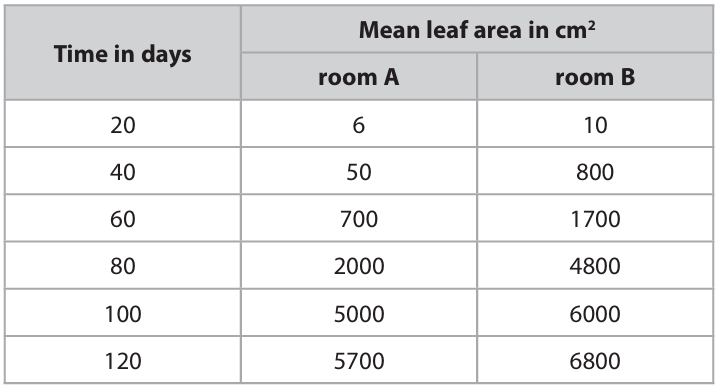
(b) The table shows the scientists’ results.

(i) Plot two line graphs to show the mean leaf area in each room at each time.
Use a ruler to join your points for each room with straight lines.
(ii) For room B, calculate the increase in mean leaf area per day from day 20 to day 120.
(iii) Explain the effect of temperature on the growth rate of the seedlings.
(iv) Describe how the scientists could measure the surface area of a leaf.
Most-appropriate topic codes (Edexcel IGCSE Biology 2025):
- 2.11: Understand how temperature changes can affect enzyme function — parts (a)(ii), (b)(iii)
- 2.20: Understand how varying temperature affect the rate of photosynthesis — parts (a)(ii), (b)(iii)
- 6.2: Understand the effects on crop yield of increased temperature — parts (a)(ii), (b)(iii)
- 5.5: Understand how abiotic factors affect organisms — parts (a)(ii), (b)(iii)
- Appendix 3: Mathematical skills — parts (a)(i), (b)(ii)
- Experimental Skills: Practical investigations — parts (a)(iii), (b)(i), (b)(iv)
- 2.21: Structure of the leaf — part (b)(iv)
▶️ Answer/Explanation
(a)(i) Calculation:
Days between 10°C and 30°C = 82 days
Total days = 120 days
Percentage = \( \frac{82}{120} \times 100 = 68.3\% \)
Answer: 68% (accept any number of significant figures that round to 68)
(a)(ii) Explanation:
The scientists allow temperature to vary because:
1. Temperature changes during the day/night (1)
2. This is more realistic/natural/outside/simulates/mirrors natural conditions (1)
Ignore changes in seasons
(a)(iii) Dependent variable:
Leaf area / growth of maize / leaf size (1)
(b)(i) Graph plotting requirements:
• Scales linear and at least 3.5 big squares on y-axis and 3 on x-axis (1)
• Lines straight and through all points (1)
• Axis correct way round (days on x and leaf area on y) with units days and cm² (1)
• Points correctly plotted within a small square (1)
• Key/labelled A and B (1)
Ignore extrapolation. Bar chart maximum 4 marks.
(b)(ii) Calculation:
Initial leaf area at day 20 = 10 cm²
Final leaf area at day 120 = 6800 cm²
Increase = \( \frac{6800 – 10}{120 – 20} = \frac{6790}{100} = 67.9 \) cm² per day
Answer: 68 cm² per day (accept 67.9 or 70)
(b)(iii) Explanation of temperature effect:
Any two of:
1. No temperature difference up to 80/82 days / increased temperature decreases growth / growth decreases in B / grows more in A after 80/82 days (1)
2. Difference in growth in first 80/82 days due to other factors / light (1)
3. Enzyme denatures at higher temperature (B) / optimum is below 30°C (1)
4. Enzyme and substrate no longer bind / change in active site (1)
Alternative: link between temperature and kinetic energy or temperature and collisions
(b)(iv) Measuring leaf surface area:
Any two of:
1. Draw around outline / put on squared paper / grid / use transparent squared grid (1)
2. Count squares / sum squares (1)
3. Multiply by 2 / for each side (1)
Alternative: measure width and length and multiply together
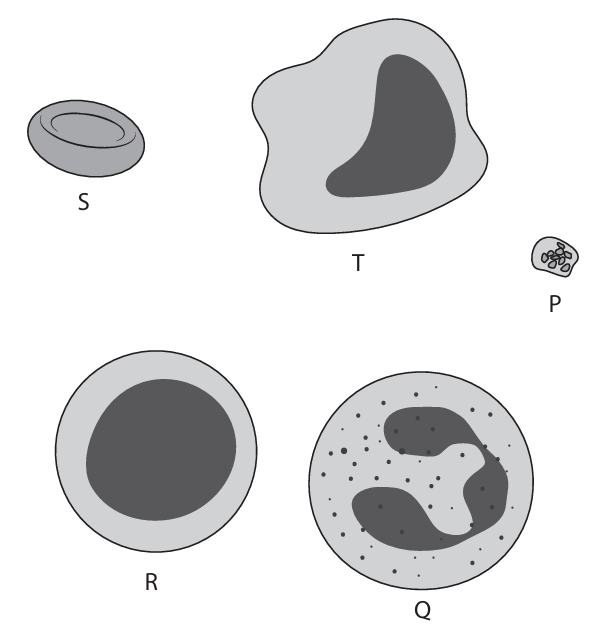
The diagram shows five components of human blood.

(a) (i) Which component is a red blood cell?
A) P
B) Q
C) S
D) T
(ii) Which component is a platelet?
A) P
B) Q
C) R
D) T
(iii) Which component is a lymphocyte?
A) P
B) Q
C) R
D) S
(iv) Which mineral ion is found in haemoglobin?
A) calcium
B) iron
C) magnesium
D) sodium
(b) Some types of blood cells are involved in the human immune response. Describe how the human immune system reacts to an infection.
(c) Scientists collect blood samples from two people. One person does not have a blood condition and the other person has a blood condition. The scientists count the number of platelets, phagocytes, lymphocytes, and red blood cells for each sample. The table shows the scientists’ results.

(i) Each blood sample has a volume of 2 mm³. Calculate the number of red blood cells in a 2 mm³ sample of blood. Give your answer in standard form.
\[ [1 \, \text{dm}^3 = 1 \times 10^6 \, \text{mm}^3] \]
(ii) Comment on the effects that the numbers of each blood component could have on the person with the blood condition. Use the data in the table and your own knowledge to help with your answer.
Most-appropriate topic codes (Edexcel IGCSE Biology):
• 3(h): Immune system response — part (b)
• 3(h): Blood composition and function — parts (a), (c)
• Appendix 3: Mathematical skills — part (c)(i)
▶️ Answer/Explanation
(a)(i) C (S)
A is not the answer as P is a platelet
B is not the answer as Q is a white blood cell
D is not the answer as T is a monocyte
(a)(ii) A (P)
B is not the answer as Q is a white blood cell
C is not the answer as R is a lymphocyte
D is not the answer as T is a monocyte
(a)(iii) C (R)
A is not the answer as P is a platelet
B is not the answer as Q is a white blood cell
D is not the answer as S is red blood cell
(a)(iv) B (iron)
A is not the answer as calcium is not found
C is not the answer as magnesium is not found
D is not the answer as sodium is not found
(b) A description that makes reference to four of the following:
• phagocytes / white blood cells engulf pathogens / bacteria (1)
• phagocytes / white blood cells digest / break down pathogens / bacteria (1)
• lymphocytes / white blood cells produce antibodies (1)
• antibodies are specific to pathogen / antigens / complementary to pathogen (1)
• antibodies attach to pathogens / bacteria / antigens (1)
• (antibodies) cause agglutination / sticking together / bursting (1)
allow ref to memory cells as alternative
(c)(i) Calculation:
\( 5.0 \times 10^{12} \) in one litre / dm³
\( (5.0 \times 10^{12}) \div (1 \times 10^6 \, \text{mm}^3) \)
So \( 5 \times 10^6 \) in 1mm³
and \( 2 \times \text{in } 2 \, \text{mm}^3 \)
\( = 1.0 \times 10^7 \) or \( 1 \times 10^7 \)
(c)(ii) An answer that makes reference to five of the following:
1. no difference in platelets (1)
2. no difference in clotting / scab formation (1)
3. more phagocytes that engulf / digest pathogens / bacteria (1)
4. more lymphocytes that produce antibodies (1)
5. can fight infection / prevent disease / more effective immune system (1)
6. has an infection / bacteria / virus / sepsis (1)
7. too much cell division / mutation / cancer (1)
8. no difference in rbc (1)
9. no difference in oxygen transport / no difference in respiration / not anaemic (1)
Ecology is the study of organisms and their environment.
(a) (i) State what is meant by the term ecosystem.
(ii) State what is meant by the term community.
(iii) State what is meant by the term population.
(b) Complete the passage about feeding relationships by writing a suitable word or words in each blank space.
Food chains show the flow of energy through an ecosystem from one organism to the next. The arrows in a food chain show the …… of energy flow. The first organism in a food chain is a ……
The position that an organism has in a food chain is known as its …… level.
Not all the energy from one level reaches organisms in the next level. Some of the energy is released as …… energy during …… or movement. Some of the energy remains in undigested food which is released as …… Some of the energy is released in metabolic waste which is excreted as ……
Some of the energy remains in the dead organism until the organism is broken down by decomposers such as …… and fungi.
Most-appropriate topic codes (Edexcel IGCSE Biology):
• 5(b): Feeding relationships — part (b)
• 5(c): Cycles within ecosystems — part (b)
▶️ Answer/Explanation
(a)(i) • community / organisms and their (non-living) environment / habitat
(a)(ii) • all of the organisms of all species in an area / all organisms in an area / all species in an area
(a)(iii) • all of one species / a species in an area
(b) • direction (1)
• producer / plant (1)
• trophic (1)
• heat / thermal (1)
• respiration (1)
• faeces / manure (1)
• urine / urea / sweat (1)
• bacteria (1)
Scientists can produce new varieties of plants by genetic modification.
(a) Describe how two named enzymes are used in genetic modification.
(b) Scientists can also produce new varieties of plants by selective breeding. Give two differences between the use of genetic modification and selective breeding to produce new varieties of plants.
Most-appropriate topic codes (Edexcel IGCSE Biology):
• 6(b): Selective breeding — part (b)
• 6(c): Genetic modification (genetic engineering) — part (b)
▶️ Answer/Explanation
(a) A description that includes:
- restriction enzyme (1)
- cuts DNA from donor / cuts / opens plasmid / cuts gene / cuts genetic material / produces sticky ends / complementary bases (1)
- ligase (1)
- join / insert / stick DNA together (1)
If function does not match enzyme – can award one mark (for either enzyme or function)
(b) An answer that makes reference to two of the following:
- GM uses foreign DNA / from other species / transgenic (1)
- GM quicker / fewer generations (1)
- GM involves asexual / clones (1)
- GM uses enzymes / plasmids / vectors (1)
- selection uses same species (1)
- slower uses sexual reproduction / crossing / pollination/ fertilisation (1)
Allow converse
Some species of seed will only germinate after they have been exposed to light.
Design an investigation to determine if exposure to light affects germination.
Include experimental details in your answer and write in full sentences.
Most-appropriate topic codes (Edexcel IGCSE Biology):
• 4.5: Practical: investigate the conditions needed for seed germination
• 3.30: Co-ordination and response — response to light stimulus
• 5.2: Practical: investigate population size — experimental design principles
▶️ Answer/Explanation
Investigation Design:
Experimental Setup:
• Use two groups of seeds from the same species, of the same age and mass
• Place one group in constant light conditions and the other group in complete darkness
• Ensure all other variables are kept constant: same temperature, same water availability, same oxygen levels, same soil type if used
• Use a large number of seeds in each group (e.g., 50 seeds per group) and repeat the experiment to ensure reliability
Procedure:
• Set up petri dishes or planting trays with identical conditions except for light exposure
• Count the number of seeds that germinate in each group after a specific time period (e.g., 7 days)
• Record observations of which seeds show root/shoot emergence or seed splitting
• Calculate the mean germination rate for each light/dark group from repeated trials
Analysis:
• Compare the germination rates between the light-exposed and dark groups
• If significantly more seeds germinate in the light group, this indicates light affects germination
• If similar numbers germinate in both groups, light may not be a required factor for this species
Control Measures:
• Maintain identical temperature for both groups
• Provide equal watering and moisture conditions
• Use the same type and volume of growth medium
• Ensure adequate oxygen availability for both groups
