

▶️ Answer/Explanation
(a)(i) A (Mucor is a eukaryotic organism with cell walls made of chitin)
B is incorrect as Mucor does not have cellulose
C is incorrect as Mucor is not a prokaryote
D is incorrect as Mucor is not a prokaryote
(a)(ii) B (1)
A is incorrect as Mucor has cytoplasm
C is incorrect as Mucor does not have chloroplasts or starch
D is incorrect as Mucor does not have chloroplasts or starch
(a)(iii)
• \(3.14 \times 45^2 = 6358.5\)
• to two sig figs = 6400
(b)(i) An answer that makes reference to two of the following:
• asexual produces genetically identical offspring / clones (1)
• asexual has no fertilisation / no gametes (1)
• asexual only has one parent cell (1)
• asexual uses (only) mitosis / asexual does not use meiosis (1)
(b)(ii) An explanation that makes reference to the following:
• sexual reproduction produces (genetic) variation (1)
• some may survive environmental changes / not all killed by disease / are more adaptable / natural selection can occur (1)
▶️ Answer/Explanation
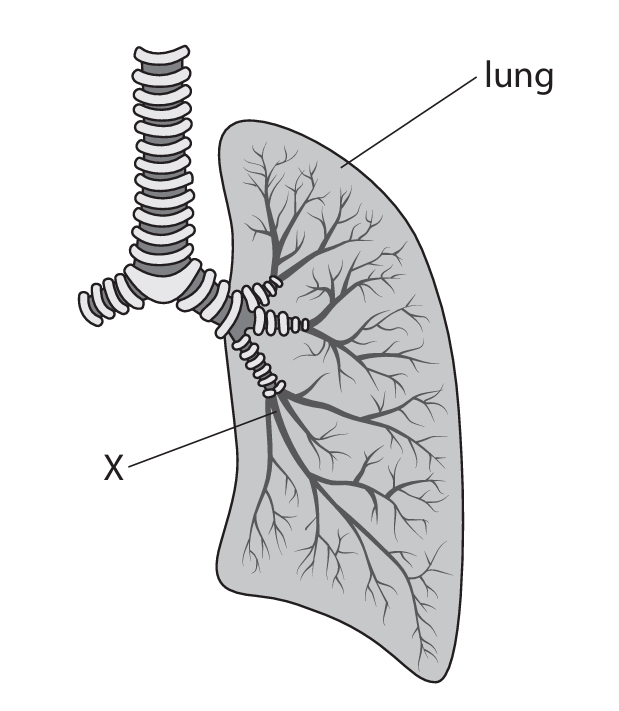
(a)(i) B (bronchiole)
A is incorrect as it is not an alveolus
C is incorrect as it is not a bronchus
D is incorrect as it is not a trachea
(a)(ii) An answer that makes reference to the following:
• it has more than one tissue / is a group of tissues / is a collection of tissues / made of multiple tissues (1)
(a)(iii) An explanation that makes reference to the following:
• diaphragm moves down / flattens (1)
• (chest / thorax) volume increases (1)
• (chest / thorax) pressure decreases / air flows from high pressure to low pressure / down a pressure gradient (1)
(b)(i) • \(35 \times 70 \times 30 = 73,500\) cm³ (2)
One mark for ×35 or ×70 or ×30 or 2450 or 1050 or 2100
Accept 74,000 or 73,000 for two marks
Correct answer gains both marks
(b)(ii) An explanation that makes reference to three of the following:
1. oxygen use lower in smokers / lower rate of oxygen use (1)
2. tar (in cigarettes) (1)
3. causes emphysema / mucus builds up / mucus not removed / cilia damaged (1)
4. less surface area (of alveoli) (1)
5. less diffusion of oxygen (into blood) (1)
6. carbon monoxide binds to haemoglobin (reducing oxygen) (1)
7. causes narrowing of arteries / blocks blood vessels (reducing flow of oxygenated blood) (1)
▶️ Answer/Explanation
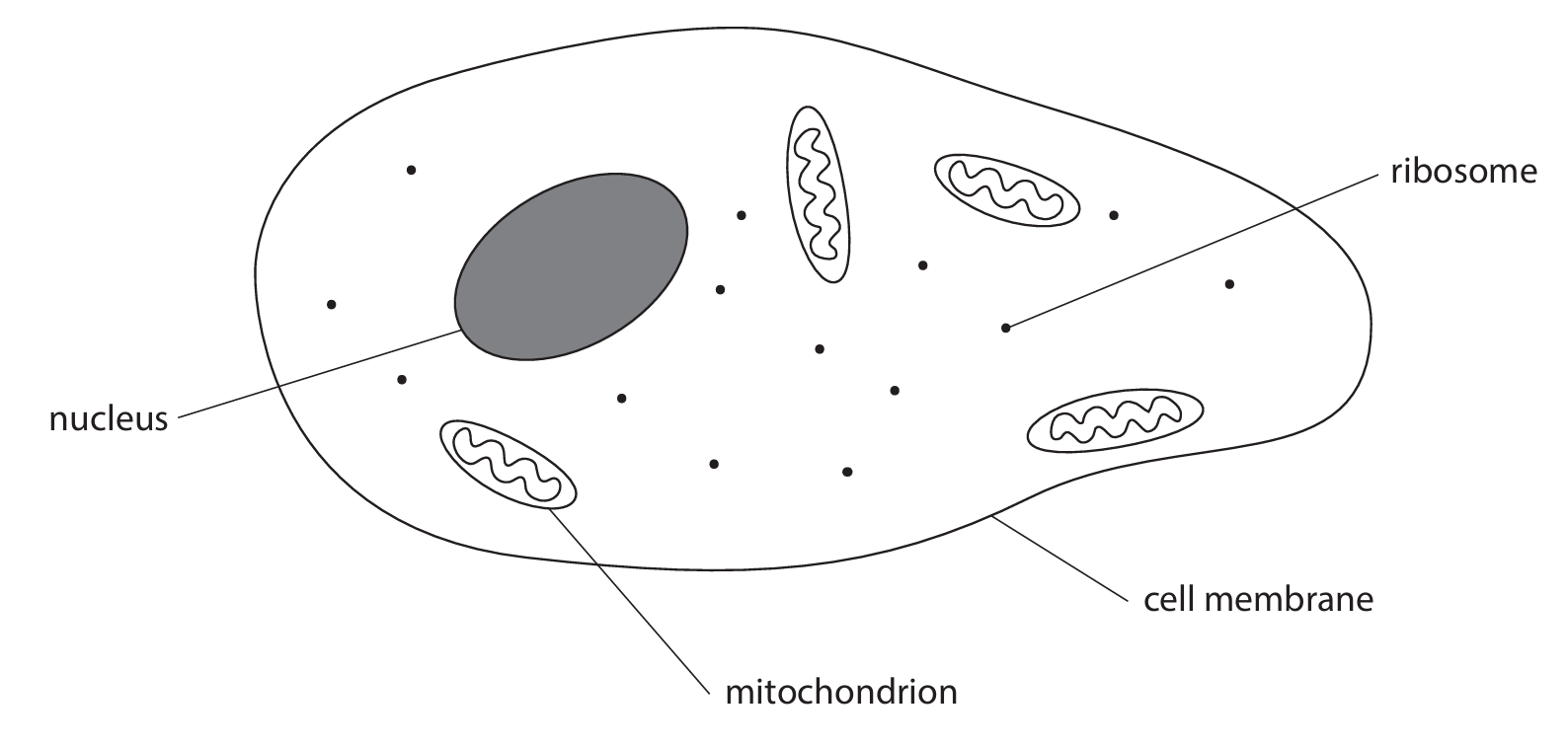
(a)(i) D (ribosome)
A is incorrect as cell membrane does not synthesise protein
B is incorrect as mitochondria does not synthesise protein
C is incorrect as the nucleus does not synthesise protein
(a)(ii) C (mitochondrion, nucleus and ribosome)
A is incorrect as ribosomes are also present in both
B is incorrect as nuclei are also present in both
D is incorrect as mitochondrion is also present in both
(b)(i) 40:1
Example calculation:
• Number of mitochondria per 10 μm3 for sperm = 12
• Volume of sperm cell = (75 ÷ 12) × 10 = 62.5 μm3
• Ratio = 2500:62.5 = 40:1
(b)(ii) An explanation that makes reference to four of the following:
• villus has highest number of mitochondria per cell / sperm has lowest number of mitochondria per cell
• sperm has highest number of mitochondria per 10 μm3 / skin has lowest number per 10 μm3
• mitochondria perform aerobic respiration / make ATP / release energy
• villus cells do active transport (so need lot of energy)
• sperm cells move / swim (so need lot of energy)
• skin cells have few active processes / use little energy

▶️ Answer/Explanation
(a)(i) • water / protein (1)
Accept amino acids
(a)(ii) 26 (2)
Example calculation: \( 9.2 \div 35 \times 100 = 26.28571 \)
One mark for correct answer to any number of decimal places e.g. 26.28571…
OR
One mark for \( 9.2 \div 35 \)
OR
One mark for \( 0.26(28571) \)
Correct answer gains both marks
(a)(iii) An answer that makes reference to one of the following: (1)
• helps peristalsis / eq (1)
• prevents constipation / eq (1)
• helps intestines push food / eq (1)
• helps release faeces / eq (1)
• helps egestion / eq (1)
• helps in movement of food / eq (1)
Reject excrete faeces
(b) An answer that makes reference to three of the following: (3)
• amylase (1)
• from salivary glands / from pancreas / eq (1)
Accept (released into / digested in) mouth
Accept (released into / digested in) small intestine / duodenum / ileum
• starch / it, is digested into maltose (1)
Accept broken down / hydrolysed / turned into for digested
• maltase digests maltose (into glucose) (1)
(c)(i) An answer that makes reference to the following: (1)
• 38 (mg per cm³) (1)
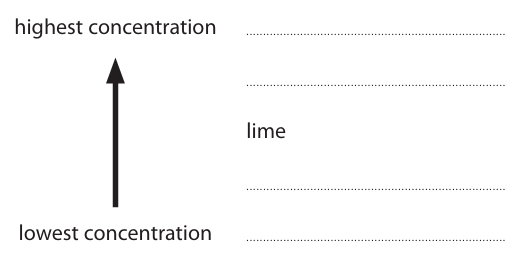
(c)(ii) An answer that makes reference to the following order: (1)
• orange lemon (lime) apple grape (1)
Accept numbers from table i.e. 3 4 (lime = 7) 18 22
(c)(iii) An answer that makes reference to two of the following: (2)
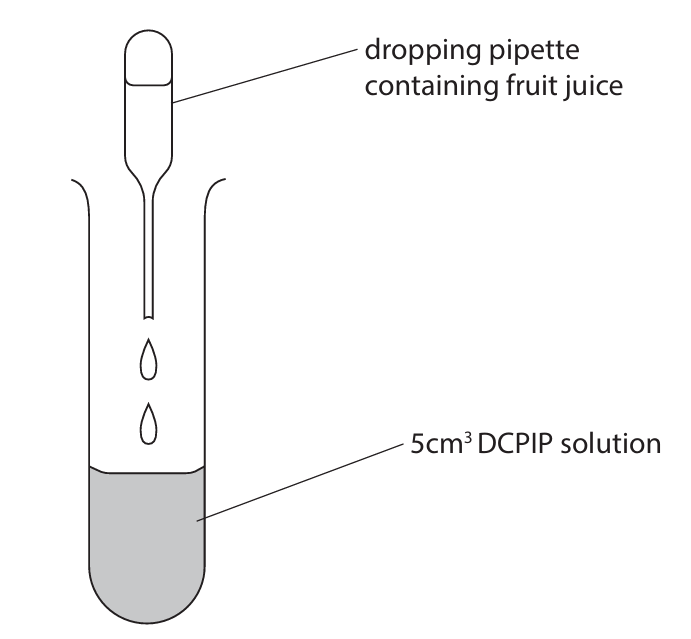
• use a syringe / graduated pipette / measuring cylinder / burette / eq (1)
• to measure volume / ml / cm³ / dm³ / mm³ / eq (1)
• as drop sizes vary / masses of drops vary / volumes of drops vary / eq (1)
• mix / swirl / stir (solution after adding drops) / eq (1)
Ignore pipette alone
Accept Automatic pipette
Accept volumetric pipette
Accept balance / scale
Accept use titration
Accept mass / weight (of juice)
Accept idea that method does not control drop size
Ignore references to repeats / replicates
(Total for Question 4 = 11 marks)

▶️ Answer/Explanation
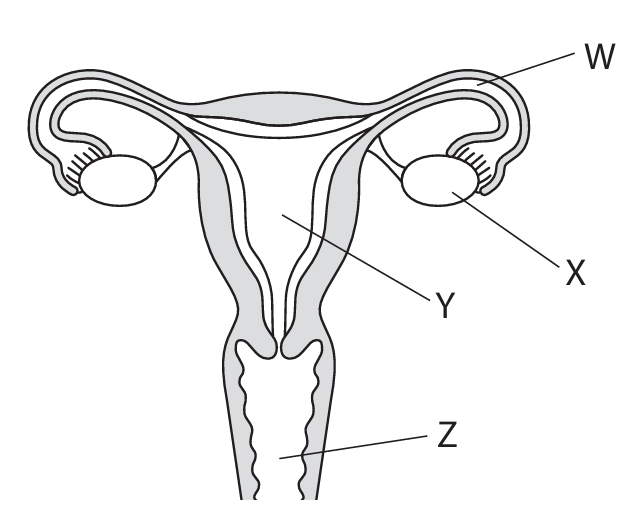
(a)(i) B (X)
A is incorrect as ovulation occurs in the ovary
C is incorrect as ovulation occurs in the ovary
D is incorrect as ovulation occurs in the ovary
(a)(ii) An answer that makes reference to two of the following:
• (progesterone is released) after ovulation / in second half of cycle / eq (1)
• maintains uterus lining / maintain endometrium / prevents menstruation / eq (1)
• so embryo can implant in the lining / to support an embryo / to support fetus / eq (1)
(a)(iii) An answer that makes reference to three of following:
• villi / villus (1)
• large surface (area) (1)
• (blood / capillaries) maintains gradient / makes steep gradient / eq (1)
• thin / short distance / maternal and fetal blood are close / eq (1)
• diffusion / active transport (1)
(b)(i) C (haploid number of 23 chromosomes)
A is incorrect as sperm are not diploid
B is incorrect as sperm are not diploid
D is incorrect as sperm have 23 chromosomes
(b)(ii) An answer that makes reference to five of the following:
• sperm movement decreases with concentration / eq (1)
• no further effect between 0.4 and 0.8 / levels off after 0.4 / eq (1)
• no effect on sperm concentration / small reduction / slight effect / unclear effect / fluctuates / eq (1)
• fertilisation would not occur (if sperm cannot swim) / eq (1)
• (sperm) needs to swim to oviducts / Fallopian tubes / fertilisation occurs in oviducts / Fallopian tubes / eq (1)
• (may not work as) some sperm can (always) move / reach eggs / reach oviducts (with any concentration) / eq (1)
• sample size is small / no repeats (so not reliable) / eq (1)
• may not have same effect in humans / may have side effects / health impacts / humans would needs bigger doses / eq (1)
• no mention of age of mice / eq (1)

▶️ Answer/Explanation
(a)(i) Graph requirements:
- Linear scale for both axes with at least two large squares on y-axis and at least half of x-axis
- Straight lines between points
- Axes with time on horizontal and mass on vertical
- Plots correct (± half square)
- Axes labelled and with units (minimum: mass/g and time/min)
(a)(ii) A description that makes reference to the following:
- Mass increases (1)
- Levels off after 25 minutes / at 27 g / eq (1)
(a)(iii) An explanation that makes reference to two of the following:
- Water moved into bag (by osmosis/diffusion) / eq (1)
- (Water moves) from a high water potential to a low water potential / from high concentration (of water) to low concentration (of water) / from dilute to concentrated / eq (1)
- Until pressure prevented more water entering / bag was full / bag was turgid / eq (1)
(b)(i) A description that makes reference to two of the following:
- Use a water bath (1)
- With a thermostat / use a (Bunsen) burner and thermometer / eq (1)
- Eye protection / eq / use tongs / gloves / eq (1)
(b)(ii) An explanation that makes reference to three of the following:
- Osmosis is faster / eq (1)
- Tubing fills faster / mass increases faster / so increase in mass will be steeper / will level off earlier / eq (1)
- More (kinetic) energy (1)
- So particles / water, will move faster / eq (1)
▶️ Answer/Explanation
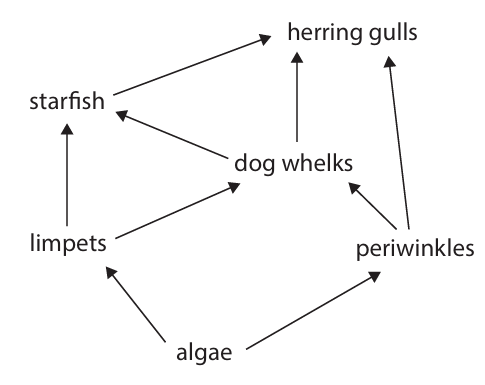
(a)(i) C (secondary consumer and tertiary consumer)
A is incorrect as it is not a primary consumer
B is incorrect as it is not a primary consumer
D is incorrect as it is also a tertiary consumer
(a)(ii) • all of (the organisms of) one / a species in an area (at one time)
(a)(iii) An explanation that makes reference to three of the following:
• (energy lost) from movement
• (energy lost) from respiration / heat loss
• (energy lost) as not some not eaten / are inedible
• (energy lost) as some not digested / indigestible / faeces / egestion
• (energy loss) due to death and decay / (energy lost) to other food chains
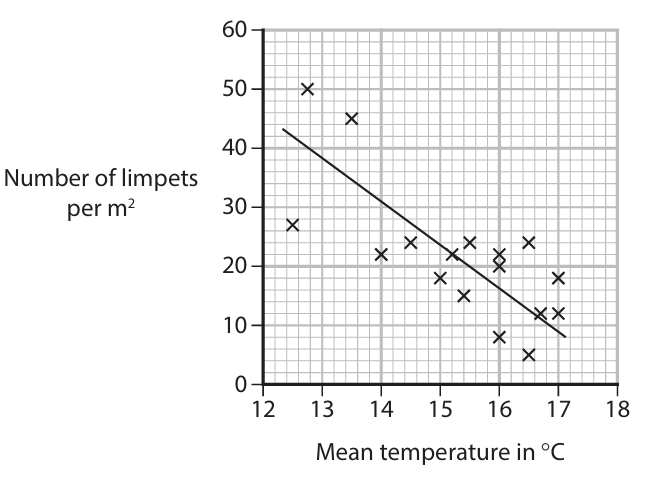
(b)(i) A description that makes reference to three of the following:
• quadrat / square in gridded area
• place randomly / choose random coordinates
• repeats
• count limpets (in quadrat / square)
• scale up for whole area multiply by area
(b)(ii) • time of day / location / area / position on shore / species of limpet / same day in August
(b)(iii) An answer that makes reference to five of the following:
1. fossil fuel use releases carbon dioxide
2. carbon dioxide is a greenhouse gas / may cause global warming
3. increased temperature reduces limpet number
4. less food / energy for starfish / dogwhelks / gulls
5. dogwhelks / gulls / starfish / secondary consumers would decrease
6. algae would increase / less algae eaten / more food for periwinkles
7. there are anomalies / outliers / not all close to line of best fit
8. other factors may affect limpet population / other greenhouse gases may have effect
9. not done for long enough time so less reliable OR done for long time / 17 years so reliable
10. data only for one month / only August / only one location / only one shore / only looks at one species

▶️ Answer/Explanation
(a)(i) • transgenic (1)
(a)(ii) A description that makes reference to three of the following:
- plasmid (is used) (1)
- restriction enzyme cuts gene / DNA / plasmid / eq (1)
- ligase joins plasmid and gene / joins DNA / eq (1)
- forming a recombinant plasmid / forming recombinant DNA / eq (1)
(b)(i) An answer that makes reference to two of the following:
- less night blindness / fewer eye problems / better vision / eq (1)
- rice is a common food / part of many diets / common crop / cheap (for consumers) to buy / eq (1)
- cheap to grow / easy to grow / easy to get large yields / eq (1)
- less health care needed / less damage to economy / eq (1)
(b)(ii) An answer that makes reference to two of the following:
- (may grow in wild and) affect food chains / food webs / ecosystems / eq (1)
- may compete with other species (in wild) / eq (1)
- may interbreed with wild plants / genes may transfer into wild plants / eq (1)
- people may think they are a risk to health / eq (1)
- may be better to give people a more balanced diet / should use natural sources of carotene / eq (1)
(c)(i) An explanation that makes reference to four of the following:
- all species decrease / eq (1)
- insects increase after 3 months / from 6 months / eq (1)
- beetles increase after 9 months / from 12 months / eq (1)
- lizard numbers do not recover / stay low / do not increase / level off after 9 months / eq (1)
- pesticide washes away / breaks down / eq (1)
- pesticide passes along food chain to beetles / to lizards / eq (1)
- insects become resistant / eq (1)
- insects increase as there are fewer beetles eating them / beetles decrease as few insects to eat / lizards decrease as few beetles to eat / eq (1)
- insects have short life cycles / lizards have long life cycle / eq (1)
(c)(ii) An answer that makes reference to two of the following:
- (biological is) more specific / does not kill other species / eq (1)
- (biological is) not toxic to humans / no residue left on plants / crops / eq (1)
- (biological is) no development of resistance / eq (1)
- (biological) lasts longer / no need to keep reapplying / eq (1)
- no bioaccumulation / no biomagnification / does not pass along food chains / eq (1)
▶️ Answer/Explanation
(a) An answer that makes reference to one of the following:
- only has an effect if two alleles are present (1)
- no effect if dominant allele is present (1)
- only has effect if dominant allele not present (1)
- no effect in heterozygous (1)
- only has an effect when homozygous / eq (1)
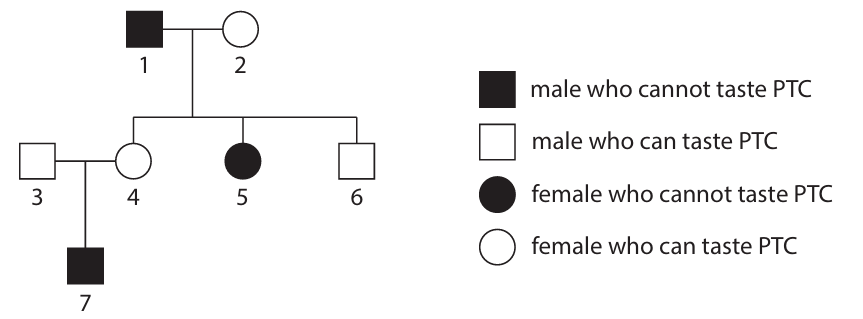
(b)(i) C (tt and Tt)
A is incorrect as both would be tasters
B is incorrect as both would be tasters
D is incorrect as neither would be tasters
(b)(ii) An explanation that makes reference to the following:
- correct parental genotypes (Tt and Tt) (1)
- correct gametes (T or t and T or t) (1)
- offspring: TT, Tt, Tt, tt (1)
- 0.375 / 3/8 / 37.5 (%) (1)
Genetic diagram:
Parents: Tt × Tt
Gametes: T, t and T, t
Offspring:
| T | t | |
| T | TT | Tt |
| t | Tt | tt |
Probability of heterozygous (Tt) = 2/4 = 0.5 or 50%
(c)(i) An explanation that makes reference to four of the following:
- mutation occurs (1)
- variation (in population) (1)
- people do not eat poisonous plants / can detect poisonous plants / eq (1)
- survive / eq (1)
- reproduce / produced offspring / breed / eq (1)
- pass on allele (to offspring) / eq (1)
(c)(ii) An answer that makes reference to two of the following:
- people who taste PTC eat fewer vegetables / do not like taste of vegetables / eq (1)
- (PTC tasters) get fewer vitamins / fewer minerals / less fibre / eq (1)
- (PTC tasters) may develop scurvy / night blindness / constipation / eq (1)
- heterozygotes carry a recessive allele / tasters may carry a non-tasting allele / heterozygotes can pass on a recessive allele / eq (1)
- some humans lived in areas with few poisonous plants / had diets with fewer plants / had mainly meat-based diets / eq (1)
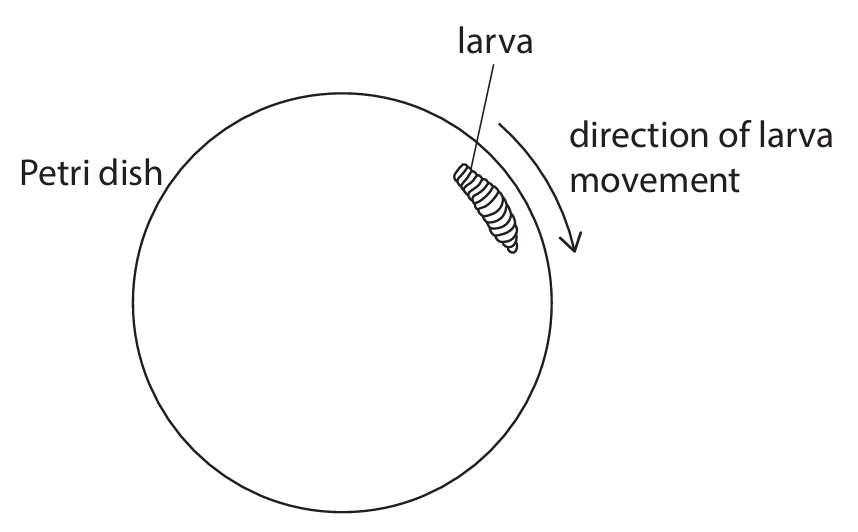
▶️ Answer/Explanation
An answer that makes reference to the following:
• C – change colour of light / wavelength of light / use different filters (1)
• O – same species / type / age / size / food (1) Ignore same larva unqualified
• R – use several larvae with each light colour / repeat (1) Ignore repeat with different colours
• M1 – measure distance larvae move / measure arc of dish / number of circuits (1) Accept measure how long it takes to move set distance for M1 and M2
• M2 – time / stated time (1) Accept time taken to do a number of laps for two marks (M1 and M2)
• S1 & S2 (two from) – same humidity / food / light intensity / temperature / of dish / surface of Petri / same dish (2) Accept clean dish between tests
Full sentence example: “I would change the colour of light using different filters while keeping the same species, age, and size of larvae, using several larvae for each colour and repeating the experiment. I would measure the distance moved along the Petri dish edge and time this movement, while controlling variables like temperature, humidity, and light intensity.”