Read the passage below. Use the information in the passage and your own knowledge to answer the questions that follow.
Pollination in fruit trees
Plants need to be pollinated to produce fruits and seeds. Some plants are self-pollinated and others are cross-pollinated.
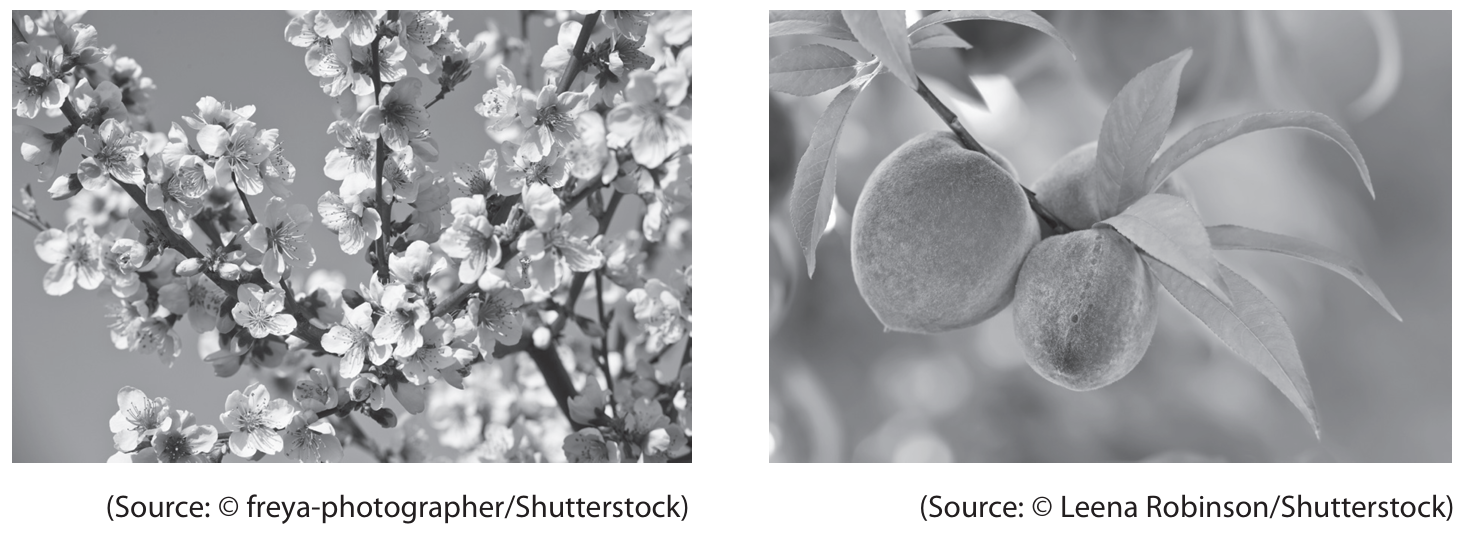
Self-pollination is usually the transfer of pollen from flowers on the same tree. In fruit trees, self-pollination also includes the transfer of pollen from another tree of the same cultivar. A cultivar is a genetically identical group of trees produced by selective breeding. Self-pollinating plants need bees or other insects to transfer pollen. Examples of self-pollinated fruit trees are plum, apricot and peach that have sweet-tasting, soft fruits.

Other fruit trees require cross-pollination and can only produce fruit by fertilisation from a different cultivar. Cross-pollination is the transfer of pollen from one cultivar to the flower of a different cultivar. Self-incompatibility prevents the same plant or cultivar from fertilising its own flowers. For example, the pollen from one cultivar of an apple tree will not fertilise trees of the same cultivar. Most hard fruit trees such as pear and apple require the presence of two different compatible cultivars for pollination to result in fruit production.
Pollen can be transferred by wind, insects or birds. Many fruit trees are pollinated by insects. Nut trees are usually pollinated by wind.
After pollination the pollen grain must germinate to lead to fertilisation. The success of pollination and fertilisation depends on favourable environmental conditions. It also requires the right pollen grain reaching the right flower, as pollen can only fertilise specific, compatible flowers. For example, pollen from a peach flower will not pollinate apple flowers.
Cross-pollinating fruit trees should be planted no more than 60 m apart. This will ensure that bees visit the trees often enough to ensure pollination. Nut trees need to be planted no more than 15 m apart.
A further complication is that a few apple and pear cultivars, known as triploids, produce sterile pollen. Triploid cultivars have three sets of chromosomes within their cells. A triploid cultivar will require another cultivar for pollination, and the trees must flower at the same time.
(a) Explain the differences between self-pollination and cross-pollination. (lines 3 to 5 and 9 to 11)
(b) Describe the sequence of events from pollen landing on a flower to fruit production.
(c) Fruit trees often produce sweet-tasting fruit containing sugars.
(i) Sugars are carbohydrates. Name the three elements in carbohydrates.
(ii) Suggest how production of sweet-tasting fruit may help spread the seeds of fruit trees. (lines 7 to 8)
(d) Explain how self-incompatibility prevents self-fertilisation. (lines 11 to 13)
(e) Describe how the structure of insect-pollinated flowers helps to achieve pollination. (line 16)
(f) Give a reason why nut trees need to be planted closer together than fruit trees. (lines 23 to 25)
(g) Explain why triploid cultivars produce sterile pollen. (lines 26 to 29)
Most-appropriate topic codes (Edexcel IGCSE Biology):
• 2(c): Biological molecules — part (c)(i)
• 3(b): Inheritance — part (g)
▶️ Answer/Explanation
(a) An explanation that makes reference to two of the following:
- self-pollination within same plant / flower / cultivar / tree / uses one parent / eq (1)
- cross-pollination from different plant / flower / cultivar / tree / uses two parents / eq (1)
(b) A description that makes reference to four of the following:
- germinates / eq (1)
- pollen tube grows down style / goes down style / eq (1)
- enters ovule (via micropyle) / eq (1)
- male nucleus / gamete travels down pollen tube / eq (1)
- fuses with ovum / fuses with female gamete / fertilises ovum / fertilises female gamete / eq (1)
- ovule becomes seed / eq (1)
- ovary becomes fruit / eq (1)
(c)(i) carbon hydrogen oxygen / C H O (1)
(c)(ii) An answer that makes reference to two of the following:
- fruit eaten by animals / insects / birds / eq (1)
- egested / lost in faeces / eq (1)
- seeds dispersed / taken to new areas / eq (1)
(d) An explanation that makes reference to two of the following:
- pollen from same plant / flower / cultivar eq (1)
- cannot germinate / no pollen tube growth / eq (1)
- no fusion / fertilisation / eq (1)
(e) A description that makes reference to the following:
- flowers are large / petals are large (so seen by insects) / eq (1)
- flowers / petals are coloured (so seen by insects) / eq (1)
- flowers are scented / have scented petals / eq (1)
- have nectary / produce nectar / eq (1)
- anthers within flower / stigma within flower so insect brushes pollen / transfers pollen to stigma / eq (1)
(f) An answer that includes:
- wind pollinated / no insects to carry pollen long distance / eq (1)
(g) An explanation that makes reference to two of the following:
- triploid cells cannot divide by meiosis / cannot be divided by two / equally / eq (1)
- cannot produce haploid (gametes) / produce one set / n chromosomes / eq (1)
- fertilisation / fusion not possible / eq (1)
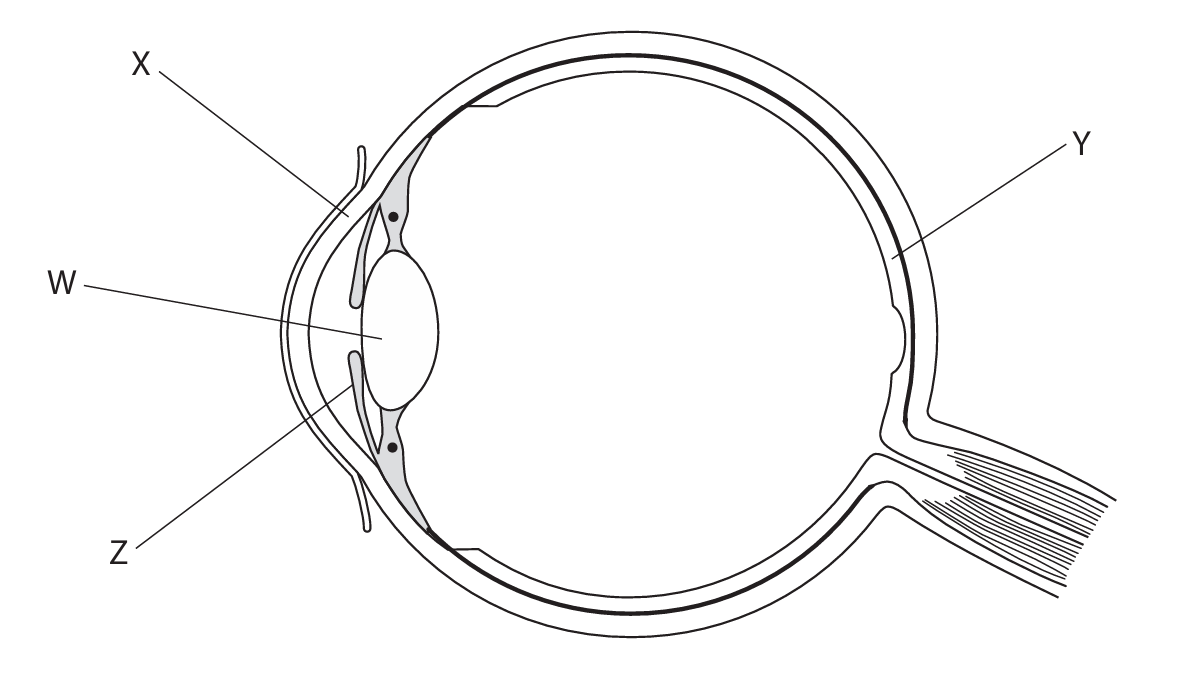
The diagram shows a section through an eye with some parts labelled.

(a) Name parts W, X and Y.
(b) Describe how structure Z changes when a person moves into a dark room.
Most-appropriate topic codes (Edexcel IGCSE Biology):
• 3.41: Describe the structure and function of the eye as a receptor — part (a)
• 3.42: Understand the function of the eye in focusing on near and distant objects, and in responding to changes in light intensity — part (b)
▶️ Answer/Explanation
(a)
• W = lens (1)
• X = cornea (1)
• Y = retina (1)
(b) A description that makes reference to the following:
• circular muscles relax (1)
• radial muscles contract (1)
• pupil dilates / gets wider (1)
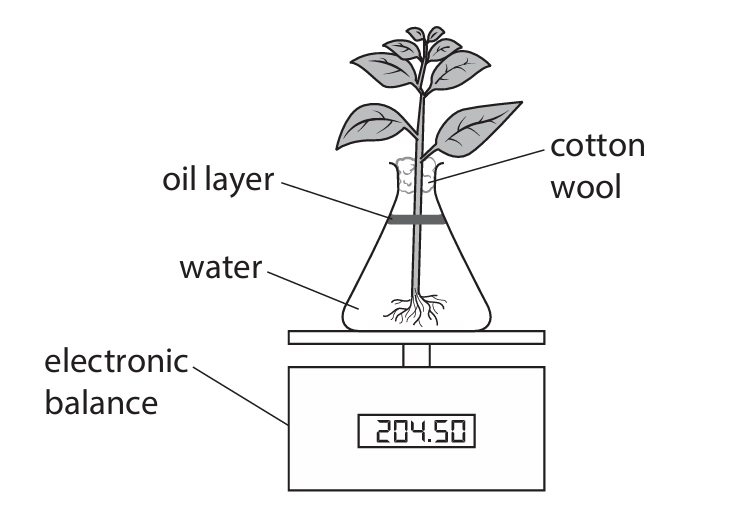
A student uses this apparatus to investigate water loss from a plant.

This is the student’s method:
- Measure the total mass of the flask, water, oil, cotton wool and plant
- Leave the apparatus for 48 hours
- Measure the new total mass of the flask, water, oil, cotton wool and plant
- Calculate the rate of change of mass during the 48 hours
Repeat steps 1-4 with the same conditions.
(a) Name the piece of apparatus used in this investigation.
A) bubble potometer
B) hydrometer
C) osmometer
D) weight potometer
(b) The total mass changes from 207.25 g to 204.50 g in the first 48 hours. Calculate, in grams per hour, the rate of change of mass.
Give your answer to two significant figures.
(c) Explain why the student repeats the investigation with the same conditions.
(d) The student then changes the conditions surrounding the plant.
(i) Describe how the student could investigate the effect that moving air has on the change in mass.
(ii) Explain the effect that faster moving air has on the change in mass.
(e) Describe how the student could modify the investigation to study the role of roots in the loss of water from a plant.
Most-appropriate topic codes (Edexcel IGCSE Biology):
• 3.6B-3.8B: Transpiration — parts (a), (b), (d)(ii)
• 4: Experimental skills — parts (c), (d)(i), (e)
▶️ Answer/Explanation
(a) D (weight potometer)
A is not the answer as it is not a bubble potometer
B is not the answer as it is not a hydrometer
C is not the answer as it is not an osmometer
(b) Calculation:
\[ \text{Rate} = \frac{207.25 – 204.50}{48} = \frac{2.75}{48} = 0.05729 \text{ g/h} \]
To two significant figures: \(0.057\) g/h
(c) An explanation that makes reference to two of the following:
- can calculate mean/average
- increases reliability
- allows detection/exclusion of anomalous results/ensure results are concordant
- change in conditions could affect water loss/results
(d)(i) A description that makes reference to the following:
- use fan/hairdryer
- control other/named environmental condition/temp/light
(d)(ii) An explanation that makes reference to three of the following:
- moves moist air/water molecules away from leaf surface/stomata/reduces humidity
- increases/restores concentration gradient
- increases transpiration/evaporation/diffusion
- more mass lost/mass changes more
(e) A description that makes reference to two of the following:
- have two plants of same species/same type/same size/same leaf area/use same plant
- remove roots
- control named environmental condition/temperature/light/moving air
A group of students investigate the biodiversity in two fields, A and B. Field A is grazed by cattle and field B has no cattle.
(a) Explain what is meant by the term biodiversity.
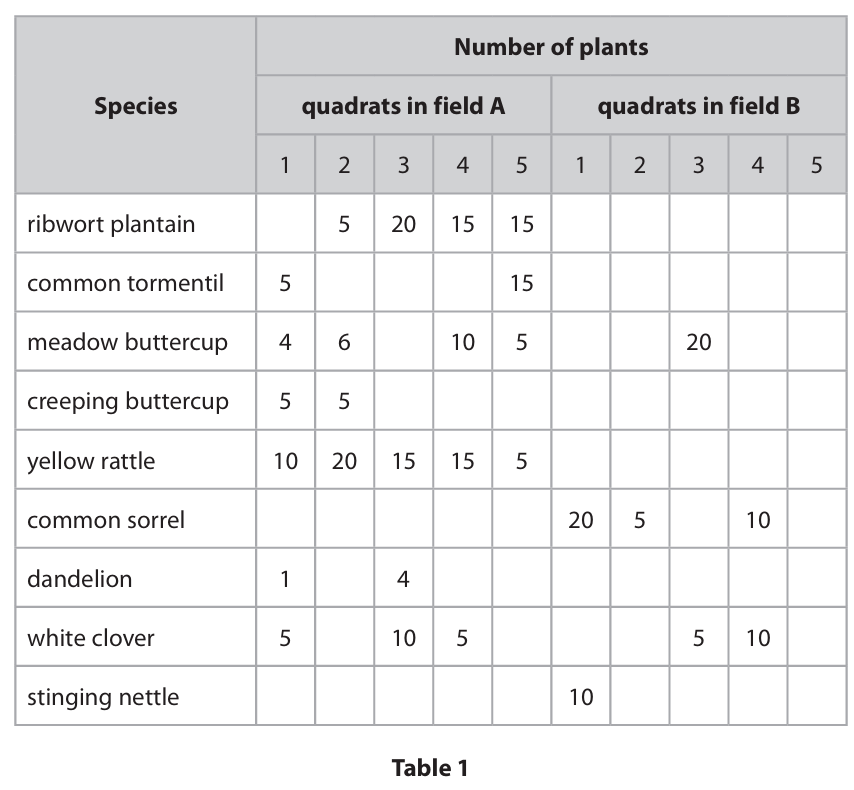
(b) The students investigate the plant species in each field. They counted the number of each species in five 0.5 m × 0.5 m quadrats. They repeated this for each field.
Table 1 shows their results.

(i) Describe how the quadrats should be placed to obtain unbiased species numbers for each field.
(ii) For the most frequently occurring plant species in field B, calculate the number of plants in one square metre.
(iii) Name the species with the greatest variation in number of plants recorded in quadrats for field B.
(iv) The students conclude that grazing affects the species in field A. Using information in Table 1 and your own knowledge, discuss the students’ conclusion.
Most-appropriate topic codes (Edexcel IGCSE Biology):
• 4(b): Feeding relationships — part (b)(iv)
• 4(c): Cycles within ecosystems — part (b)(iv)
• 4(d): Human influences on the environment — part (b)(iv)
• 5.3B: Biodiversity — part (a)
• 5.4B: Practical: investigate distribution and measure biodiversity — parts (b)(i), (b)(ii), (b)(iii)
▶️ Answer/Explanation
(a) An explanation that makes reference to two of the following:
- (number / amount / how many / range) the different species / eq (1)
- number / abundance / how many of each species / eq (1)
- variation / variety (of organisms) (in an ecosystem) / eq (1)
(b)(i) A description that makes reference to the following:
- place at random / eq (1)
- (place quadrats at) co-ordinates / eq (1)
Use random coordinates = 2 marks
(b)(ii) Calculation:
Most frequently occurring species in field B: common sorrel
Total plants counted: \(20 + 5 + 10 = 35\)
Total area sampled: \(5 \times (0.5 \times 0.5) = 5 \times 0.25 = 1.25 \text{ m}^2\)
Number per square metre: \(35 \div 1.25 = 28 \text{ per m}^2\)
Answer: 28
(b)(iii) meadow buttercup (1)
(b)(iv) An answer description that makes reference to five of the following:
- more species present / eq (1)
- more even distribution / similar numbers of each / eq (1)
- common sorrel / stinging nettles absent / eq (1)
- more biodiversity / grazing increases biodiversity / eq (1)
- reliable / repeated / more than one quadrat done in each field / eq (1)
- no information on water / sunlight / temperature / fertilisers / minerals / seasons / eq (1)
- only done on one field / repeat in other fields / eq (1)
- no information about amount of animals / age of animals / duration / eq (1)
- grazing reduces competition allows different species to grow / prevents succession / eq (1)
- grazing provides increased nitrates / minerals / manure / eq (1)
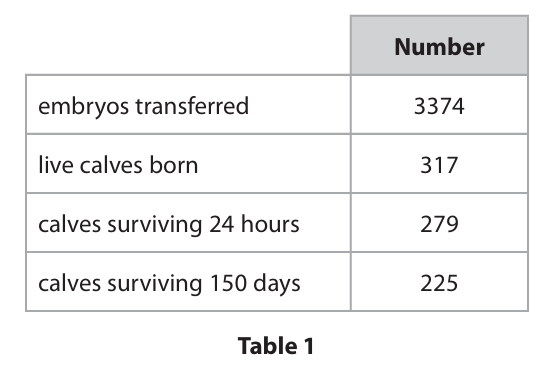
Scientists collect data to measure how successful cloning is in cattle.
Table 1 shows the scientists’ data.

(a) Calculate the percentage of embryos transferred that result in live calves being born.
(b) Describe the stages in the production of a cloned mammal from an adult mammal.
(c) There is some evidence that cloned cattle may have weakened immune systems. Explain why a weakened immune system can affect the health of cloned cattle.
(d) Scientists also collected data comparing cloned cattle and a control group.
Table 2 shows their results.
| Group | ||
|---|---|---|
| clones | controls | |
| number of cows | 10 | 11 |
| mean birth mass in kg | 45.8 | 39.6 |
| mean age at puberty in days | 419.3 | 356.5 |
| mean body mass at puberty in kg | 359 | 303 |
| daily mass increase in kg per day | 0.75 | 0.78 |
Comment on the effects of cloning on the growth and development of these cattle.
Most-appropriate topic codes (Edexcel IGCSE Biology):
• 2(h): Transport — part (c)
• Appendix 3: Mathematical skills — part (a)
▶️ Answer/Explanation
(a)
Calculation: \( \frac{317}{3374} \times 100 = 9.40\% \)
Percentage = 9.40%
(b)
A description that makes reference to four of the following points:
- use enucleated egg / empty egg / remove nucleus from egg
- nucleus from body cell / diploid nucleus placed into empty egg
- use of electricity / shock
- cell division / mitosis
- embryo into uterus / womb
- surrogate mother
(c)
An explanation that makes reference to two of the following points:
- fewer white blood cells / phagocytes / lymphocytes / memory cells
- fewer antibodies produced / antibodies produced slower / less phagocytosis / less engulfing
- less resistance / more susceptible to infection / disease / pathogen not killed / pathogen remains
(d)
An answer description that makes reference to four of the following:
- small study few cows involved
- not repeated / not reliable / no information on strain / breed / type only females / only cows
- higher birth mass in clones
- older at puberty in clones / puberty later in clones
- higher mass at puberty in clones
- small difference / slight difference in growth rate / no significant difference in growth rate / slightly lower daily mass increase
- no reference to diet / hormones / supplements
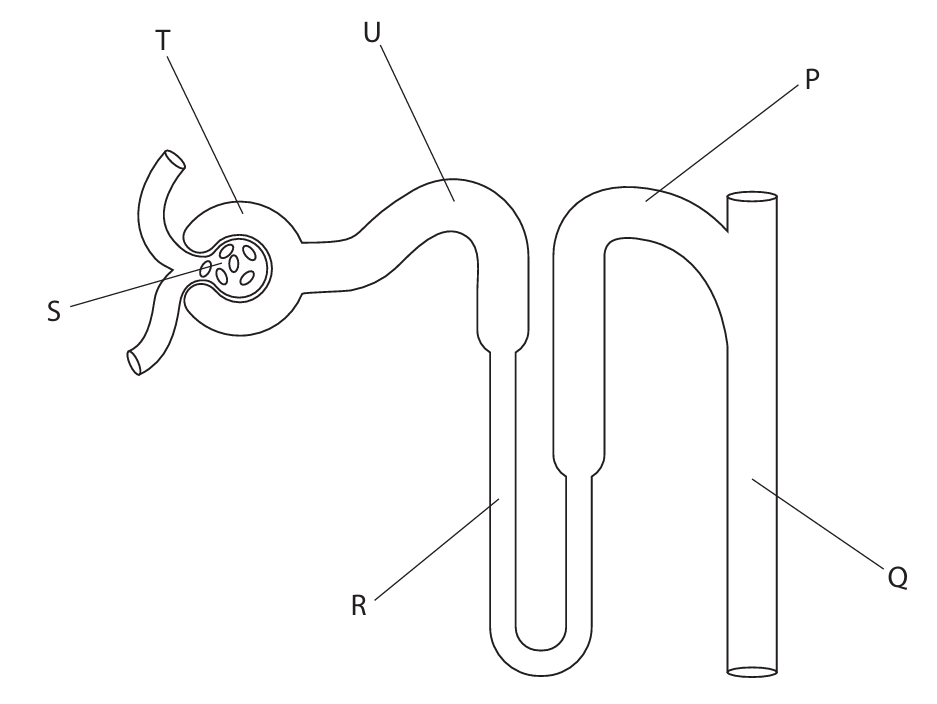
The diagram shows a nephron from a human kidney with some structures labelled.

(a) (i) Which of these is structure U?
A) Bowman’s capsule
B) collecting duct
C) loop of Henle
D) proximal convoluted tubule
(ii) Which process occurs between structure S and structure T?
A) ADH production
B) selective reabsorption
C) transpiration
D) ultrafiltration
(iii) Which structure is the collecting duct?
A) P
B) Q
C) S
D) T
(b) The table shows the concentrations of protein and glucose in blood plasma, in glomerular filtrate and in urine.
| Substance | Concentration in blood plasma (g/100 cm³) | Concentration in glomerular filtrate (g/100 cm³) | Concentration in urine (g/100 cm³) |
|---|---|---|---|
| protein | 8.0 | 0.0 | 0.0 |
| glucose | 0.1 | 0.1 | 0.0 |
(i) Calculate the mass of glucose in 5 dm³ of blood plasma.
\[\text{mass} = \text{…… grams}\]
(ii) Explain why there is no protein in the urine.
(iii) Explain why there is glucose in the glomerular filtrate but no glucose in the urine.
Most-appropriate topic codes (Edexcel IGCSE Biology):
• 3.24B: Structure of nephron — part (a)
• 3.25B: Ultrafiltration — part (a)(ii)
• 3.26B-3.28B: Selective reabsorption and osmoregulation — parts (b)(ii), (b)(iii)
• Appendix 3: Mathematical skills — part (b)(i)
▶️ Answer/Explanation
(a)(i) D (proximal convoluted tubule)
A is not correct as U is not the Bowman’s capsule
B is not correct as U is not the collecting duct
C is not correct as U is not the loop of Henle
(a)(ii) D (ultrafiltration)
A is not correct as it is not ADH production
B is not correct as it is not selective reabsorption
C is not correct as it is not transpiration
(a)(iii) B (Q)
A is not correct as P is the distal convoluted tubule
C is not correct as S is the glomerulus
D is not correct as T is the Bowman’s capsule
(b)(i) Calculation:
Concentration of glucose in blood plasma = 0.1 g/100 cm³
5 dm³ = 5000 cm³
Mass of glucose = (0.1 g/100 cm³) × 5000 cm³ = 5 grams
(b)(ii) An explanation that makes reference to two of the following:
• protein molecules too large / large mass / too heavy (1)
• cannot pass out of glomerulus / into Bowman’s capsule / into nephron / into tubules / through basement membrane (1)
• so stay in blood / not in filtrate (1)
(b)(iii) An explanation that makes reference to two of the following:
• glucose passes out of glomerulus / into Bowman’s capsule / into nephron / into tubules / through basement membrane (1)
• (then) reabsorbed / back into blood (1)
• by active transport (1)
• in proximal convoluted tubule / PCT (1)
