
▶️ Answer/Explanation
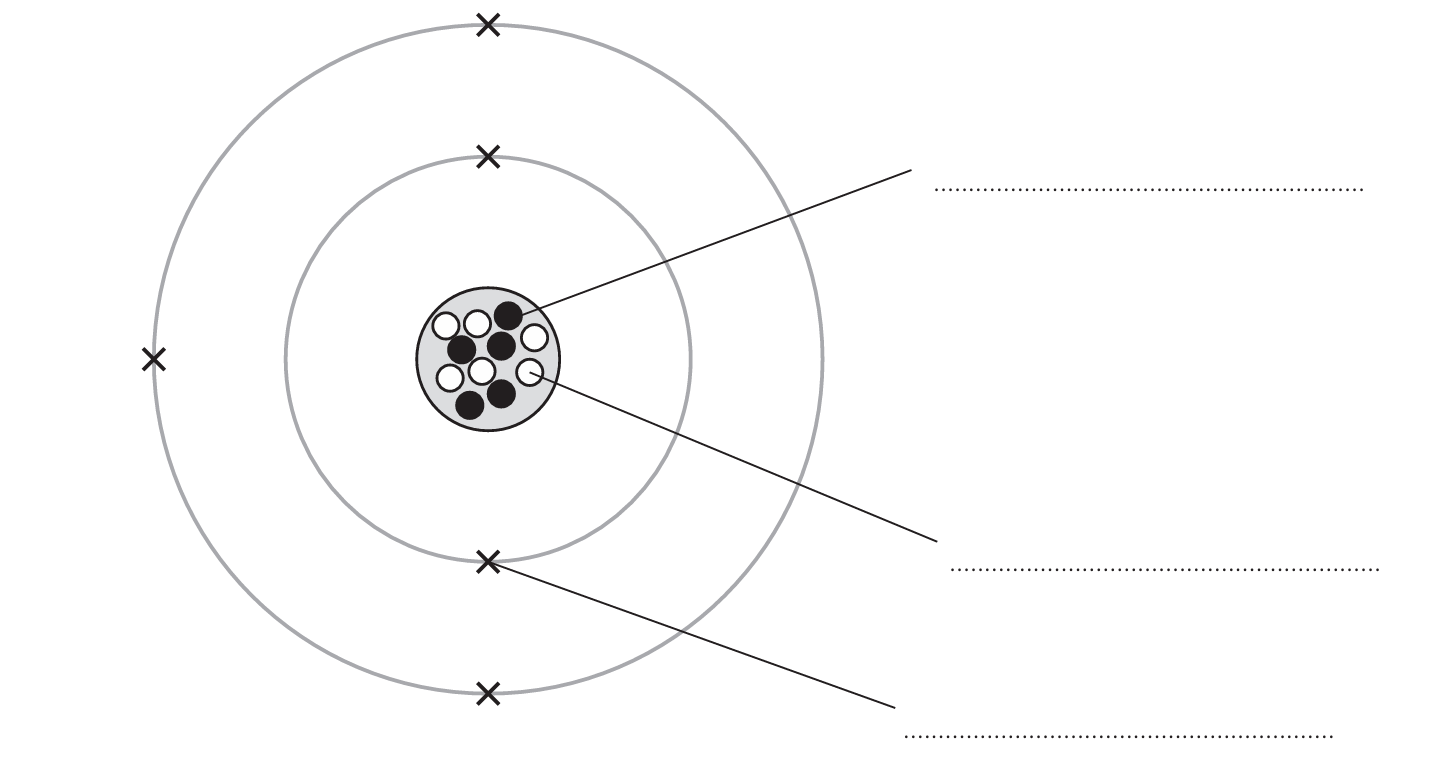
(a) Labels on the diagram should be:
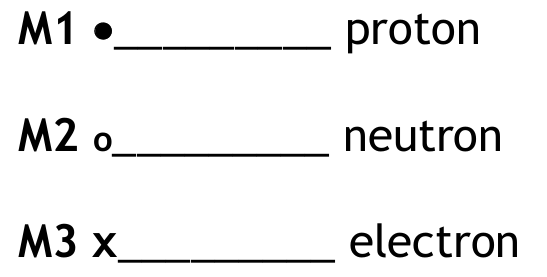
- In the nucleus: proton and neutron (must be in the correct order).
- In the electron shells/orbiting: electron.
Marking Note: If proton and neutron are in the wrong order, allow one mark for M1 & M2.
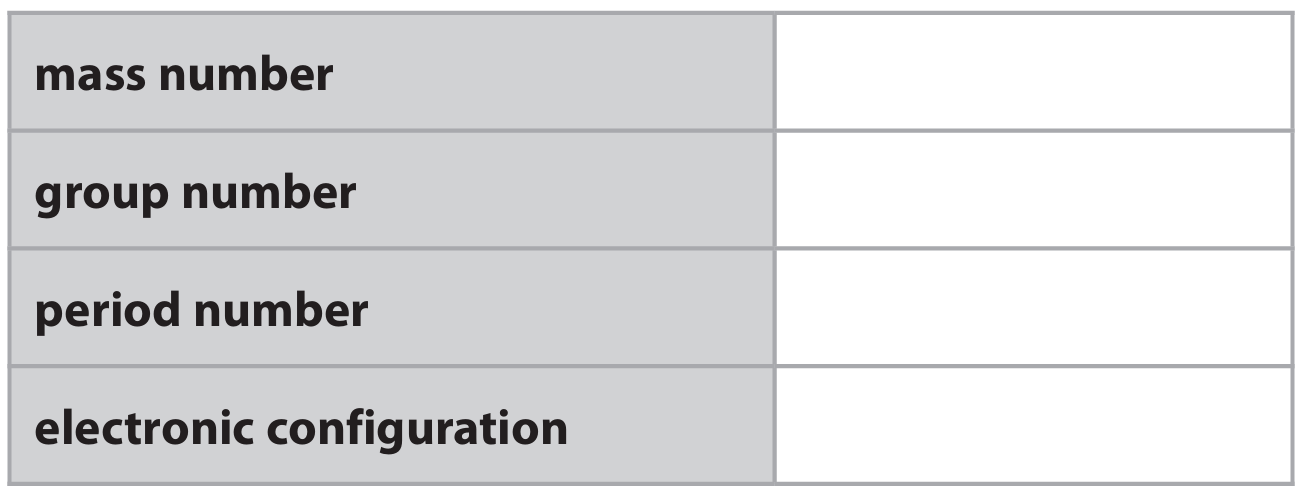
(b) Completed table:
| mass number | 11 |
| group number | 3 |
| period number | 2 |
| electronic configuration | 2,3 |
Explanation:
• Mass number = protons + neutrons. From diagram: 5 protons + 6 neutrons = 11.
• Electronic configuration: 5 electrons total. First shell holds 2, second shell holds the remaining 3: 2,3.
• Group number: For main group elements, the group number is equal to the number of electrons in the outer shell. Outer shell has 3 electrons, so Group 3.
• Period number: The period number is equal to the number of occupied electron shells. This atom has electrons in two shells (first and second), so Period 2.
(c) boron (ALLOW B)
Explanation: The atom has 5 protons. The atomic number (number of protons) defines the element. The element with atomic number 5 is boron (symbol B).
▶️ Answer/Explanation
(a) An explanation linking the following two points:
- The ink (dyes) would dissolve in the solvent used in chromatography / the pencil mark (graphite) will not dissolve in the solvent.
- If ink were used, it would travel/smudge/run with the solvent, producing spots that would interfere with the results / make it impossible to identify the dyes in the test inks or calculate accurate \( R_f \) values. The pencil mark remains fixed at the start line.
(b) An explanation linking the following two points:
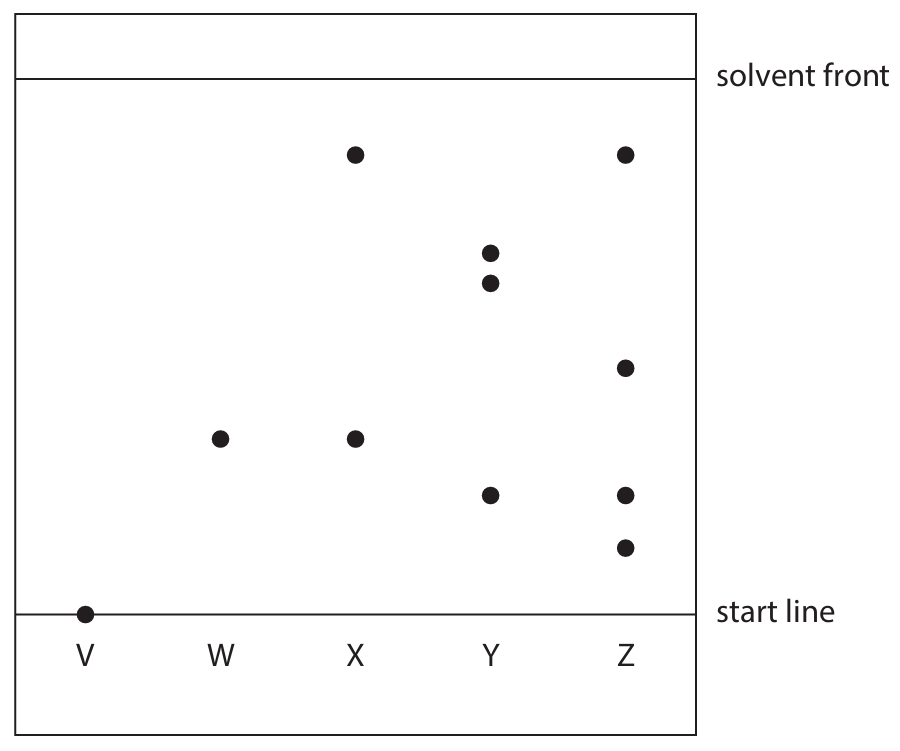
- Inks X and Z.
- Both contain a dye that has traveled the furthest distance from the start line towards the solvent front. In chromatography, a substance that is more soluble in the solvent will be carried further up the paper.
(c) An explanation linking the following points:
- For W: It produces only one distinct spot on the chromatogram. Since each dye in a mixture should separate into its own spot, a single spot indicates the presence of only one dye.
- For V: It has not moved from the start line (it is insoluble in the solvent used). Because it has not separated at all, it is impossible to tell from this chromatogram whether it contains one or more dyes. All components remain together at the origin, so it may contain more than one dye.
(d) Calculation of the \( R_f \) value:
The \( R_f \) value is calculated using the formula: \[ R_f = \frac{\text{distance moved by substance (spot)}}{\text{distance moved by solvent front}} \]
- Measure distance from start line to centre of spot W: \( 2.2 \, \text{cm} \) to \( 2.3 \, \text{cm} \) (allow within this range).
- Measure distance from start line to solvent front: \( 6.9 \, \text{cm} \).
- Calculation: \( R_f = \frac{2.2}{6.9} \) or \( \frac{2.3}{6.9} \).
- Result: \( \frac{2.2}{6.9} = 0.3188… \) or \( \frac{2.3}{6.9} = 0.3333… \).
- Answer to two significant figures: \( \mathbf{0.32} \) or \( \mathbf{0.33} \).
Note: Values are based on typical measurements from the chromatogram. In an exam, actual measurements would be taken from the diagram provided.
▶️ Answer/Explanation
(a)
- Butane contains only hydrogen and carbon atoms (it is a hydrocarbon).
- It contains only carbon–carbon single bonds (and carbon–hydrogen single bonds).
- Therefore, it is saturated (it contains the maximum possible number of hydrogen atoms per carbon, with no double or triple bonds).
Mark scheme note: M1 – contains H and C only. M2 – “only”. M3 – contains only single bonds.
(b)(i)
\(2C_4H_{10} + 13O_2 \rightarrow 8CO_2 + 10H_2O\)
Balanced equation showing complete combustion. Accept multiples or fractions for balancing.
(b)(ii)
Carbon (soot/particulates) OR Water (vapour).
Incomplete combustion produces carbon (soot), carbon monoxide, and water vapour.
(b)(iii)
Carbon monoxide binds irreversibly to haemoglobin in red blood cells, forming carboxyhaemoglobin. This reduces the blood’s capacity to carry oxygen around the body, leading to oxygen deprivation in tissues (asphyxiation).
Mark scheme: “carbon monoxide reduces the capacity of blood to transport oxygen”.
(c)(i)
- Isomers are molecules that have the same molecular formula (same number and type of atoms).
- But they have different structural formulae / different arrangements of atoms.
(c)(ii)
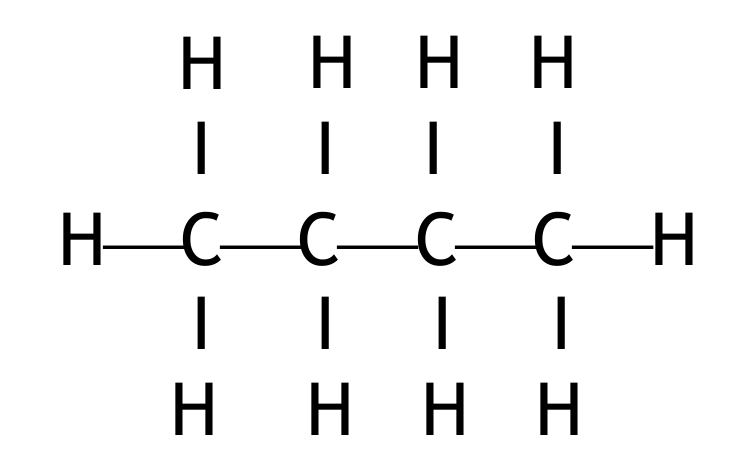
Displayed formulae for the two isomers of butane:
1. Butane (n-butane):
2. Methylpropane (isobutane):
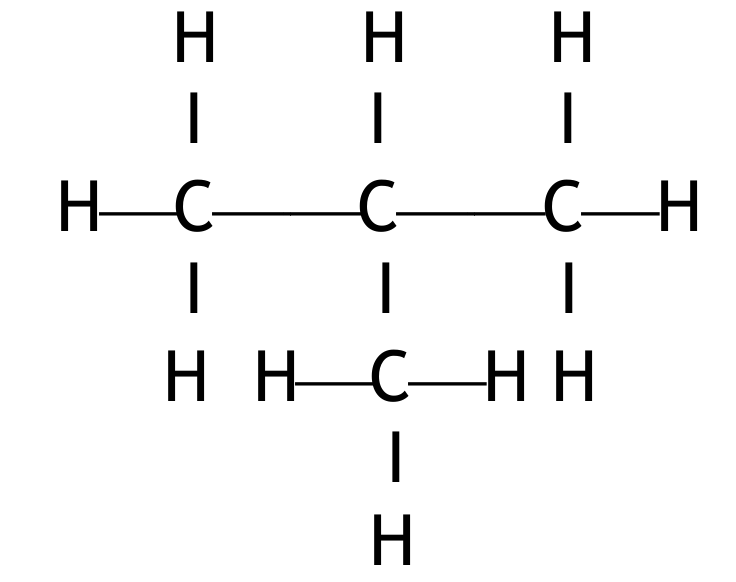
Both must show all atoms and all bonds.
(d)
- Hexane (\(C_6H_{14}\)) has a longer carbon chain/more atoms/higher molecular mass than butane (\(C_4H_{10}\)).
- This results in stronger intermolecular forces (specifically London dispersion/van der Waals forces) between hexane molecules.
- Therefore, more energy is required to overcome these stronger forces during boiling.
- Hence, hexane has a higher boiling point than butane.
Mark scheme note: M1 – hexane is larger/longer chain. M2 – stronger intermolecular forces. M3 – more energy needed to overcome forces. DO NOT mention breaking covalent bonds.
▶️ Answer/Explanation
(a) Two conditions needed for iron to rust:
1. Oxygen (or air) (ALLOW: air)
2. Water (or moisture/water vapour/steam) (ALLOW: moisture, water vapour, steam)
(b) A (galvanisation)
B is not the answer because oxidation is a type of reaction, not the name of a coating process.
C is not the answer because reduction is a type of reaction, not the name of a coating process.
D is not the answer because sacrificial protection is a principle/mechanism, not the name of the coating process itself.
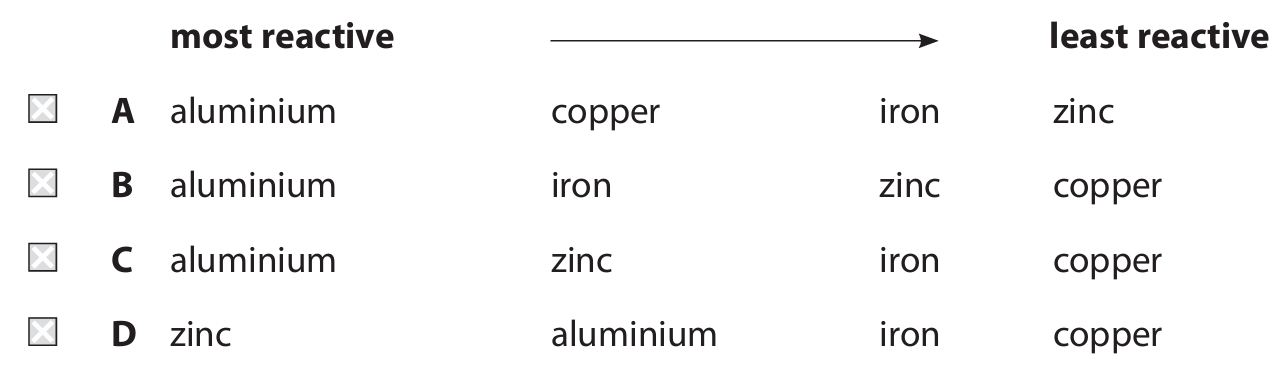
(c) C (aluminium zinc iron copper)
A is not the correct order of reactivity.
B is not the correct order of reactivity.
D is not the correct order of reactivity.
Knowledge: Aluminium is more reactive than zinc, which is more reactive than iron, which is more reactive than copper.
(d) Test: Add sodium hydroxide solution.
Result: A brown precipitate forms. (ACCEPT: red-brown, orange-brown)
Note: The brown precipitate is iron(III) hydroxide, Fe(OH)\(_3\). This is a standard test for Fe\(^{3+}\) ions.
(e)(i) An explanation that links the following points:
• Iron(III) oxide / Fe\(_2\)O\(_3\) loses oxygen, so it is reduced.
• Carbon monoxide gains oxygen (to form CO\(_2\)), so it is oxidised.
ALTERNATIVE: Fe\(^{3+}\) gains electrons (to become Fe) and is reduced, while carbon in CO loses electrons (or gains oxygen) and is oxidised.
(e)(ii) Calculation:
M1: Amount (moles) of Fe = \( \frac{28}{56} = 0.5 \) mol (M\(_r\) of Fe = 56)
M2: From equation: Fe\(_2\)O\(_3\) → 2Fe, so moles of Fe\(_2\)O\(_3\) = \( \frac{0.5}{2} = 0.25 \) mol
M3: Mass of Fe\(_2\)O\(_3\) = \( 0.25 \times 160 = 40 \) g
Answer: 40 g (correct answer without working scores 3 marks)
(e)(iii) Calculation:
M1: Percentage yield = \( \frac{\text{actual yield}}{\text{theoretical yield}} \times 100 = \frac{21}{28} \times 100 \)
M2: \( = 75\% \) (0.75 scores 1 mark only)
Answer: 75% (correct answer without working scores 2 marks)

▶️ Answer/Explanation
(a)
\[ 2\mathrm{NaOH(aq)} + \mathrm{H_2SO_4(aq)} \rightarrow \mathrm{Na_2SO_4(aq)} + 2\mathrm{H_2O(l)} \]
Explanation: A balanced neutralisation reaction producing sodium sulfate and water. State symbols indicate aqueous solutions and liquid water.
(b)
• Use a polystyrene cup instead of a glass beaker.
• Reason: Polystyrene is a better thermal insulator, reducing heat loss to the surroundings, leading to a more accurate measurement of the temperature change.
Alternative answer: Place a lid on the beaker to minimise heat loss by evaporation/convection.
(c) (i), (ii), (iii)
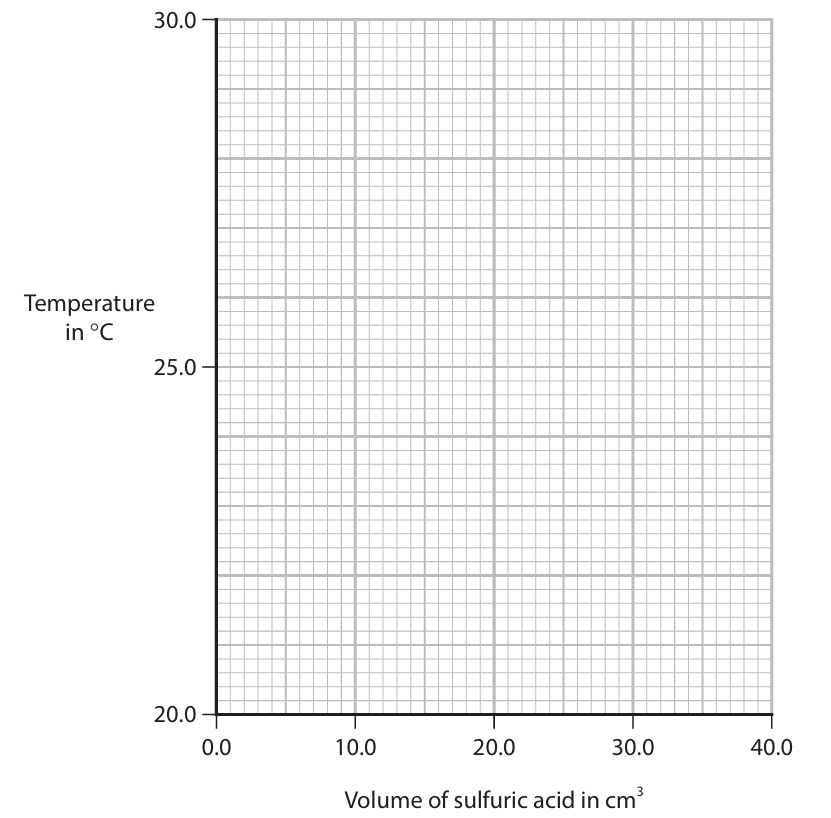
Graph plotted with the following key features:
• Points plotted correctly from the table.
• The point at 15 cm³ (temperature 24.4 °C) is circled as anomalous.
• First line of best fit drawn through points at 0, 5, 10, 20, 25, 30 cm³ (rising trend).
• Second line of best fit drawn through points at 30, 35, 40 cm³ (slight downward trend).
• The two lines intersect.
(d)
Volume of acid ≈ 27.5 cm³
Maximum temperature ≈ 28.6 °C
Note: Values are read from the intersection point on the graph, as per the mark scheme (approximately 27.5 cm³ and 28.6 °C).
(e)
• The temperature was recorded too early (before the mixture was fully mixed or before it reached its maximum temperature).
OR
• The mixture was not stirred properly before the temperature was taken, leading to an uneven temperature distribution and a lower reading.
Both explanations result in the recorded temperature being lower than the true maximum for that volume of acid.
▶️ Answer/Explanation
(a) Why diamond has a high melting point:
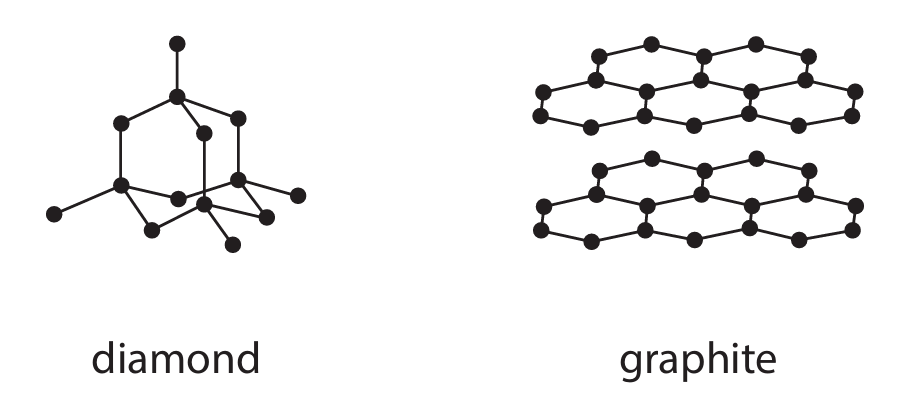
• M1: The structure of diamond is a giant covalent lattice held together by strong covalent bonds between carbon atoms.
• M2: To melt diamond, a very large number of these strong covalent bonds must be broken.
• M3: Breaking these numerous, strong bonds requires a large amount of thermal energy, which corresponds to a very high melting point.
Key Chemistry: Diamond’s tetrahedral network, where each carbon atom is bonded to four others via covalent bonds, results in a rigid, three-dimensional structure that is extremely resistant to heat.
(b) Why graphite is soft and conducts electricity:
Why graphite is soft:
• M1 & M5: In graphite, each carbon atom forms three strong covalent bonds with other carbon atoms, creating layers of hexagonal rings.
• M2 & M4: These layers are held together by weak intermolecular forces (London dispersion forces), not by covalent bonds.
• M3: Because the forces between the layers are weak, the layers can slide easily over one another when a force is applied, making graphite soft and slippery (useful as a lubricant).
Why graphite conducts electricity:
• M5 & M6: Each carbon atom in graphite uses only three of its four outer electrons for bonding within a layer. The fourth electron from each atom is delocalised and is free to move throughout the entire layer.
• M7: These delocalised electrons are free to move and carry charge. When a voltage is applied, these mobile electrons can flow through the structure, allowing graphite to conduct electricity.
Key Chemistry: The combination of strong covalent bonding within layers and weak forces between them, along with the presence of a ‘sea’ of delocalised electrons, gives graphite its unique set of properties, distinguishing it from diamond.
▶️ Answer/Explanation
(a)(i)
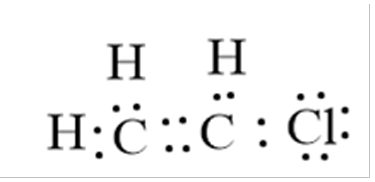
A correct dot-and-cross diagram showing the double bond between the two carbon atoms and single bonds to H and Cl. Only outer shell electrons (valency electrons) are shown. For example, Carbon (Group 4) has 4 outer electrons, Hydrogen has 1, Chlorine (Group 7) has 7. The double bond is represented by two shared pairs of electrons between the carbons.
(a)(ii)
A covalent bond is the electrostatic attraction between a shared pair of electrons and the nuclei of the bonded atoms. The negatively charged electrons are attracted to the positively charged nuclei, holding the atoms together.
(a)(iii)
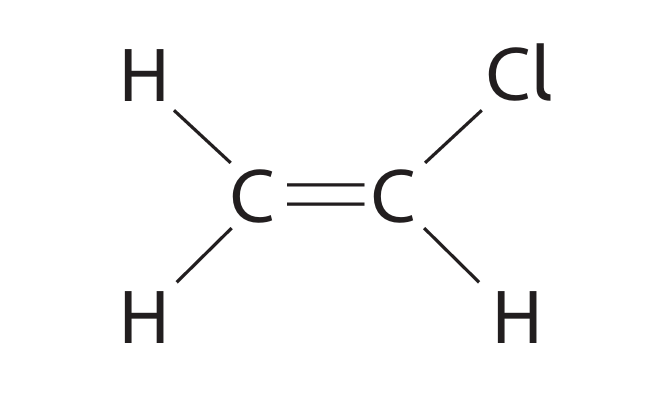
The repeat unit of poly(chloroethene) (PVC) is derived from the monomer chloroethene by opening the double bond. Its displayed formula is:
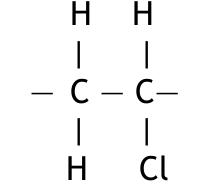
It is shown with extension bonds at each end to indicate it is a repeating unit within a long chain.
(a)(iv)
Method 1: Landfill
Problem: Poly(chloroethene) is inert and non-biodegradable. It takes up valuable space in landfill sites and takes a very long time to decompose (hundreds of years).
Method 2: Burning (Incineration)
Problem: When burned, poly(chloroethene) can produce toxic hydrogen chloride gas (HCl) and other harmful gases, contributing to air pollution and acid rain.
(b)
Step 1: Assume 100g of compound, so masses are C=22.0g, H=4.6g, Br=73.4g.
Step 2: Find moles of each element.
Moles of C = \( \frac{22.0}{12.0} = 1.833 \)
Moles of H = \( \frac{4.6}{1.0} = 4.6 \)
Moles of Br = \( \frac{73.4}{79.9} \approx 0.919 \)
Step 3: Divide by the smallest number of moles (0.919).
C: \( \frac{1.833}{0.919} \approx 2.0 \)
H: \( \frac{4.6}{0.919} \approx 5.0 \)
Br: \( \frac{0.919}{0.919} = 1.0 \)
Step 4: The simplest whole number ratio is C : H : Br = 2 : 5 : 1.
Therefore, the empirical formula is C\(_2\)H\(_5\)Br.
(c)
The reactions differ in type, conditions, observation, and products.
Ethene (alkene):
• Type: Rapid addition reaction.
• Condition: Occurs readily at room temperature.
• Observation: Bromine water is decolorized immediately (orange/brown to colorless).
• Product: Forms 1,2-dibromoethane (C\(_2\)H\(_4\)Br\(_2\)), a single saturated molecule.
Ethane (alkane):
• Type: Slow substitution reaction.
• Condition: Requires ultraviolet (UV) light as a catalyst.
• Observation: Bromine water decolorizes very slowly or not visibly under normal conditions; stays orange.
• Product: Forms bromoethane (C\(_2\)H\(_5\)Br) and hydrogen bromide (HBr) gas.
▶️ Answer/Explanation
(a) An explanation that links any two pairs:
Pair 1:
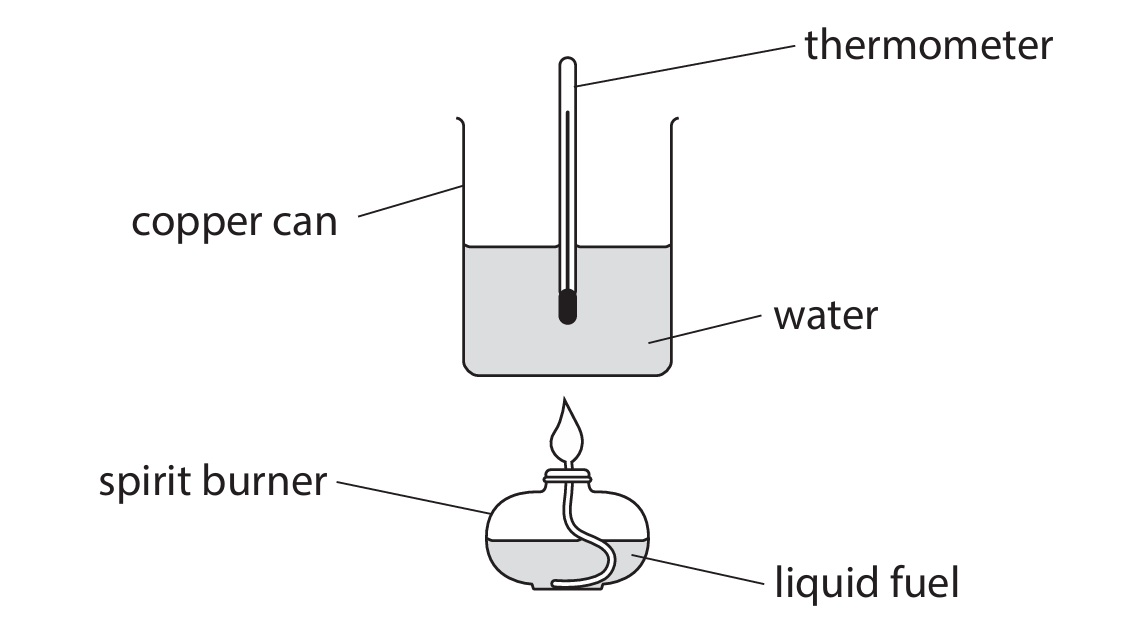
M1: Use the same volume (or mass) of water.
M2: So that the same amount of heat is required to raise its temperature (makes heat transferred to water comparable).
Pair 2:
M1: Stir the water.
M2: To ensure the temperature is uniform throughout the water (so the thermometer reading is accurate).
Pair 3:
M1: Keep the spirit burner the same distance from the copper can / Keep the wick height the same.
M2: So that the proportion of heat loss to the surroundings is consistent for each fuel.
(b)(i)
Step 1: Calculate the temperature change, \(\Delta T\):
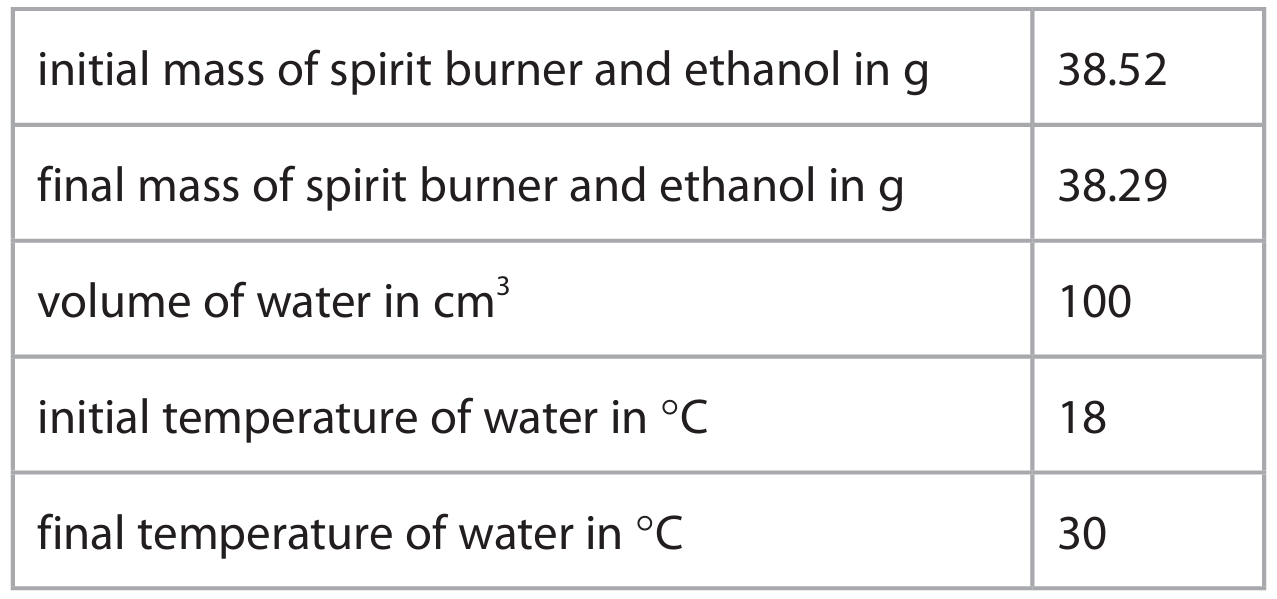
\[ \Delta T = T_{\text{final}} – T_{\text{initial}} = 30 – 18 = 12 \, \text{°C} \]
Step 2: Use the formula \(Q = mc\Delta T\):
Mass of water, \(m = 100 \, \text{g}\) (since \(1 \, \text{cm}^3\) of water has a mass of \(1 \, \text{g}\)).
Specific heat capacity, \(c = 4.2 \, \text{J g}^{-1} \text{°C}^{-1}\).
\[ Q = 100 \times 4.2 \times 12 = 5040 \, \text{J} \]
Answer: \(Q = 5040 \, \text{J}\) (Accept \(5000 \, \text{J}\) to 2 significant figures).
(b)(ii)
Step 1: Calculate the mass of ethanol burned:
\[ \text{Mass of ethanol} = 38.52 – 38.29 = 0.23 \, \text{g} \]
Step 2: Calculate the amount (in moles) of ethanol burned:
Molar mass of ethanol, \(M_r = 46 \, \text{g mol}^{-1}\).
\[ \text{Amount (moles)} = \frac{\text{mass}}{M_r} = \frac{0.23}{46} = 0.0050 \, \text{mol} \]
Step 3: Calculate the enthalpy change per mole (\(\Delta H\)) in J/mol:
The heat energy released (\(Q = 5040 \, \text{J}\)) corresponds to the combustion of 0.0050 mol of ethanol.
\[ \Delta H = \frac{Q}{\text{amount in moles}} = \frac{5040}{0.0050} = 1\,008\,000 \, \text{J mol}^{-1} \]
Step 4: Convert J/mol to kJ/mol:
\[ \Delta H = \frac{1\,008\,000}{1000} = 1008 \, \text{kJ mol}^{-1} \]
Step 5: Include the correct sign (combustion is exothermic):
\[ \Delta H = -1008 \, \text{kJ mol}^{-1} \]
Final Answer: \(\mathbf{-1008 \, kJ \, mol^{-1}}\) (Accept \(-1000 \, \text{kJ mol}^{-1}\) to 2 significant figures).