

▶️ Answer/Explanation
(a)(i) freezing
Explanation: The process where a liquid loses thermal energy, particles slow down and arrange into a fixed pattern, forming a solid.
(a)(ii) evaporation
Explanation: The process where a liquid gains thermal energy, particles at the surface gain enough energy to overcome intermolecular forces and escape into the gas phase. (Note: ‘Evaporation’ specifically occurs at the surface and below the boiling point, whereas ‘boiling’ is the rapid change throughout the liquid at its boiling point. The term provided in the box is ‘evaporation’).
(a)(iii) sublimation
Explanation: The direct change from solid to gas without passing through the liquid state. This requires particles in the solid to gain sufficient energy to break all intermolecular forces directly.
(b) A description covering three key points about gas particles:
• Arrangement: The particles are far apart / have large spaces between them / are randomly / irregularly arranged.
• Movement: The particles move rapidly in all directions / have (almost) total freedom of movement / move freely.
• Energy: The particles have high (kinetic) energy / more energy than in solids or liquids.
Full context: In a gas, the particles are widely separated with negligible forces of attraction between them except during collisions. They move randomly and rapidly, colliding with each other and the container walls (which creates gas pressure). They possess the highest kinetic energy of the three states of matter at a given temperature.
▶️ Answer/Explanation
(a)(i) Water
Also acceptable: moisture / water vapour / steam.
Rusting is an electrochemical process that requires both oxygen and water (or water vapour) to occur.
(a)(ii) Hydrated iron(III) oxide
Also acceptable: ferric oxide / \(\text{Fe}_2\text{O}_3\).x\(\text{H}_2\text{O}\) (commonly simplified to \(\text{Fe}_2\text{O}_3\)).
Rust is a hydrated form of iron(III) oxide, which forms when iron reacts with oxygen and water.
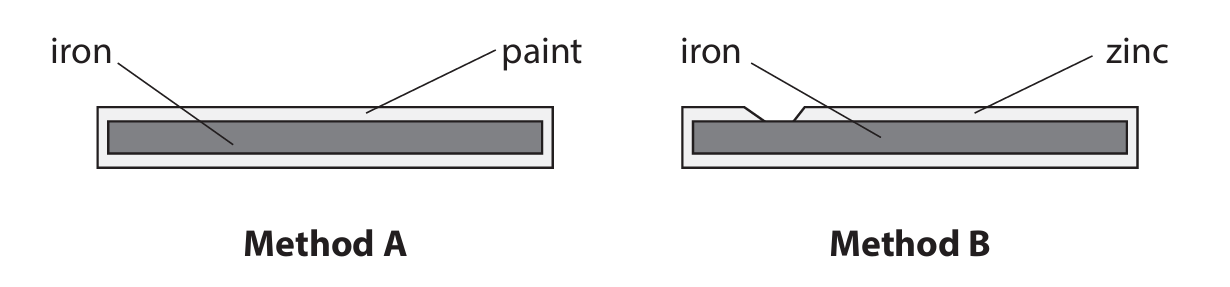
(b)(i) The paint acts as a barrier / protective layer which prevents oxygen/air and water from reaching the surface of the iron.
(b)(ii) Galvanising / Galvanisation
Also acceptable: sacrificial protection.
Method B involves coating the iron with a layer of zinc, a process known as galvanising.
(b)(iii)
• Zinc is more reactive than iron (it is higher in the reactivity series).
• Because zinc is more reactive, it oxidises / loses electrons / corrodes in preference to iron. The zinc acts as a sacrificial anode.
• Even if the zinc layer is scratched and the iron is exposed, the zinc will still oxidise first, protecting the iron. The electrons lost by zinc prevent the iron from losing electrons (being oxidised).
This is an application of sacrificial protection, a form of cathodic protection.
▶️ Answer/Explanation
(a)
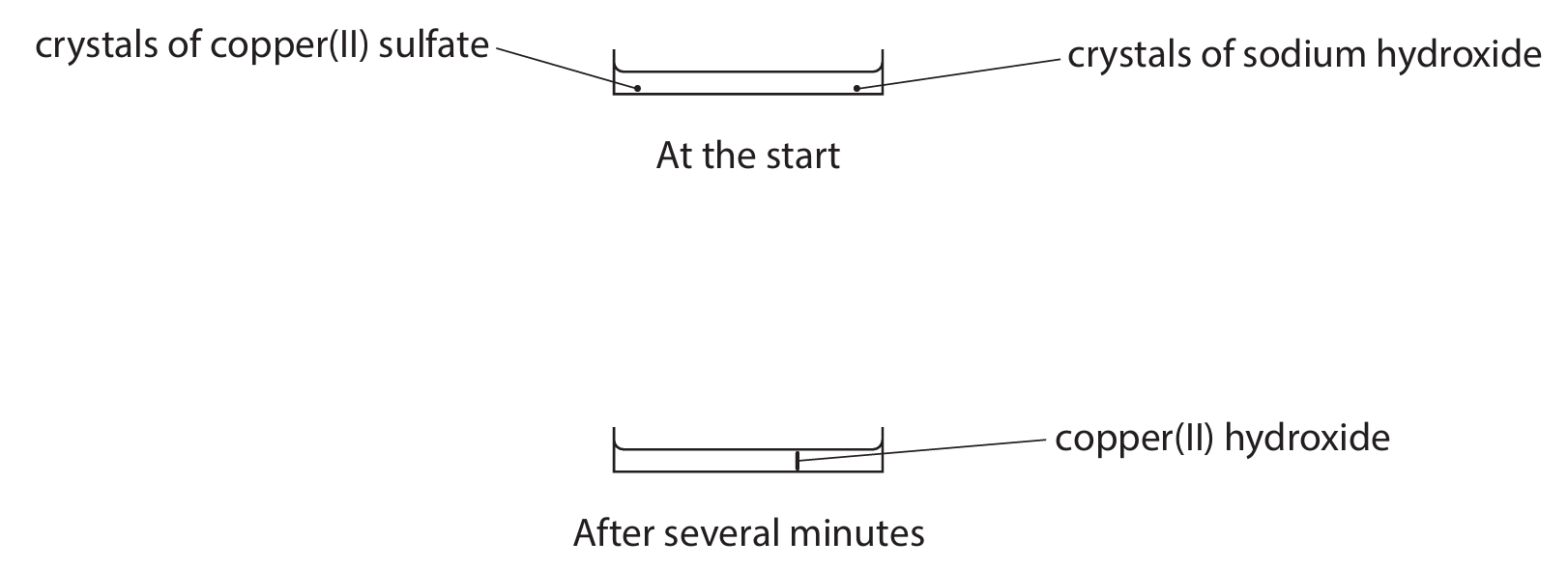
M1: dissolving / dissolves / dissolution
M2: diffusion / diffuses
Note: The order of the two answers can be either way round.
Details: The solid crystals must first dissolve in the water to form mobile ions (\(\text{Cu}^{2+}, \text{SO}_4^{2-}, \text{Na}^+, \text{OH}^-\)). These ions then diffuse through the water from areas of high concentration (near the crystals) to areas of lower concentration. When \(\text{Cu}^{2+}\) and \(\text{OH}^-\) ions meet, they react to form the insoluble precipitate \(\text{Cu(OH)}_2\).
(b)
M1: particles move faster / particles have more kinetic energy
M2: so particles collide and react after a shorter period of time / diffuse faster / more frequent collisions
Details: At a higher temperature, the particles (ions) gain more kinetic energy. This causes them to move faster. As a result, the dissolved ions diffuse through the solution more rapidly, leading to more frequent and more energetic collisions between \(\text{Cu}^{2+}\) and \(\text{OH}^-\) ions per unit time. This increases the rate of the reaction, so the solid \(\text{Cu(OH)}_2\) forms in less time.
(c)(i)
3 / three
Details: The formula \(\text{Cu(OH)}_2\) contains copper (\(\text{Cu}\)), oxygen (\(\text{O}\)), and hydrogen (\(\text{H}\)). These are three different chemical elements.
(c)(ii)
2+ / \(\text{Cu}^{2+}\)
Allow: +2 / \(\text{Cu}^{+2}\)
Details: In ionic compounds, the sum of the charges must be zero. The hydroxide ion has a charge of \(1-\) (\(\text{OH}^-\)). Since there are two hydroxide ions, their total charge is \(2-\). To balance this, the copper ion must have a charge of \(2+\).
▶️ Answer/Explanation
(a)
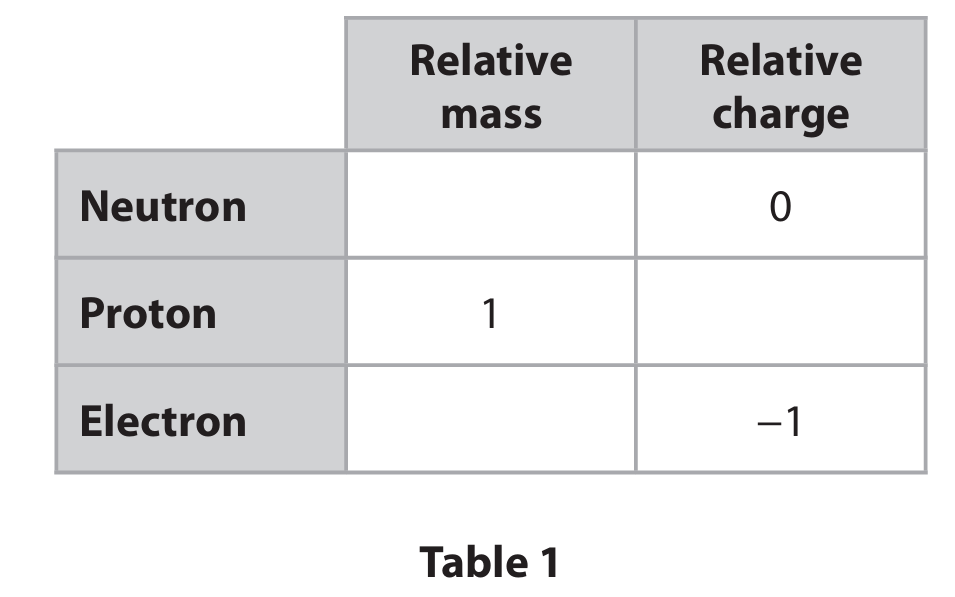
Completed Table:
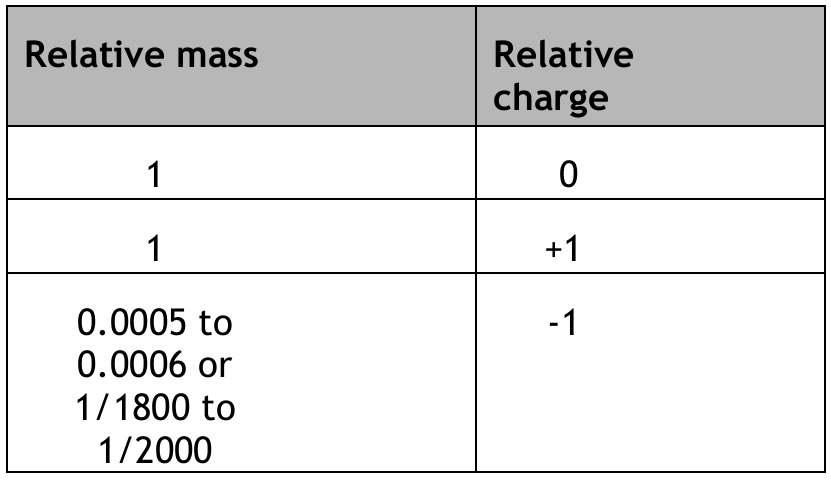
Explanation: The relative mass of a neutron and proton is 1. The relative charge of a proton is +1. The relative mass of an electron is approximately \( \frac{1}{1836} \) (or 0.0005).
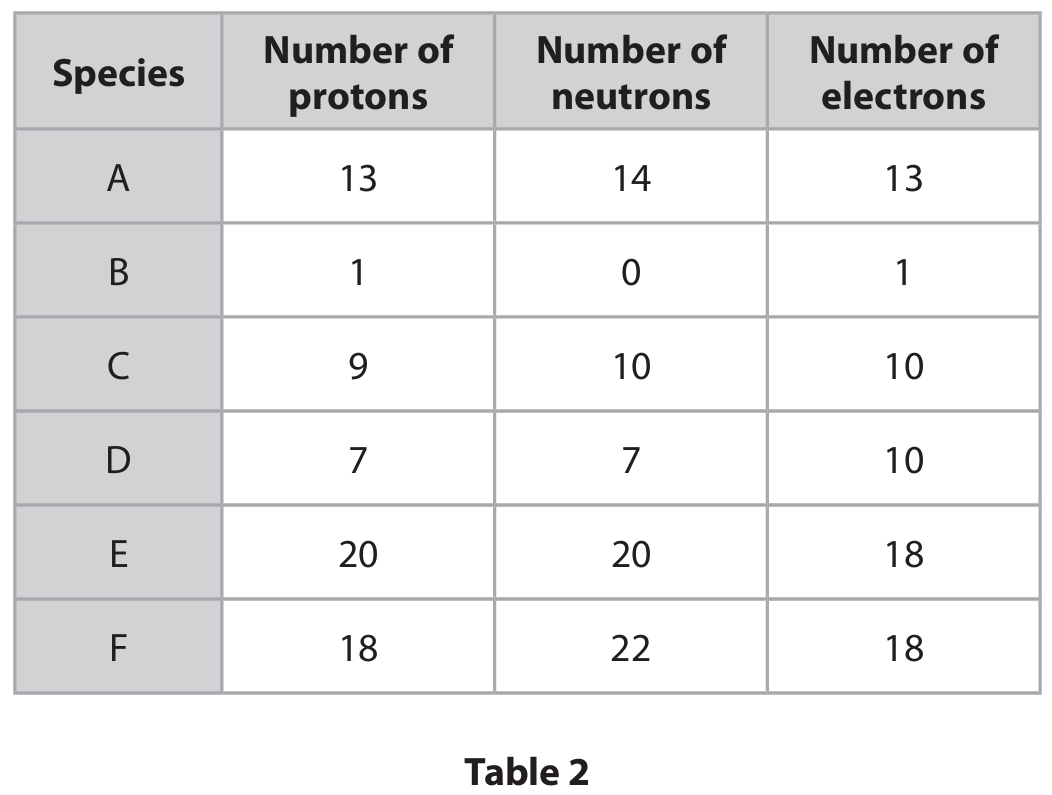
(b)(i) A
Explanation: Species A (Aluminium atom) has 13 electrons. Its electron configuration is 2,8,3, so it has 3 electrons in its outer shell.
(b)(ii) D
Explanation: Species D has 7 protons (Nitrogen) but 10 electrons, meaning it has gained 3 electrons, giving it a 3- charge (\( \text{N}^{3-} \)).
(b)(iii) C
Explanation: Species C has 9 protons and 10 neutrons. Mass number = protons + neutrons = 9 + 10 = 19.
(c)
Similarity: same number of protons / same atomic number / same electron configuration / 3 protons
Difference: different number of neutrons / \( ^{6}\text{Li} \) has 3 neutrons, \( ^{7}\text{Li} \) has 4 neutrons
Note: Isotopes are atoms of the same element with the same number of protons but different numbers of neutrons.
(d)
Calculation:
\( A_r = \frac{(79.0 \times 24) + (10.0 \times 25) + (11.0 \times 26)}{100} \)
\( A_r = \frac{1896 + 250 + 286}{100} \)
\( A_r = \frac{2432}{100} = 24.32 \)
Rounded to one decimal place: \( \mathbf{24.3} \)
Explanation: The relative atomic mass is the weighted average of the isotopic masses, based on their percentage abundances.
▶️ Answer/Explanation
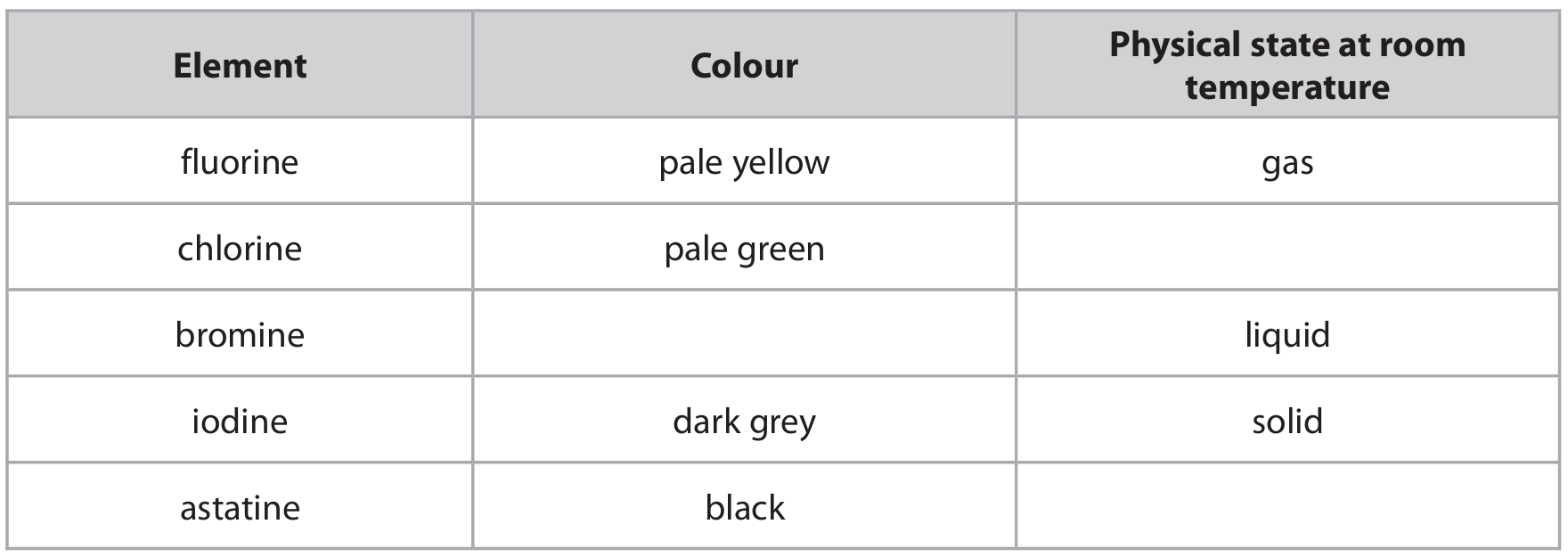
(a) Completed Table
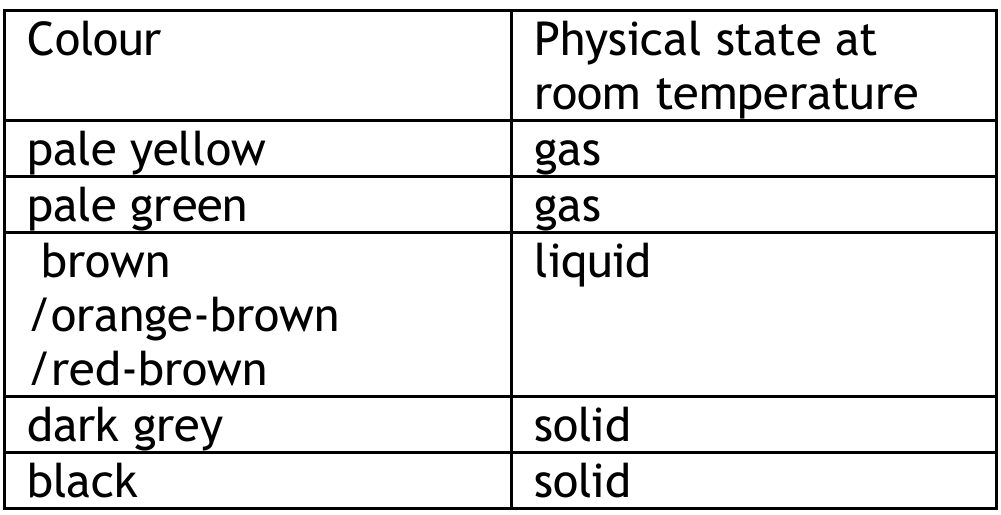
Explanation: The properties of halogens show trends down the group. As the atomic number increases, the elements become darker in colour and their physical state at room temperature changes from gas (F\(_2\), Cl\(_2\)) to liquid (Br\(_2\)) to solid (I\(_2\), At). Astatine, being the last naturally occurring halogen, is predicted to be a dark-colored solid.
(b)(i) The balanced chemical equation is:
\[ Cl_2 + 2NaBr \rightarrow Br_2 + 2NaCl \] Explanation: Chlorine is more reactive than bromine. It displaces bromide ions from solution, oxidizing them to bromine molecules (Br\(_2\)), while itself being reduced to chloride ions (Cl\(^-\)).
(b)(ii) No reaction occurs.
Explanation: Bromine is less reactive than chlorine. Since chlorine is above bromine in Group 7, it is a stronger oxidizing agent. Bromine cannot oxidize chloride ions (Cl\(^-\)) to chlorine (Cl\(_2\)) because chloride ions are more stable (harder to oxidize) than bromide ions. Therefore, adding bromine water to sodium chloride solution results in no observable change.
(b)(iii) This is a redox reaction because:
- Oxidation occurs: Astatide ions (At\(^-\)) lose electrons (their oxidation state increases from -1 to 0) to form astatine molecules (At\(_2\)). At\(^-\) is the reducing agent.
- Reduction occurs: Bromine molecules (Br\(_2\)) gain electrons (their oxidation state decreases from 0 to -1) to form bromide ions (Br\(^-\)). Br\(_2\) is the oxidizing agent.
Since there is simultaneous electron loss (oxidation) and electron gain (reduction), the reaction is classified as a redox reaction. This also demonstrates the reactivity trend: bromine is higher in the group than astatine and is therefore a stronger oxidizing agent, capable of oxidizing astatide ions.
▶️ Answer/Explanation
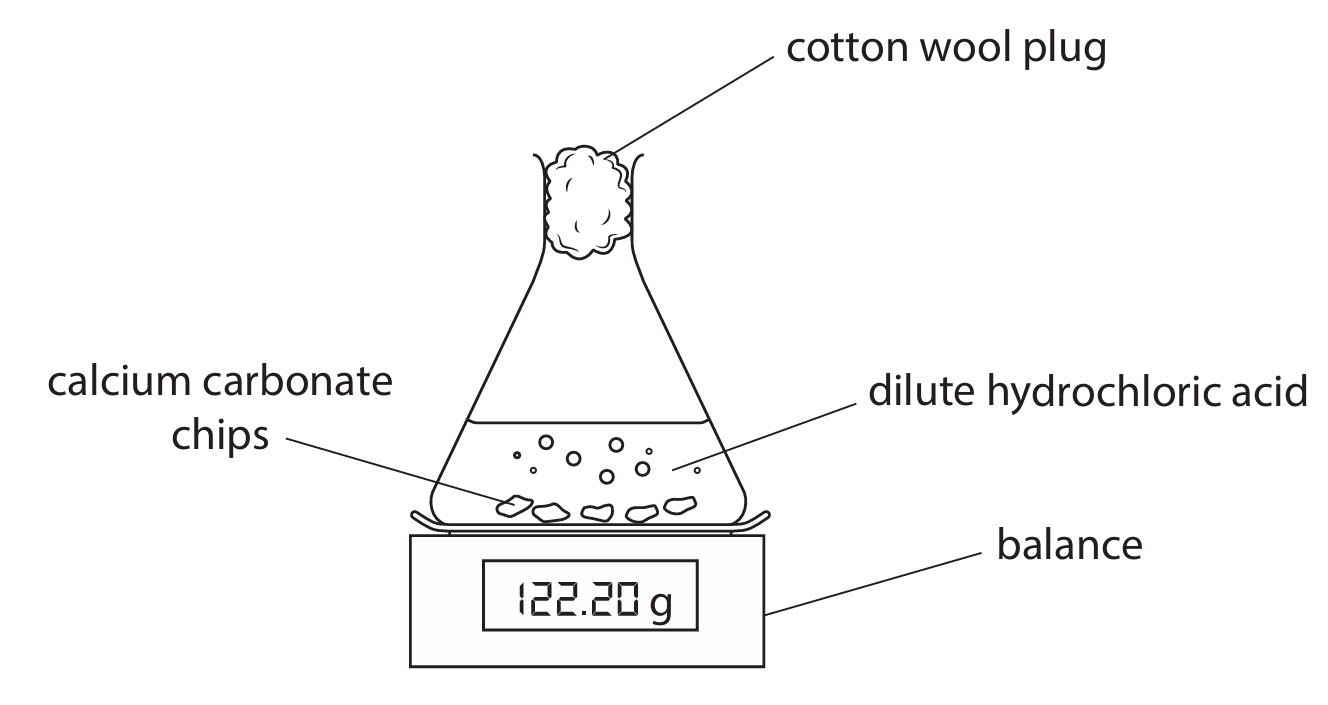
(a) Mass reading on the balance
- Moles of \(\text{CaCO}_3 = \frac{5.00}{100} = 0.0500 \text{ mol}\)
- From the equation, 1 mol \(\text{CaCO}_3\) produces 1 mol \(\text{CO}_2\).
- Mass of \(\text{CO}_2\) lost = \(0.0500 \times 44 = 2.20 \text{ g}\).
- Initial total mass = mass of flask + contents. The balance reading decreases by the mass of \(\text{CO}_2\) lost. The final reading = initial reading \( – 2.20 \text{ g}\).
- If the initial reading was, for example, 122.20 g (as implied in the diagram), the final reading would be \(122.20 – 2.20 = 120.00 \text{ g}\).
Answer: 120.00 g.
(b)(i) & (ii) Graph
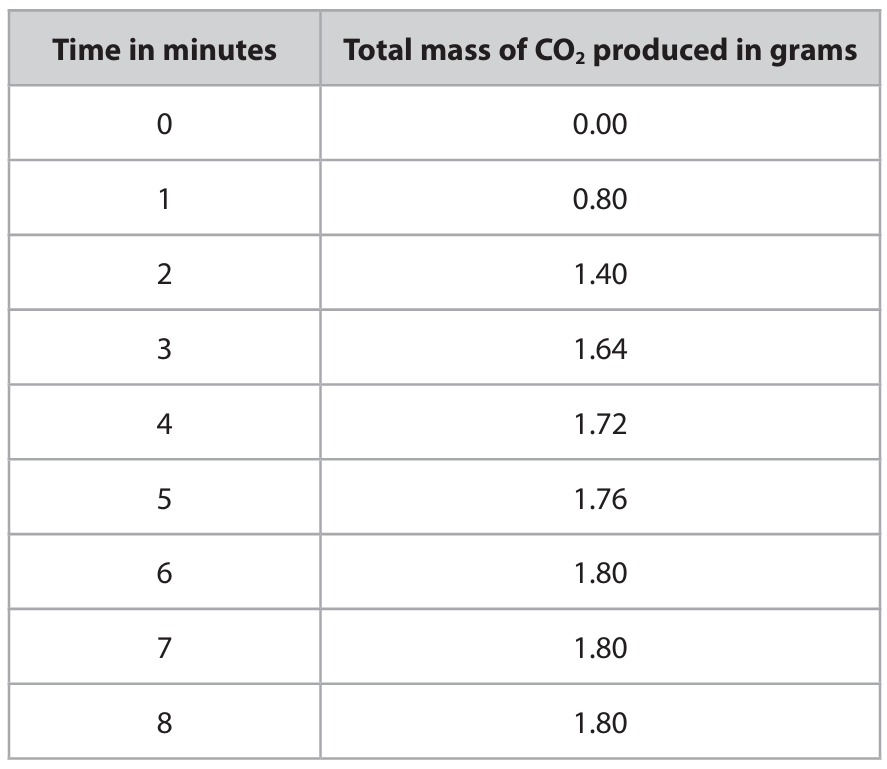
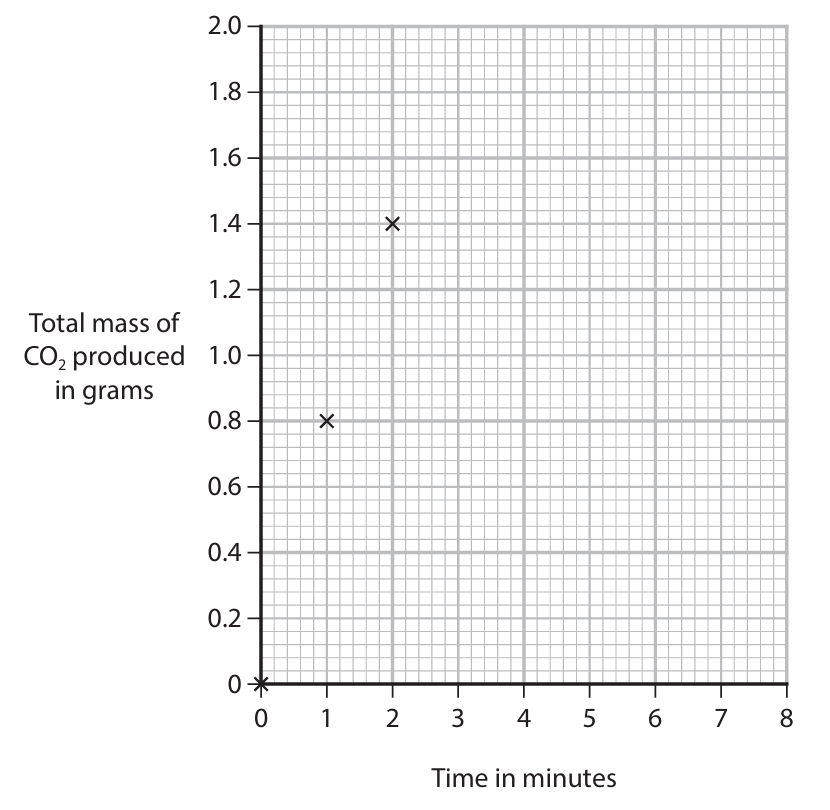
Plot the points from the table (Time on x-axis, Mass of CO₂ on y-axis) and draw a smooth curve of best fit that starts steep, becomes less steep, and eventually levels off at 1.80 g.
(b)(iii) Rate at 2 minutes
- Method: Draw a tangent to the curve at \(t = 2\) minutes. The gradient of this tangent = \(\frac{\Delta y}{\Delta x} = \frac{\text{change in mass of CO}_2 (\text{g})}{\text{change in time (min)}}\).
- Example Calculation (using typical tangent values): If the tangent passes through (1.0 min, 0.60 g) and (3.0 min, 1.70 g), then:
Gradient = \(\frac{1.70 – 0.60}{3.0 – 1.0} = \frac{1.10}{2.0} = 0.55\) - Units: The rate = gradient = \(0.55 \text{ g min}^{-1}\) (or g/min).
Answer: ~0.55 g min⁻¹ (value depends on tangent drawn).
(b)(iv) Explanation of graph shape
The graph is steepest at the start because the reaction rate is fastest initially. This is due to the highest concentration of HCl. As the reaction proceeds, the concentration of HCl decreases (it is being used up), and the amount of CaCO₃ surface area available also decreases. This reduces the frequency of successful collisions, so the rate slows (curve becomes less steep). After about 6 minutes, the curve levels off (plateaus) because the reaction has finished—all the calcium carbonate has been used up. No more CO₂ is produced, so the total mass of CO₂ becomes constant.
(c) Effect of using powder
The rate of reaction increases significantly. Using powder instead of chips greatly increases the surface area of the calcium carbonate exposed to the acid. A larger surface area provides more sites for collisions between HCl particles and CaCO₃ particles. This leads to more frequent successful collisions per unit time, increasing the rate. The initial steep part of the mass-time graph would be even steeper, and the reaction would finish more quickly (the plateau would be reached sooner).
Key points: Increased surface area → more collisions per second → faster rate.
▶️ Answer/Explanation
(a) Any correct description of the electrostatic forces in a covalent bond:
• Attraction between (positively charged) nuclei and the shared pair(s) of electrons. OR
• Attraction between the shared pair(s) of electrons and (positively charged) nuclei.
(Mark scheme: 1 mark for each correct component of the description; “nuclei” must be plural).
(b)(i) A dot-and-cross diagram showing:
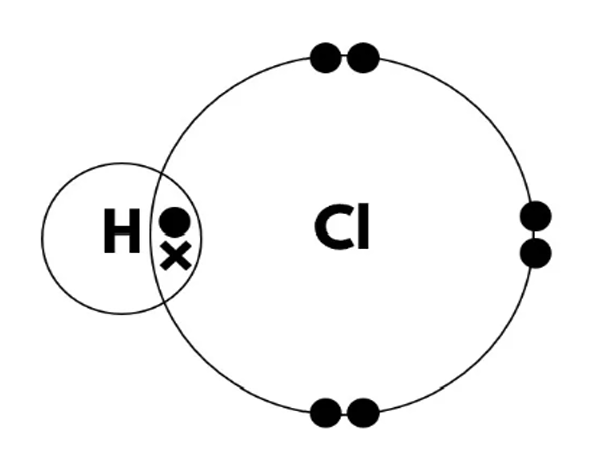
• Hydrogen atom with one electron (dot or cross).
• Chlorine atom with seven outer shell electrons (dots or crosses, using the opposite symbol to hydrogen).
• One shared pair of electrons between them, completing chlorine’s outer shell (8 electrons) and hydrogen’s (2 electrons).
Example: H with one dot, Cl with 7 crosses, one shared pair (dot and cross overlapping).
(b)(ii) Hydrogen chloride has a simple molecular structure. The molecules are held together by weak intermolecular forces. These forces require only a small amount of energy to overcome during boiling, hence the low boiling point.
(Mark scheme: M1 for “weak intermolecular forces”, M2 for “require little energy to overcome”).
(c)(i) Any one of the following:
• Oxygen is a smaller atom than silicon.
• Oxygen has two electron shells, silicon has three.
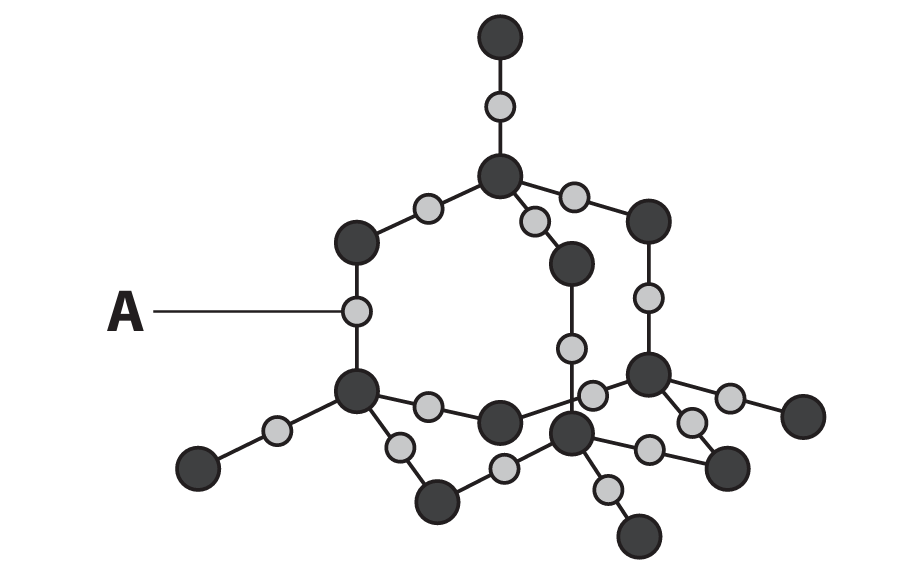
• Each silicon atom is bonded to four oxygen atoms.
• Each oxygen atom is bonded to two silicon atoms.
(The diagram shows oxygen atoms bridging between silicon atoms).
(c)(ii) Silicon dioxide (\(\text{SiO}_2\)) is an acidic oxide and calcium oxide (\(\text{CaO}\)) is a basic oxide. They react in an acid-base (neutralisation) reaction to form the salt calcium silicate (\(\text{CaSiO}_3\)).
Do not credit “calcium oxide is an alkali” – alkalis are soluble bases.
(c)(iii) An explanation linking structure to properties:
• Silicon dioxide has a giant covalent (macromolecular) structure/lattice. (M1)
• It has a three-dimensional tetrahedral structure where each silicon atom is covalently bonded to four oxygen atoms. (M4, M5)
• There are strong covalent bonds throughout the entire structure. (M2)
• A very large amount of energy is required to break these strong covalent bonds to melt or break the structure. (M3)
• The atoms are fixed in a rigid, non-layered network, so they cannot slide over each other, making it very hard. (M6)
(Mark scheme: 5 marks for any five valid points. Do not credit mention of intermolecular forces or ionic bonding).
▶️ Answer/Explanation
(a) alkanes
Crude oil is predominantly a mixture of hydrocarbons from the alkane homologous series.
(b) A three-mark explanation:
1. (The impurity) sulfur burns/combusts to form sulfur dioxide (\(SO_2\)).
2. Sulfur dioxide dissolves in/reacts with (rain)water.
3. This forms sulfuric acid (\(H_2SO_4\)), causing acid rain.
Nitrogen oxides (from high-temperature combustion) can also cause acid rain, but the question specifies the “common impurity in fuels,” which is sulfur.
(c)(i)
• Temperature: 600–700 °C
• Catalyst: alumina / silica / aluminosilicates / zeolites / \(Al_2O_3\) / \(SiO_2\)
(c)(ii) A three-mark explanation:
1. Long-chain alkanes are less useful/have lower demand.
2. Cracking produces shorter alkanes (e.g., \(C_8H_{18}\)) that are more useful as fuels (e.g., petrol/gasoline).
3. Cracking also produces alkenes (e.g., \(C_2H_4\)) which are used to make polymers/plastics and other chemicals (like alcohols).
This process balances supply (lots of long chains from distillation) with demand (more need for short-chain fuels and feedstocks).
(d)(i) A two-mark explanation:
1. Isomers are molecules with the same molecular formula.
2. But they have different structural/displayed formulae (different arrangements of atoms).
(d)(ii) The other two isomers of \(C_5H_{12}\) (pentane) are:
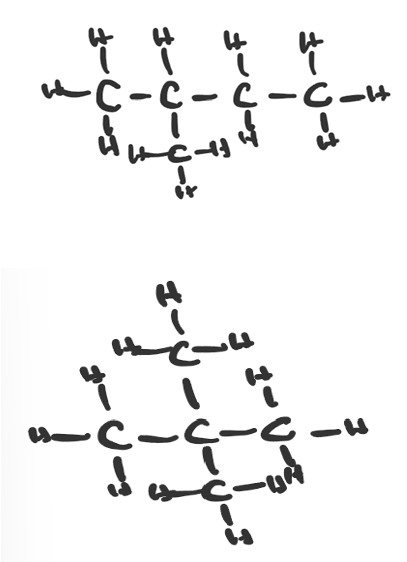
• 2-methylbutane (branched chain with a methyl (\(-CH_3\)) group on the second carbon).
• 2,2-dimethylpropane (neopentane, a central carbon bonded to three methyl groups and one other carbon/hydrogen).
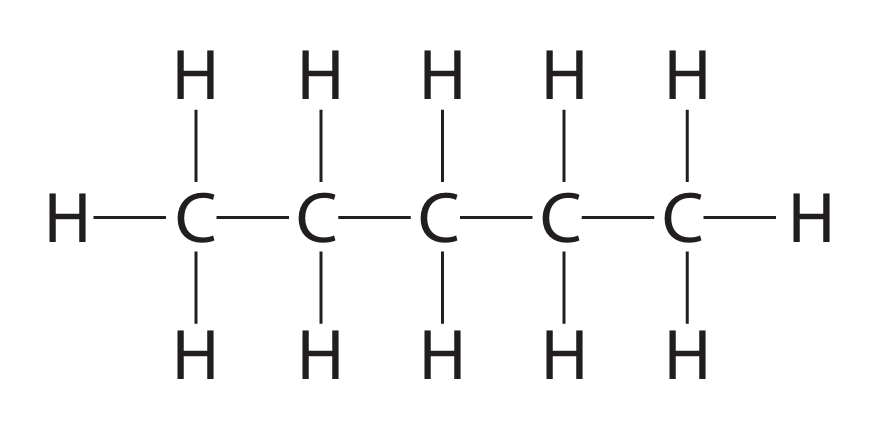
Pentane itself (\(CH_3-CH_2-CH_2-CH_2-CH_3\)) is the straight-chain isomer shown in the question.
▶️ Answer/Explanation
(a) (i) Any two of the following:
- M1: Use a polystyrene cup (instead of a glass beaker).
- M2: This provides better insulation / reduces heat loss to the surroundings.
- M3: Use a lid on the container / leave the mixture to reach a steady temperature before recording it.
Improving the insulation minimizes energy exchange with the environment, leading to a more accurate measurement of the temperature change solely due to the reaction.
(a) (ii) The zinc powder is in excess.
If the zinc is in excess, all of the copper(II) sulfate will react regardless of the exact mass of zinc added. Therefore, the limiting reactant and the amount of heat released depend only on the amount of copper(II) sulfate, not on the zinc.
(a) (iii) From blue to colourless.
The blue colour of the solution is due to aqueous copper(II) ions (\( \text{Cu}^{2+}(\text{aq}) \)). As these ions are displaced and form solid copper, the blue colour fades, leaving a colourless solution of zinc sulfate.
(b) (i) Calculation of heat energy change \(Q\):
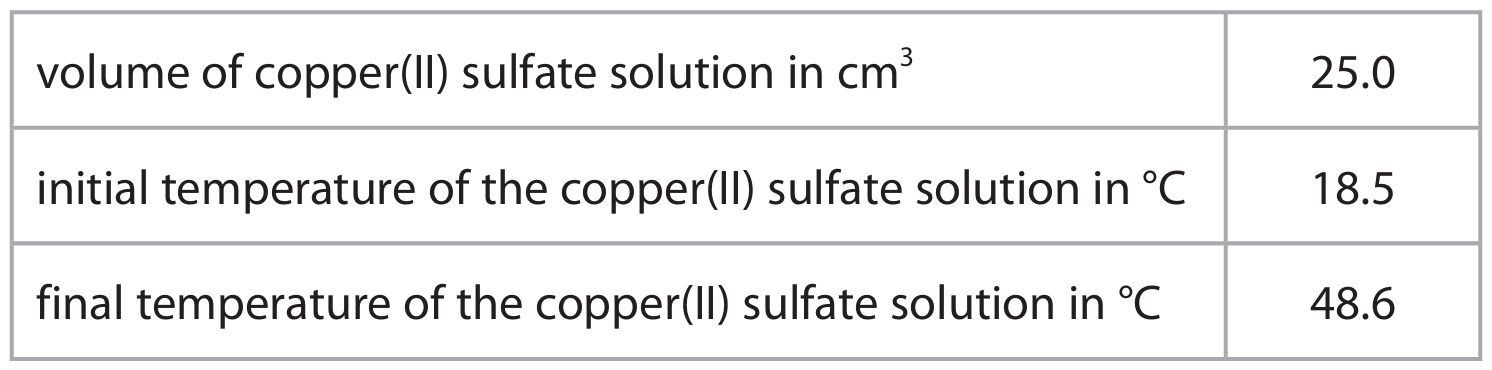
- Mass of solution, \(m = 25.0 \, \text{cm}^3 \times 1.0 \, \text{g cm}^{-3} = 25.0 \, \text{g}\)
- Temperature change, \(\Delta T = 48.6^\circ \text{C} – 18.5^\circ \text{C} = 30.1^\circ \text{C}\)
- Specific heat capacity, \( c = 4.2 \,\mathrm{J\,g^{-1}\,^{\circ}C^{-1}} \)
- Using \(Q = mc\Delta T\):
\[ Q = 25.0 \times 4.2 \times 30.1 \] \[ Q = 3160.5 \, \text{J} \]
Answer: \(3160.5 \, \text{J}\) (Accept \(3160 \, \text{J}\) or \(3161 \, \text{J}\) with appropriate significant figures).
(b) (ii) Calculation of molar enthalpy change \(\Delta H\):
- Calculate moles of \(\text{CuSO}_4\): \[ \text{moles} = \frac{\text{mass}}{M_r} = \frac{6.38}{159.5} = 0.0400 \, \text{mol} \]
- Energy change per mole from experiment: \[ \frac{Q}{\text{moles}} = \frac{3800 \, \text{J}}{0.0400 \, \text{mol}} = 95000 \, \text{J/mol} \]
- Convert to kJ/mol: \[ \frac{95000 \, \text{J/mol}}{1000} = 95 \, \text{kJ/mol} \]
- The reaction is exothermic (temperature increased), so \(\Delta H\) is negative. \[ \Delta H = -95 \, \text{kJ/mol} \]
Answer: \(-95 \, \text{kJ/mol}\)
The negative sign is crucial as it indicates the reaction releases heat (exothermic). The calculation follows the formula: \(\Delta H = \frac{-Q}{\text{moles of limiting reactant}}\).
▶️ Answer/Explanation
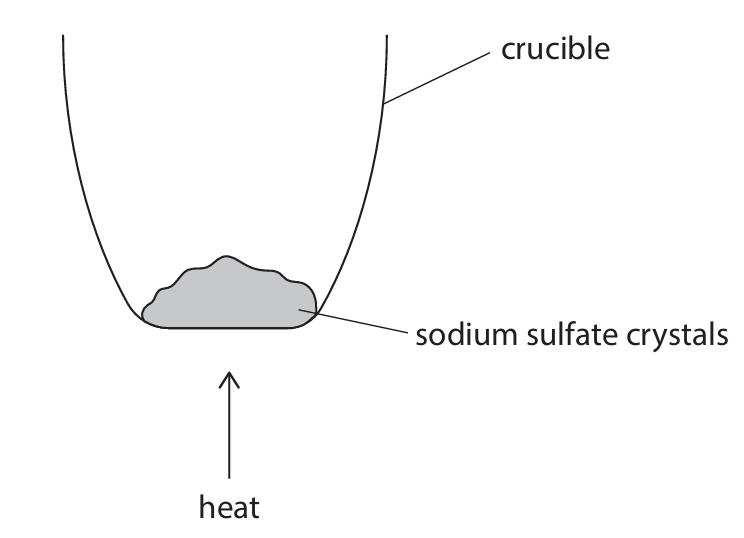
(a) Tests to identify the white solid as sodium sulfate:
To identify sodium ions:
• Perform a flame test on a small sample of the solid.
• Observation: A persistent yellow/orange flame confirms the presence of \(\text{Na}^+\).
To identify sulfate ions:
• Dissolve a sample of the solid in distilled water to make a solution.
• Add dilute hydrochloric acid (to remove carbonate or other acid-soluble ions that could interfere).
• Add barium chloride solution (or barium nitrate).
• Observation: A white precipitate (\(\text{BaSO}_4\)) confirms the presence of \(\text{SO}_4^{2-}\).
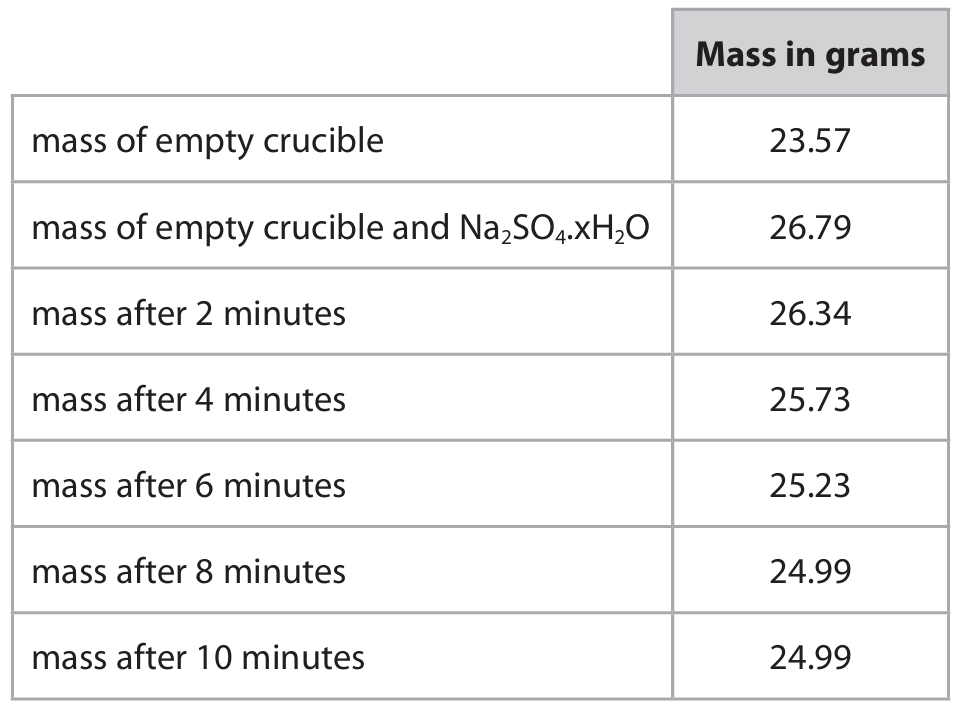
(b)(i) The results show that all water has been removed because the mass of the crucible and its contents stays constant between the 8-minute and 10-minute readings (both 24.99 g). This indicates no further mass loss, meaning no more water is being driven off.
(b)(ii) Mass of anhydrous sodium sulfate:
The final constant mass (crucible + anhydrous \(\text{Na}_2\text{SO}_4\)) = 24.99 g.
Mass of empty crucible = 23.57 g.
\(\text{Mass of anhydrous } \text{Na}_2\text{SO}_4 = 24.99 – 23.57 = 1.42 \text{ g}\).
(b)(iii) Mass of water lost:
Initial mass (crucible + hydrated salt) = 26.79 g.
Final mass (crucible + anhydrous salt) = 24.99 g.
\(\text{Mass of water lost} = 26.79 – 24.99 = 1.80 \text{ g}\).
(b)(iv) Calculation of \(x\):
• Moles of \(\text{Na}_2\text{SO}_4 = \frac{1.42}{142} = 0.0100 \text{ mol}\).
• Moles of \(\text{H}_2\text{O} = \frac{1.80}{18} = 0.100 \text{ mol}\).
• Ratio \(\text{H}_2\text{O} : \text{Na}_2\text{SO}_4 = \frac{0.100}{0.0100} = 10\).
Therefore, \(x = 10\). The formula is \(\text{Na}_2\text{SO}_4 \cdot 10\text{H}_2\text{O}\).
Note: This is the common hydrated form of sodium sulfate (Glauber’s salt). The experiment relies on the principle of thermal decomposition to remove water of crystallisation and using molar masses to find the mole ratio.