This question is about gases.
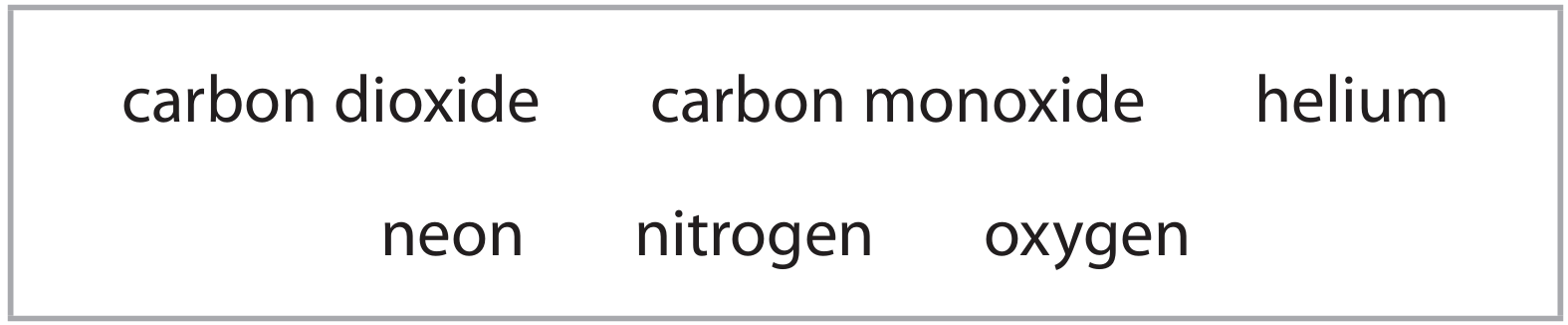
(a) The box gives the names of some gases.

Choose gases from the box to answer questions (i) to (iv).
You may use each gas once, more than once or not at all.
(i) Identify two gases in Group 0 of the Periodic Table.
(ii) Identify the gas that makes up about \(21\%\) of the atmosphere.
(iii) Identify a greenhouse gas.
(iv) Identify the toxic gas formed by incomplete combustion of a hydrocarbon.
(b) Describe a test to show that a gas is carbon dioxide.
Most-appropriate topic codes (Pearson Edexcel IGCSE Chemistry 4CH1):
• 2(c): Gases in the atmosphere — part (a)(ii), (a)(iii), (a)(iv)
• 2(h): Chemical tests — part (b)
• 4(b): Crude oil & combustion — part (a)(iv)
▶️ Answer/Explanation
(a)(i) helium and neon
(a)(ii) oxygen
ACCEPT \(O_2\)
(a)(iii) carbon dioxide
ACCEPT \(CO_2\)
(a)(iv) carbon monoxide
ACCEPT \(CO\)
(b)
M1: (Bubble the gas through) limewater
M2: which turns (from colourless to) cloudy/milky
M2 dependent on M1. ALLOW white precipitate.
Crude oil is a mixture of hydrocarbons.
(a) Name the process used to separate crude oil into fractions.
(b) Give one use for the bitumen fraction.
(c) The diagram shows the displayed formula of one of the alkanes in the refinery gases fraction.
H H H H
| | | |
H—C—C—C—C—H
| | | |
H H H H
(i) Determine the molecular formula of this alkane.
(ii) Name this alkane.
(iii) Give the general formula of the homologous series of alkanes.
Most-appropriate topic codes (Pearson Edexcel IGCSE Chemistry 4CH1):
• 4(c): Alkanes — parts (c)(i), (c)(ii), (c)(iii)
• 4(a): Introduction to organic chemistry — parts (c)(iii) — homologous series
▶️ Answer/Explanation
(a) (fractional) distillation
(b) (surfacing) roads / road tar / tarmac / roofs
ALLOW ‘making roads’.
(c)(i) \(\mathrm{C_4H_{10}}\)
(c)(ii) butane
(c)(iii) CnH2n+2
This question is about a compound called potassium permanganate.
(a) A teacher makes a saturated solution of potassium permanganate using this method.
The teacher adds \(25 \, \text{cm}^3\) of water at \(50 \, ^\circ\text{C}\) to a beaker.
The teacher then adds solid potassium permanganate one spatula at a time, while stirring, until the solution is saturated.
(i) Give the meaning of the term saturated solution.
(ii) Give a reason why crystals form when the saturated solution cools from \(50 \, ^\circ\text{C}\) to room temperature.
(b) The teacher pours \(25 \, \text{cm}^3\) of a saturated solution of potassium permanganate at room temperature into an evaporating dish. The teacher leaves the solution until all the water has evaporated. The teacher records the mass of the evaporating dish and the mass of the evaporating dish with the dry crystals.
mass of evaporating dish \(= 64.10 \, \text{g}\)
mass of evaporating dish with dry crystals \(= 65.35 \, \text{g}\)
Calculate the solubility of potassium permanganate in grams per \(100 \, \text{g}\) of water.
\([1.00 \, \text{cm}^3 \, \text{of water has a mass of } 1.00 \, \text{g}]\)
(c) The equation shows the thermal decomposition of potassium permanganate.
\[2KMnO_4 \rightarrow K_2MnO_4 + MnO_2 + O_2\]
(i) Describe a test to show that oxygen gas is produced.
(ii) Calculate the \( M_r \) of \( K_2MnO_4 \). (1)
(d) Potassium permanganate is an oxidising agent.
Give a reason why potassium permanganate is an oxidising agent.
Most-appropriate topic codes (Edexcel IGCSE Chemistry 4CH1):
• 1(e): Chemical formulae, equations and calculations — Relative formula mass \(M_r\) (part c(ii))
• 1(i): Electrolysis — Oxidation and reduction (concept of oxidising agent) (part d)
• 2(b): Group 7 (Halogens) — Test for oxygen gas (part c(i))
• 2(f): Acids, alkalis and titrations — Solubility rules (implicit in part b)
• 2(h): Chemical tests — Test for oxygen (part c(i))
▶️ Answer/Explanation
(a)(i) A solution that contains the maximum amount of solute that can dissolve (at a particular temperature).
(a)(ii) The solubility (of potassium permanganate) decreases as the temperature decreases, so the excess solute crystallises out.
(b)
Mass of potassium permanganate \( = 65.35 – 64.10 = 1.25 \, \text{g}\)
Mass of water \( = 25 \, \text{g}\) (since \(1 \, \text{cm}^3\) water \(= 1 \, \text{g}\))
Solubility in \(100 \, \text{g}\) water \( = \left( \frac{1.25}{25} \right) \times 100 = 5.00 \, \text{g per 100 g water}\)
(c)(i) Insert a glowing splint into the gas; the splint relights.
(c)(ii)
\(M_r(K_2MnO_4) = 2 \times 39.1 + 54.9 + 4 \times 16.0 = 197.1 \approx 197\)
(d) It can accept electrons / it can donate oxygen / it causes another substance to be oxidised (while itself is reduced).
This question is about Group 1 metals.
(a) A teacher adds a small piece of lithium metal to a trough containing water.
(i) Complete the equation for the reaction between lithium and water by adding the state symbols.
\[2Li(\text{……}) + 2H_2O(\text{……}) \rightarrow 2LiOH(\text{……}) + H_2(\text{……})\]
(ii) Give two observations made when the lithium is added to the water.
(iii) The reaction produces \(375 \, \text{cm}^3\) of hydrogen gas at room temperature and pressure (rtp).
Show, by calculation, that the mass of lithium added is between \(0.20 \, \text{g}\) and \(0.30 \, \text{g}\).
[1 mol of gas has a volume of \(24\,000 \, \text{cm}^3\) at rtp]
[for lithium, \(A_r = 7\)]
(b) Potassium is more reactive than lithium.
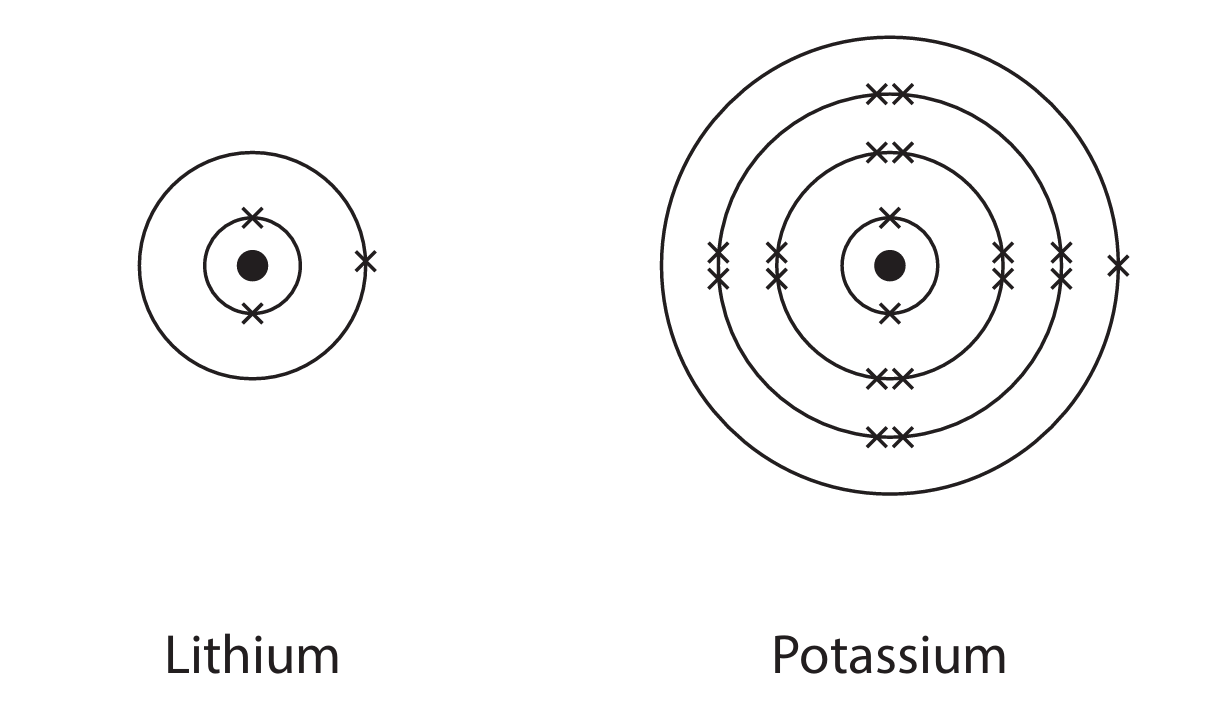
The diagram shows the electronic structure of an atom of lithium and an atom of potassium.

(i) Give one observation that is different when a small piece of potassium, instead of lithium, is added to water.
(ii) Explain why potassium is more reactive than lithium. Refer to the electronic structure of lithium and of potassium in your answer.
Most-appropriate topic codes (Pearson Edexcel IGCSE Chemistry 4CH1):
• 1(e): Chemical formulae, equations and calculations — Part (a)(i) & (a)(iii)
• 1(c): Atomic structure — Part (b)(ii)
• 1(d): The Periodic Table — Part (b)(ii)
▶️ Answer/Explanation
(a)(i) \(2Li(\text{s}) + 2H_2O(\text{l}) \rightarrow 2LiOH(\text{aq}) + H_2(\text{g})\)
(a)(ii) Any two from:
- Effervescence / fizzing / bubbling
- The lithium gets smaller / disappears / dissolves
- The lithium floats
- The lithium moves (on the surface)
(a)(iii) Calculation:
Amount of hydrogen = \(\frac{375}{24000} = 0.015625 \text{ mol}\)
From the equation: \(2Li \rightarrow H_2\), moles of Li = \(2 \times 0.015625 = 0.03125 \text{ mol}\)
Mass of lithium = \(0.03125 \times 7 = 0.21875 \text{ g}\) (which is between \(0.20 \text{ g}\) and \(0.30 \text{ g}\))
(b)(i) Any one from:
- Potassium melts / turns into a ball
- Potassium moves faster / reaction is faster
- Faster effervescence
- (Lilac/purple/pink) flame
(b)(ii) Explanation:
- Potassium has more electron shells / a larger atomic radius than lithium. (M1)
- The outer electron in potassium is further from the nucleus / more shielded from the nuclear attraction. (M2)
- Therefore, the outer electron in potassium is less strongly attracted to the nucleus / is lost more easily. (M3)
- This makes potassium more reactive than lithium.
This question is about metals and metal compounds.
(a) The method used to extract a metal depends on the reactivity of the metal.
Explain which method is used to extract sodium metal from sodium chloride.
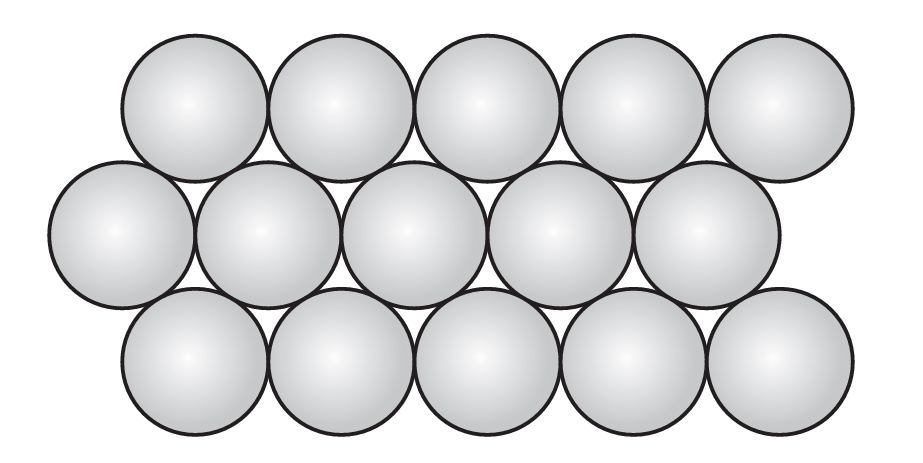
(b) The diagram shows the arrangement of particles in a pure metal.

Explain why pure metals are soft.
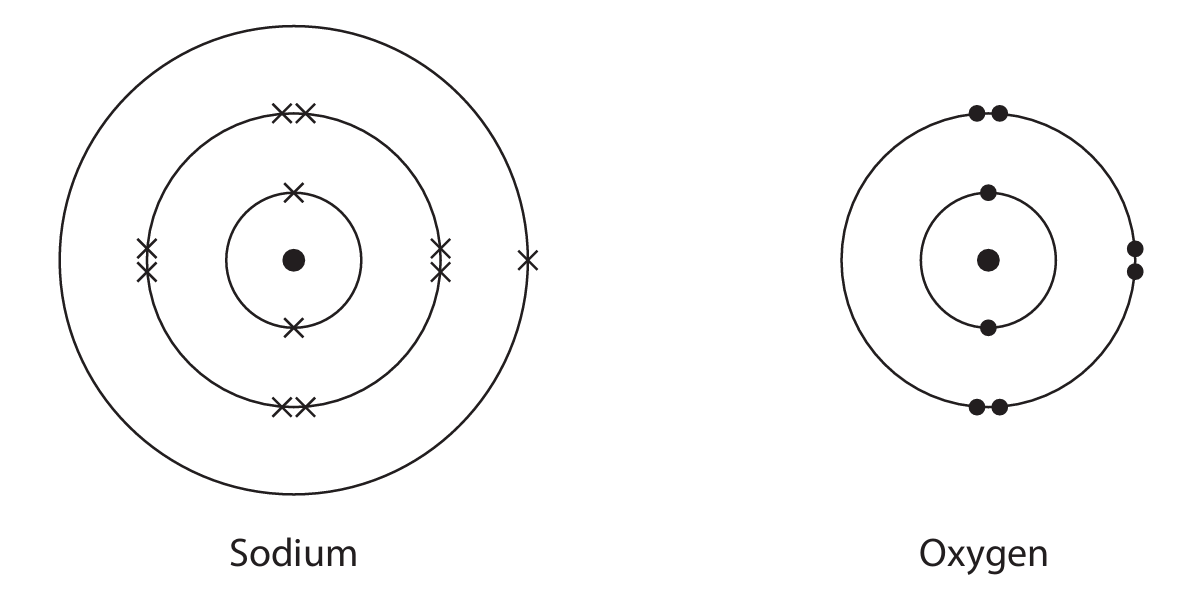
(c) The diagram shows the electronic structure of an atom of sodium and an atom of oxygen.

Describe, in terms of electrons, what happens when sodium reacts with oxygen.
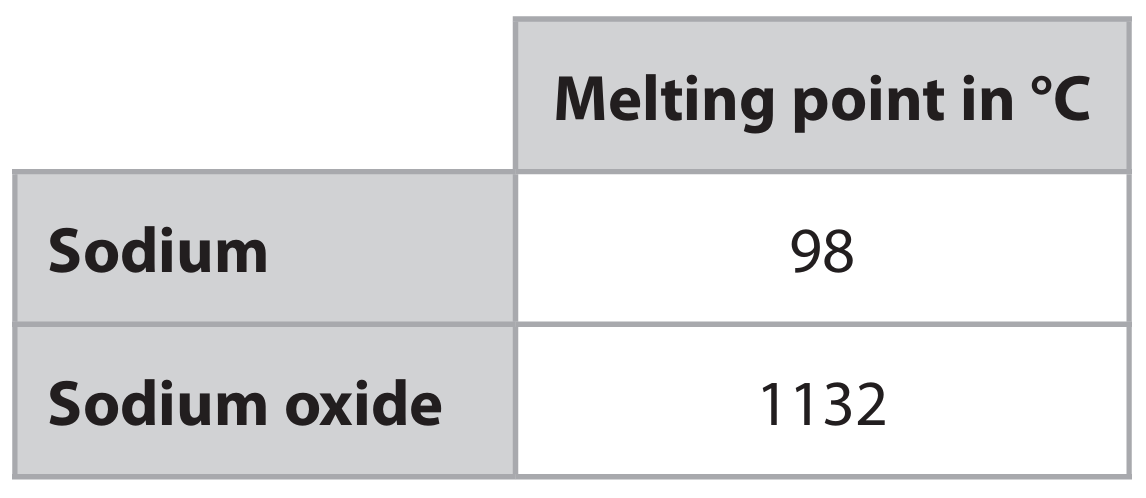
(d) The table shows the melting points of sodium and sodium oxide.

Explain why sodium and sodium oxide have different melting points.
In your answer you should refer to:
- the structures of sodium and sodium oxide
- the forces between the particles
Most-appropriate topic codes (Edexcel IGCSE Chemistry 4CH1):
• 1(h): Metallic bonding — part (b)
• 1(f) & 2(h): Ionic bonding & Chemical tests — part (c) (electron transfer in ionic bond formation)
• 1(f) & 1(h): Ionic bonding & Metallic bonding — part (d) (comparison of structures and forces)
▶️ Answer/Explanation
(a)
- M1: Electrolysis
- M2: As sodium is more reactive than carbon / it is above carbon in the reactivity series / carbon cannot displace sodium
Note: M2 is dependent on M1. Do not accept “electrolysis of an aqueous solution”.
(b)
- M1: Layers/rows of atoms/ions/particles can slide over one another
- M2: Because there are no strong directional bonds holding them rigidly in place / planes of ions can move past each other
Note: Do not accept mention of molecules, intermolecular forces, or electrons sliding.
(c)
- M1: Sodium loses electrons (to form Na+)
- M2: Oxygen gains electrons (to form O2−)
Note: Accept correctly labelled diagrams showing electron transfer. Do not accept sharing of electrons (covalent bonding).
(d)
Sodium:
- M1: Giant metallic structure/lattice
- M2: Electrostatic attraction between positive ions and delocalised electrons
Sodium oxide:
- M3: Giant ionic structure / ionic lattice
- M4: Strong electrostatic attraction between oppositely charged ions (Na+ and O2−)
Comparison:
- M5: More energy is required to overcome the strong ionic bonds in sodium oxide than the metallic bonds in sodium.
Note: Do not accept intermolecular forces for M1, M2, M3, or M4. M5 is a comparative mark independent of M1–M4.
A student does a titration to find the volume of phosphoric acid solution \( (H_3PO_4) \) needed to neutralise a sample of potassium hydroxide solution (KOH). One of the products of the reaction is potassium phosphate.
This is the student’s method.
- use a measuring cylinder to transfer \( 25 \, \text{cm}^3 \) of potassium hydroxide solution to a conical flask
- add two drops of an indicator
- fill a burette with phosphoric acid solution and record the initial reading on the burette
- add the acid to the conical flask
- record the final burette reading when the indicator changes colour
This is the equation for the reaction.
\[ H_3PO_4(aq) + 3KOH(aq) \rightarrow K_3PO_4(aq) + 3H_2O(l) \]
(a) Explain two improvements to the student’s method that would give more accurate results.
(b) The student repeats the titration correctly. The potassium hydroxide solution has a concentration of \( 0.150 \, \text{mol/dm}^3 \). The phosphoric acid solution has a concentration of \( 0.0400 \, \text{mol/dm}^3 \). Calculate the volume, in \( \text{cm}^3 \), of phosphoric acid solution needed to neutralise \( 25.0 \, \text{cm}^3 \) of \( 0.150 \, \text{mol/dm}^3 \) potassium hydroxide solution. Give your answer to three significant figures.
(c) Potassium phosphate solution reacts with calcium chloride solution. One of the products is the insoluble solid, calcium phosphate.
(i) Complete the equation for the reaction.
\[ 2K_3PO_4(aq) + \_\_\_ CaCl_2(aq) \rightarrow Ca_3(PO_4)_2(s) + \_\_\_ KCl(aq) \]
(ii) The student reacts a solution containing \( 0.0400 \, \text{mol} \) of potassium phosphate with an excess of calcium chloride solution. The student obtains \( 5.70 \, \text{g} \) of calcium phosphate. Show that the percentage yield for the reaction is about \( 90\% \).
\[ [\text{for } Ca_3(PO_4)_2, \quad M_r = 310] \]
(iii) Describe how the student can obtain a pure, dry sample of calcium phosphate from the mixture at the end of the reaction.
Most-appropriate topic codes (Edexcel IGCSE Chemistry 4CH1):
• 2(g) Acids, bases and salt preparations: part (c)(iii) – obtaining a pure, dry salt.
• 1(e) Chemical formulae, equations and calculations: part (c)(i) – balancing equations; part (c)(ii) – reacting masses and percentage yield.
• Appendix 5: Command word taxonomy: parts (a) “Explain”, (b) “Calculate”, (c)(ii) “Show that”, (c)(iii) “Describe”.
▶️ Answer/Explanation
(a) Any two of the following pairs:
- M1: Use a pipette (instead of a measuring cylinder).
M2: So the volume of alkali added is more precise. - M1: Add the acid dropwise towards the endpoint.
M2: So the exact endpoint is seen. - M1: Swirl the flask.
M2: So the acid and alkali are fully mixed/reacted. - M1: Repeat the titration.
M2: So concordant results are obtained / so anomalous results can be ignored. - M1: Do the titration on a white tile.
M2: So the colour change can easily be seen. - M1: Rinse the burette with acid.
M2: So that the concentration of acid in the burette is not affected.
(b)
M1: Amount of KOH = \( \frac{25.0 \times 0.150}{1000} = 0.00375 \, \text{mol} \).
M2: Moles of \( H_3PO_4 \) needed = \( \frac{0.00375}{3} = 0.00125 \, \text{mol} \).
M3: Volume of \( H_3PO_4 \) = \( \frac{0.00125}{0.0400} \times 1000 = 31.25 \, \text{cm}^3 \).
M4: Volume = \( \mathbf{31.3 \, cm^3} \) (to three significant figures).
(c)(i)
\[ 2K_3PO_4(aq) + 3CaCl_2(aq) \rightarrow Ca_3(PO_4)_2(s) + 6KCl(aq) \]
(c)(ii) One possible method:
M1: From the equation, 2 mol \( K_3PO_4 \) produce 1 mol \( Ca_3(PO_4)_2 \). Therefore, 0.0400 mol \( K_3PO_4 \) produce \( \frac{0.0400}{2} = 0.0200 \, \text{mol} \) \( Ca_3(PO_4)_2 \).
M2: Theoretical mass = \( 0.0200 \times 310 = 6.20 \, \text{g} \).
M3: Percentage yield = \( \frac{5.70}{6.20} \times 100 = 91.9\% \approx 90\% \).
(c)(iii) To obtain a pure, dry sample of calcium phosphate:
M1: Filter the mixture to separate the solid calcium phosphate from the solution.
M2: Wash the residue (calcium phosphate) with distilled water to remove soluble impurities.
M3: Leave to dry on a windowsill / dry between filter papers / dry in a desiccator / dry in a warm oven.
This question is about ethanol, C₂H₅OH, which can be used as a fuel.
Ethanol can be produced by the fermentation of glucose solution.
(a) (i) Name the substance that is added that causes the fermentation of glucose solution.
(ii) Which temperature is most suitable for fermentation?
- A 0°C
- B 10°C
- C 30°C
- D 100°C
(iii) Explain why fermentation is done in the absence of air.
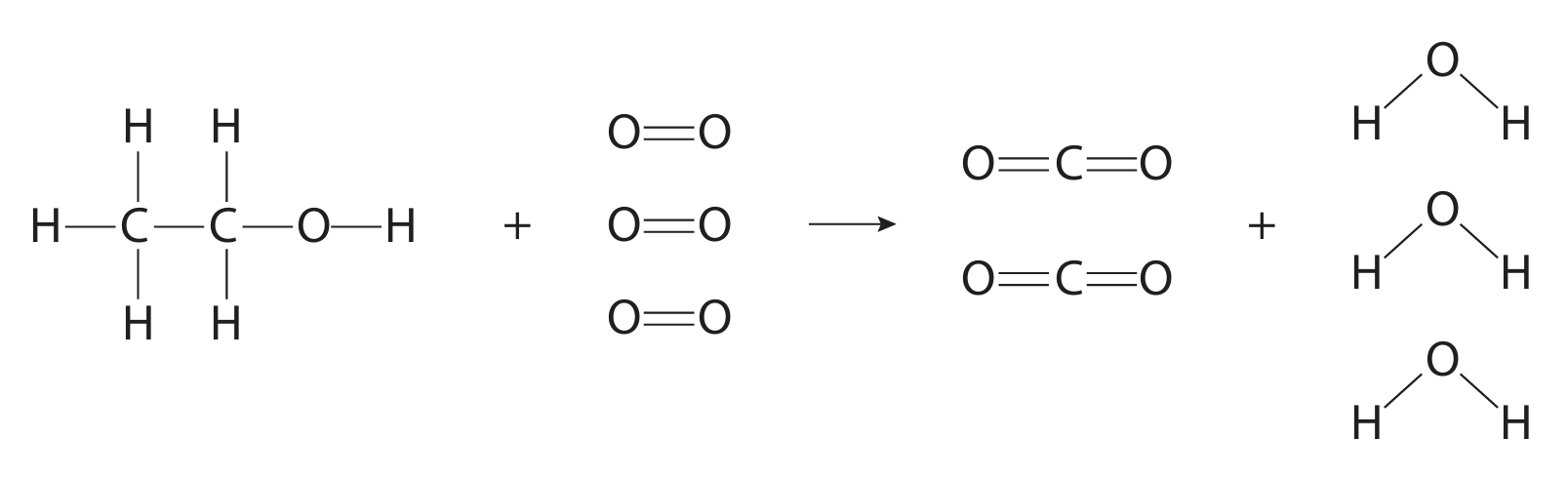
(b) This is the equation for the combustion of ethanol.
\[C_2H_5OH + 3O_2 \rightarrow 2CO_2 + 3H_2O\]
The equation shows the displayed formulae of the reactants and products

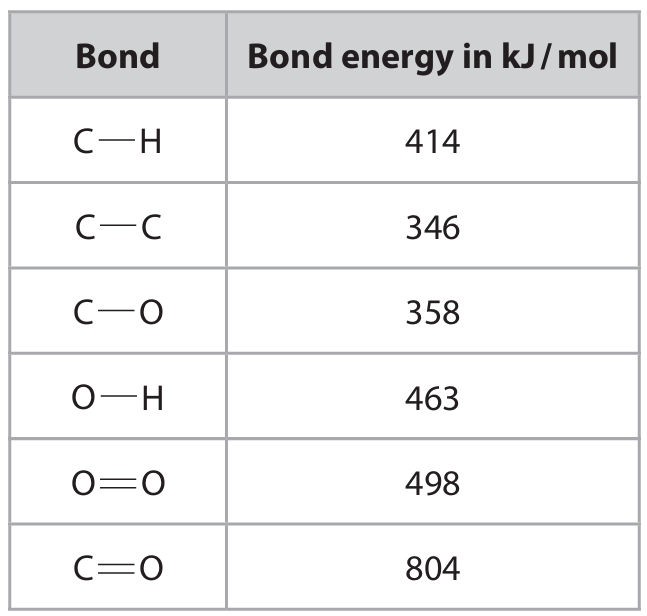
The table shows some bond energies.

(i) Use the bond energies to show that the molar enthalpy change, \(\Delta H\), is about \(-1300 \, \text{kJ/mol}\).
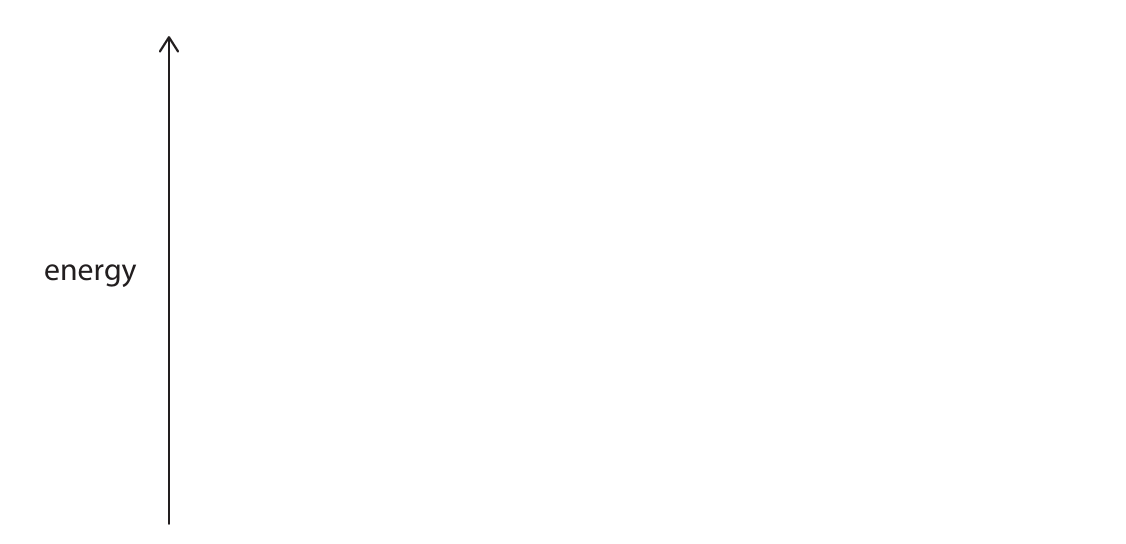
(ii) Complete the energy level diagram for the reaction between C₂H₅OH and O₂.

(iii) Explain, in terms of bonds broken and bonds made, why this reaction is exothermic.
(c) Ethanol reacts with compound A to produce ester B and compound C.
This is the equation for the reaction.

(i) Draw the displayed formula for compound A and for compound C.

(ii) Name ester B.
Most-appropriate topic codes (Edexcel IGCSE Chemistry 4CH1):
• 3(a): Energetics — Bond energy calculations, enthalpy change — part (b)
• 4(g): Esters — Formation and naming — part (c)
▶️ Answer/Explanation
(a)(i) yeast
(a)(ii) C 30°C
A is not the correct answer because 0°C is too low for fermentation
B is not the correct answer because 10°C is too low for fermentation
D is not the correct answer because 100°C is too high for fermentation
(a)(iii) An explanation using either of the following linked pairs:
Option 1:
M1: Oxygen (in the air) would react with ethanol/alcohol.
ALLOW ethanol would be oxidised.
M2: To form ethanoic acid.
ALLOW to form carboxylic acid / to form vinegar/acetic acid.
OR
Option 2:
M1: (In the presence of air) the glucose would react with the oxygen.
ALLOW correct reference to aerobic respiration.
M2: So ethanol does not form.
ALLOW forms CO₂ and H₂O.
(b)(i)
M1: \(346 + (5 \times 414) + 358 + 463 + (3 \times 498)\) OR \(4731\) (kJ/mol) [Bonds broken: 1×C-C, 5×C-H, 1×C-O, 1×O-H, 3×O=O]
M2: \((4 \times 804) + (6 \times 463)\) OR \(5994\) (kJ/mol) [Bonds made: 4×C=O, 6×O-H]
M3: \(\Delta H = 4731 – 5994 = -1263\) kJ/mol (≈ -1300 kJ/mol)
-1263 kJ/mol scores 3 marks. ALLOW ecf for M3.
(b)(ii)
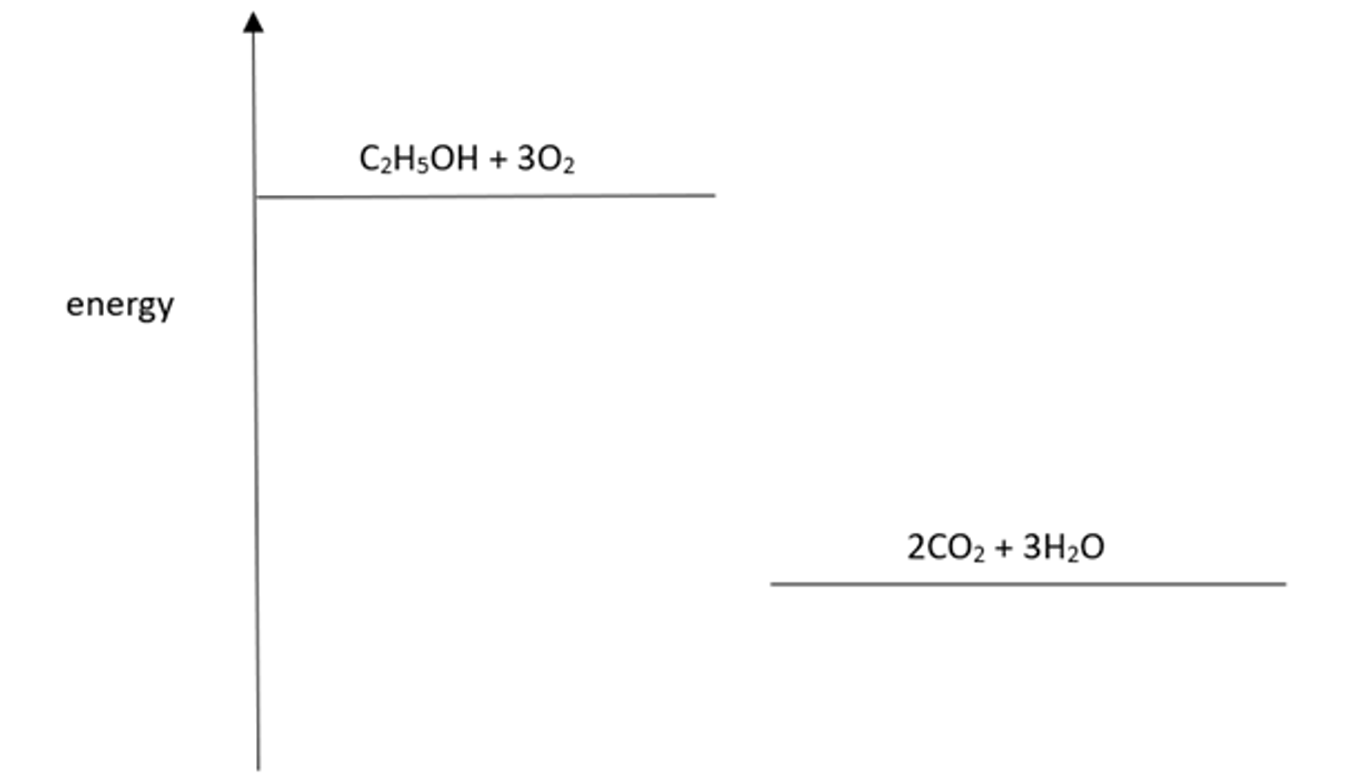
M1: Right-hand line (products) drawn below left-hand line (reactants).
M2: Correct names/balanced formulae of both reactants (C₂H₅OH + 3O₂) shown on the higher line.
M3: Correct names/balanced formulae of both products (2CO₂ + 3H₂O) shown on the lower line.
IGNORE any activation energy hump. IGNORE enthalpy change arrow.
(b)(iii) An explanation that links together the following two points:
M1: More energy is given out when the bonds are made.
M2: Than is taken in when the bonds are broken.
ACCEPT correct reverse argument.
OR
M1: Breaking bonds is endothermic/takes in energy AND making bonds is exothermic/releases energy.
M2: The energy released is more than the energy taken in.
(c)(i)
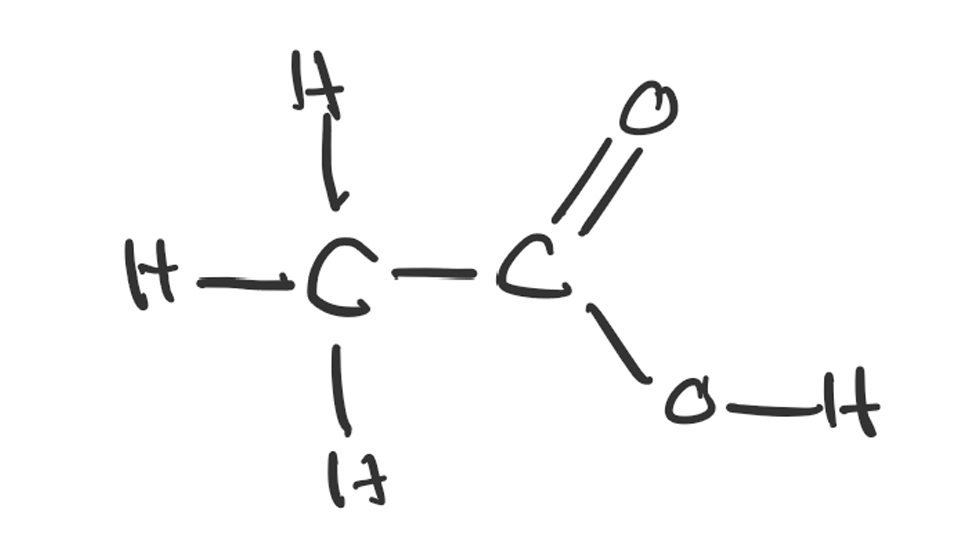
M1: Displayed formula for compound A (ethanoic acid):
M2: Displayed formula for compound C (water):
ACCEPT any reasonable shape for the molecules.
(c)(ii) ethyl ethanoate
IGNORE hyphens.