Question
The relationships of four species of bacteria, $P, Q, R$ and $S$, were compared.
- Species $P$ and $Q$ have a more recent common ancestor than either species has with species $R$.
- Species $S$ developed recently from species $P$.
Which species has the least similar base sequences in their DNA compared to the other three species of bacteria?
(A) $P$
(B) $Q$
(C) $R$
(D) $S$
(B) $Q$
(C) $R$
(D) $S$
▶️ Answer/Explanation
The degree of similarity in DNA base sequences is determined by how recently species shared a common ancestor. According to the data, $P$ and $Q$ are closely related, and $S$ is very closely related to $P$ because it branched off recently. This places $P, Q,$ and $S$ in a relatively tight evolutionary cluster. In contrast, species $R$ shared a common ancestor with the others much further back in time. Because more time has passed since $R$ diverged, more mutations have accumulated, resulting in the greatest number of differences in its DNA sequence compared to the other three. Therefore, $R$ is the most genetically distinct.
✅ Answer: (C)
✅ Answer: (C)
Question
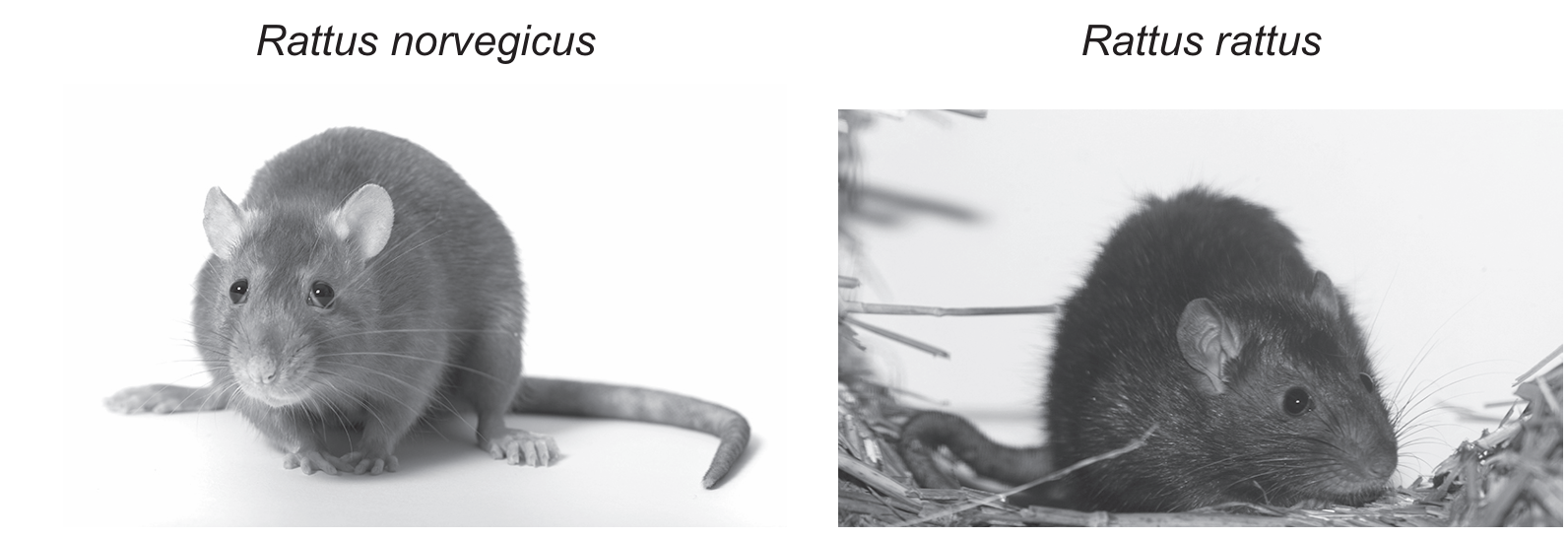
The photographs show two different rats

Which statement about the rats is correct?
(A) The rats belong to the same genus.
(B) The rats belong to the same species.
(C) The rats can breed together to produce fertile offspring.
(D) The rats do not share any of the same features.
(B) The rats belong to the same species.
(C) The rats can breed together to produce fertile offspring.
(D) The rats do not share any of the same features.
▶️ Answer/Explanation
Binomial nomenclature uses two names: the first is the genus and the second is the species. Both rats share the first name, Rattus, meaning they belong to the same genus. They have different second names (norvegicus vs. rattus), which indicates they are different species. Because they are different species, they generally cannot breed to produce fertile offspring, making option (B) and (C) incorrect. Since they are in the same genus, they naturally share many biological features, making (D) incorrect.
✅ Answer: (A)
✅ Answer: (A)
Question
What are the two parts of the scientific name of an organism?
(A) genus followed by kingdom
(B) genus followed by species
(C) kingdom followed by genus
(D) kingdom followed by species
(B) genus followed by species
(C) kingdom followed by genus
(D) kingdom followed by species
▶️ Answer/Explanation
The system used to name organisms is called binomial nomenclature, developed by Carl Linnaeus. This system uses two Latin words to uniquely identify every species. The first part of the name represents the genus, which is always capitalized, and the second part represents the species (or specific epithet), which is written in lowercase. Together, these two levels of classification provide a precise “first and last name” for an organism, ensuring scientists worldwide use the same terminology regardless of local common names. For example, in Homo sapiens, Homo is the genus and sapiens is the species.
✅ Answer: (B)
✅ Answer: (B)
