
▶️ Answer/Explanation
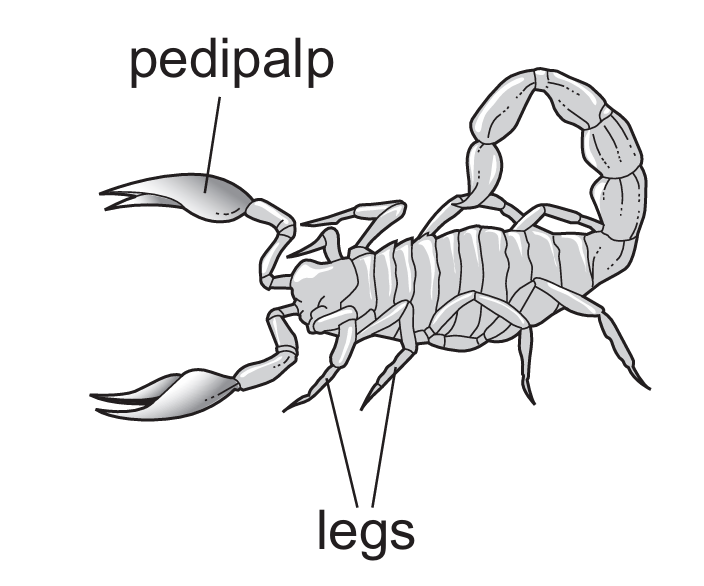
The organism shown is a scorpion, which belongs to the class Arachnida. Key identifying features include having exactly $4$ pairs of jointed walking legs (totaling $8$ legs), which distinguishes them from insects ($3$ pairs). Additionally, they possess specialized appendages called pedipalps (the pincers) and lack antennae, another hallmark of the arachnid group. Unlike crustaceans, they are primarily terrestrial and lack a heavy calcified exoskeleton with numerous pairs of legs. Their body is typically divided into two main segments: the cephalothorax and the abdomen.
✅ Answer: (A)
✅ Answer: (A)
▶️ Answer/Explanation
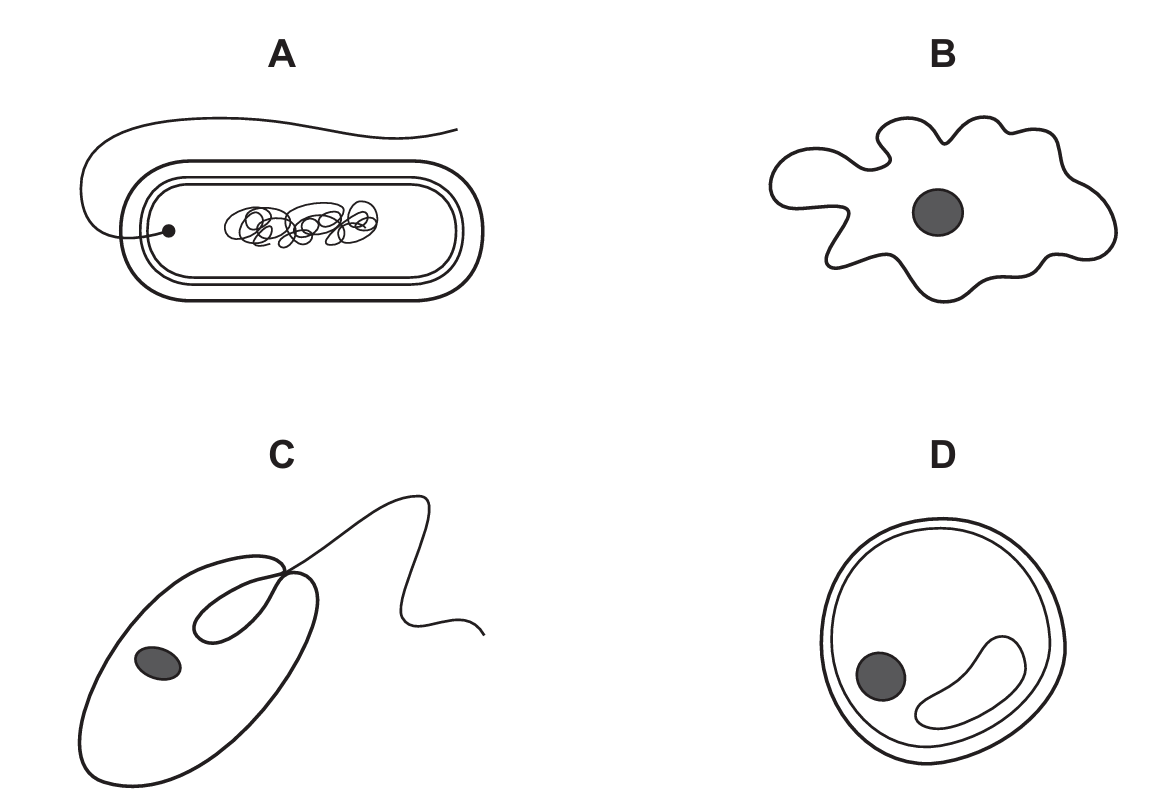
Organism A represents a bacterium, which is a classic example of a prokaryote. Unlike eukaryotes, prokaryotes lack a membrane-bound nucleus; instead, their genetic material consists of a circular DNA loop found in a region called the nucleoid, visible as the tangled mass in the center.
In contrast, organisms B, C, and D all contain a distinct, shaded circular structure representing a nucleus. These organisms (likely an amoeba, a flagellated protist, and a yeast or plant cell) are eukaryotes because they sequester their DNA within that nuclear envelope. Organism A also features a flagellum and a cell wall, typical of many bacterial species.
✅ Answer: (A)