Home / iGCSE Biology (0610)-11.1 Gas exchange in humans – iGCSE Style Questions Paper 2

iGCSE Biology (0610)-11.1 Gas exchange in humans – iGCSE Style Questions Paper 2

Question

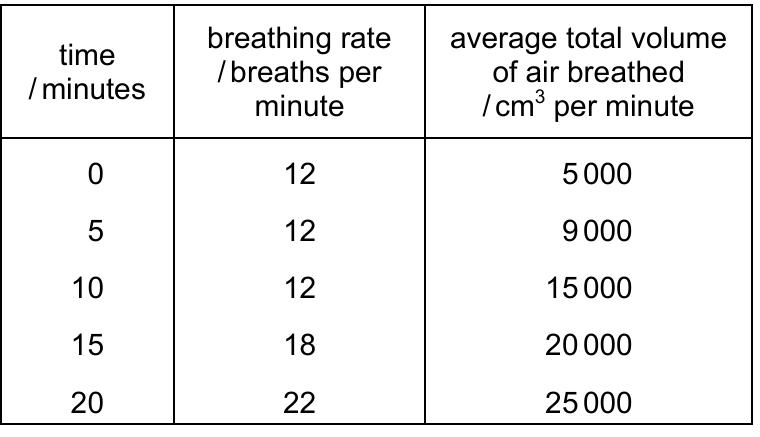
The table shows the breathing rate and the average total volume of air breathed by a student when exercising for $20$ minutes.

Which conclusion can be made from the data in the table about the effect of exercise on breathing?

(A) Between $0$ minutes and $10$ minutes, there is no change to the depth of breathing.
(B) Between $0$ minutes and $10$ minutes, the depth of breathing increases.
(C) Between $10$ minutes and $20$ minutes, there is no change to the rate of breathing.
(D) Between $15$ minutes and $20$ minutes, the depth of breathing decreases.
▶️ Answer/Explanation
To determine the “depth” of breathing (tidal volume), we divide the total volume of air per minute by the breathing rate. Between $0$ and $10$ minutes, the breathing rate remains constant at $12$ breaths/min, but the total volume of air increases from $5000$ to $15000$ $\text{cm}^3$/min. Since more air is being moved in the same number of breaths, each individual breath must be larger. This confirms that the depth of breathing is increasing during this interval. Conversely, option C is incorrect because the rate increases from $12$ to $22$, and option D is incorrect as the total volume continues to rise faster than the rate.
Answer: (B)

Question

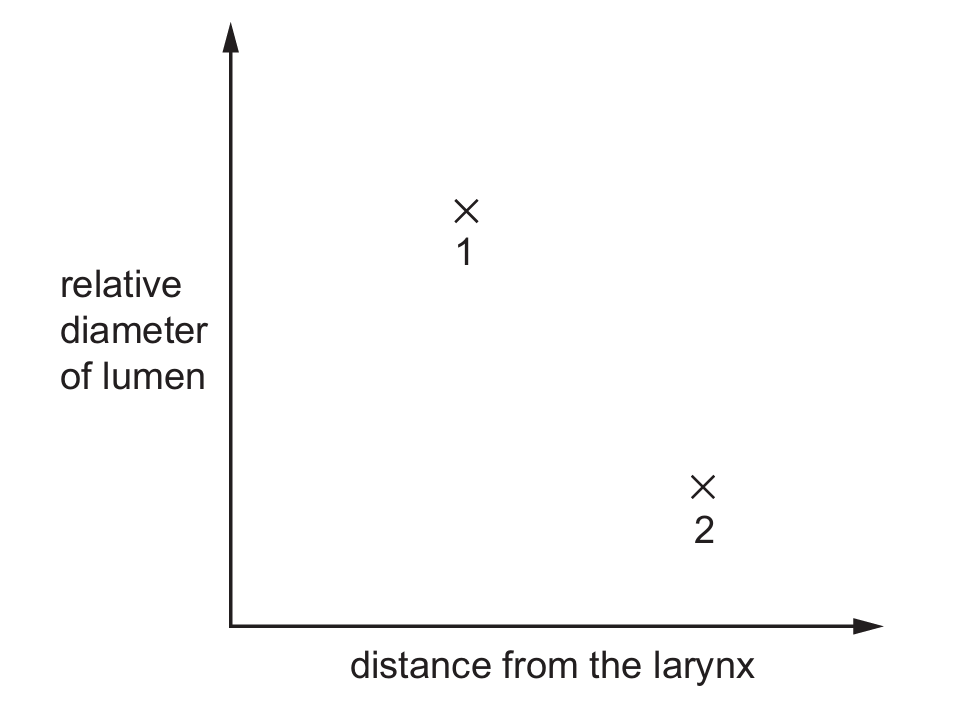
The plotted points, $1$ and $2$, on the graph show two different types of structure in the breathing system of a human.

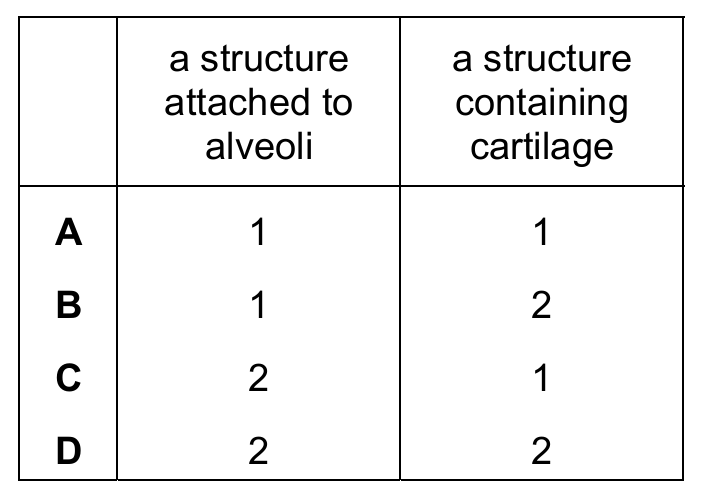
Which row identifies a structure attached to alveoli and a structure containing cartilage?

▶️ Answer/Explanation
To solve this, we must analyze the graph axes: the x-axis represents distance from the larynx and the y-axis represents relative diameter. Structure $1$ is close to the larynx and has a large diameter, which describes the trachea or main bronchi; these structures contain cartilage to keep the airway open. Structure $2$ is far from the larynx and has a much smaller diameter, representing bronchioles. Bronchioles are the structures directly attached to the alveoli but lack cartilage. Therefore, $2$ fits the first column and $1$ fits the second column.
Answer: (C)

Question

What helps to keep the trachea open during breathing?

(A) cartilage
(B) cilia
(C) external intercostal muscles
(D) larynx
▶️ Answer/Explanation

The trachea, or windpipe, is supported by a series of $C$-shaped rings made of cartilage. This stiff yet flexible tissue provides structural support that prevents the airway from collapsing under the negative pressure created during inhalation. While the other options are part of the respiratory system, they serve different functions:

  • Cilia are microscopic hairs that sweep mucus and debris out of the airways.
  • External intercostal muscles assist in expanding the ribcage during breathing.
  • The larynx is the voice box located at the top of the trachea.

Therefore, cartilage is specifically responsible for maintaining the patency of the tracheal tube.

Answer: (A)

Scroll to Top