
▶️ Answer/Explanation
(a)
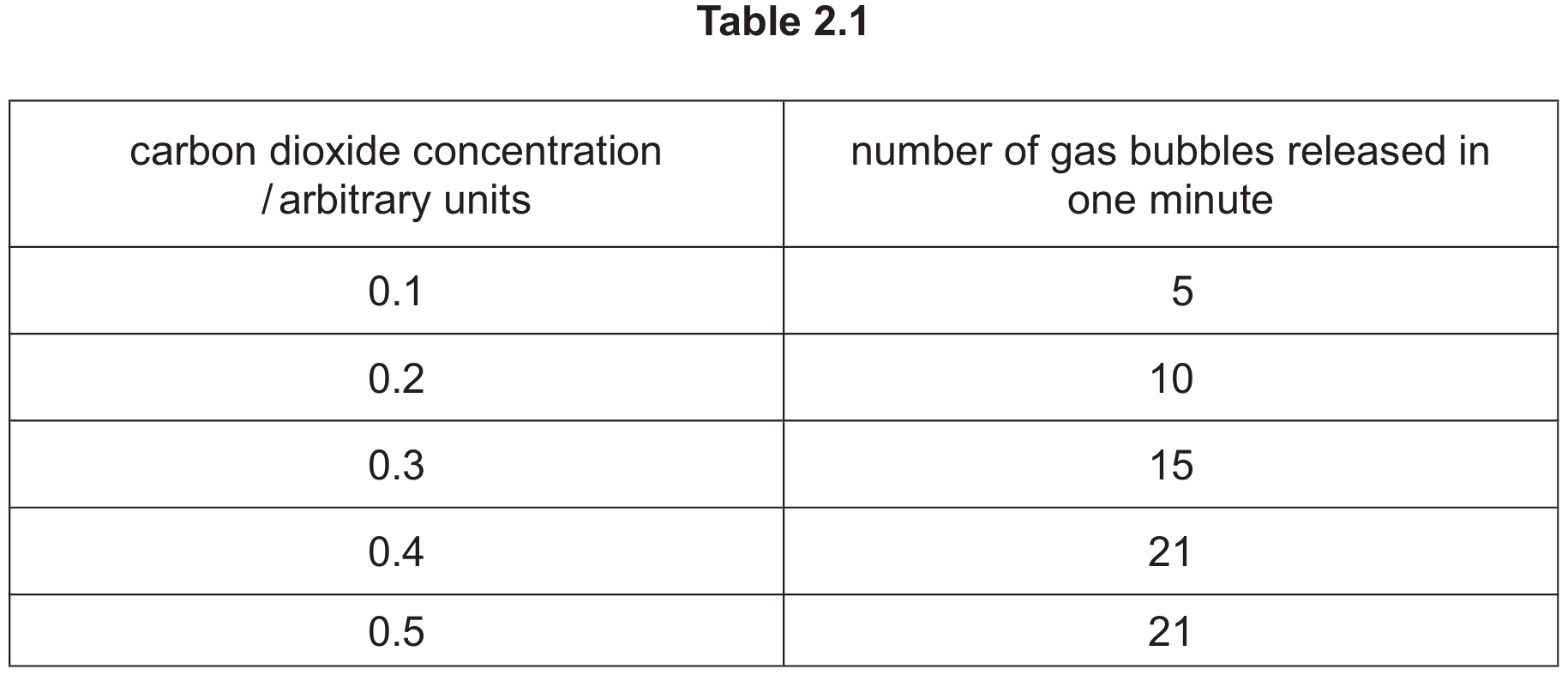
As the carbon dioxide concentration increases, the number of gas bubbles released in one minute increases and then remains the same.
This is because carbon dioxide is a raw material required for photosynthesis.
The number of gas bubbles released remains the same between the carbon dioxide concentrations of \(0.4\) and \(0.5\) arbitrary units.
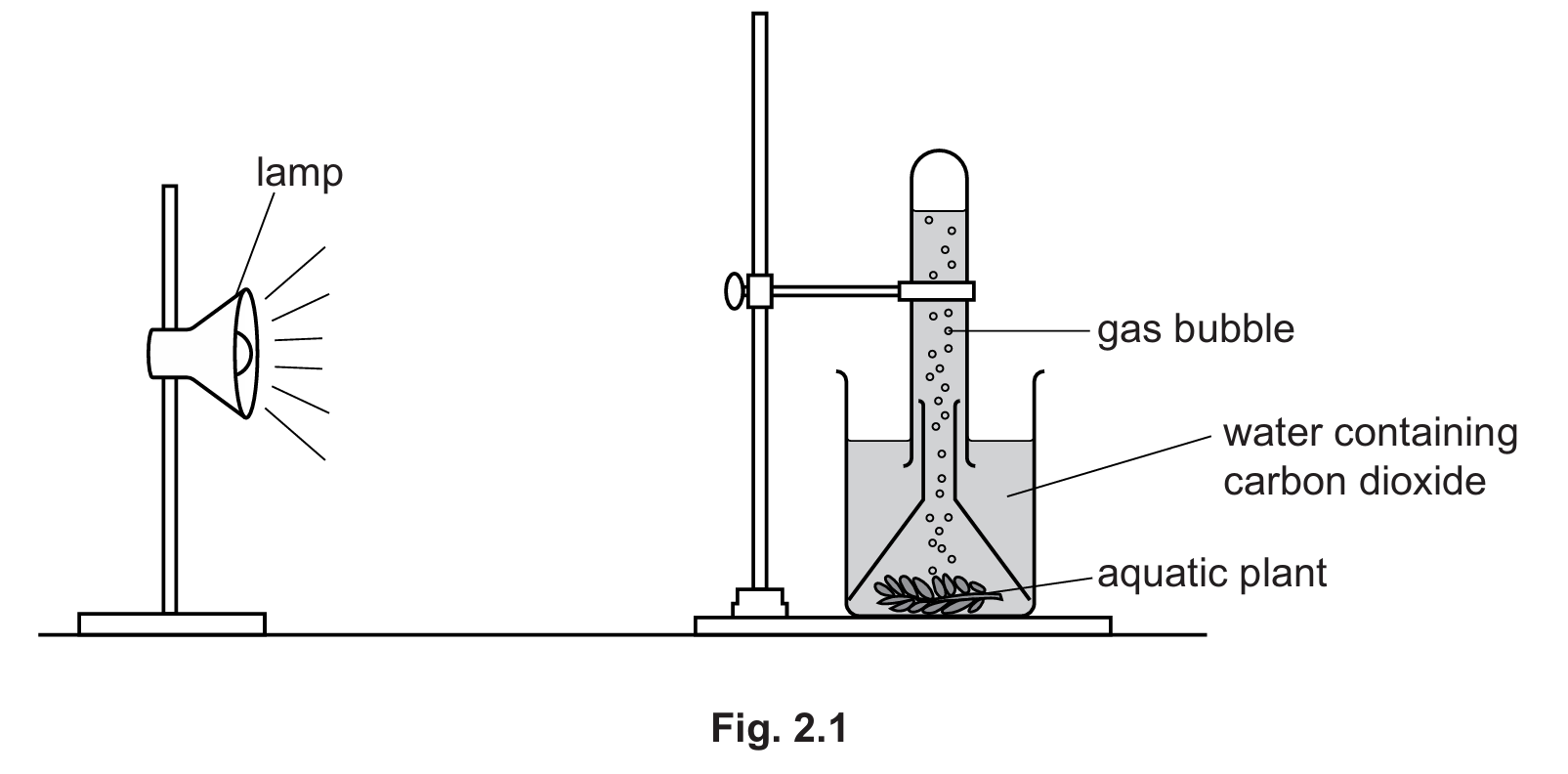
Photosynthesis produces oxygen gas which is released as bubbles.
The distance between the lamp and the aquatic plant is kept constant during the investigation so that the light intensity remains the same.
Explanation:
The experiment measures the rate of photosynthesis by counting oxygen bubbles. Initially, as the concentration of the reactant ($CO_2$) rises from \(0.1\) to \(0.4\), the rate of reaction rises, showing that \(CO_2\) was the limiting factor. However, between \(0.4\) and \(0.5\), the rate stays constant at \(21\) bubbles per minute. This indicates that \(CO_2\) is no longer the limiting factor; another factor (such as light intensity or temperature) has become limiting, preventing the rate from increasing further.
(b)
The green pigment is chlorophyll, which is located in the chloroplasts. Its primary importance is that it absorbs light energy (from the sun). It then transfers this energy into chemical energy to synthesize carbohydrates (specifically glucose) from carbon dioxide and water.
(c)
Respiration (specifically aerobic respiration).
Explanation:
While photosynthesis consumes carbon dioxide to produce oxygen, respiration is the metabolic process occurring in all living cells (including plants) that breaks down glucose using oxygen to produce energy, releasing carbon dioxide as a waste product.