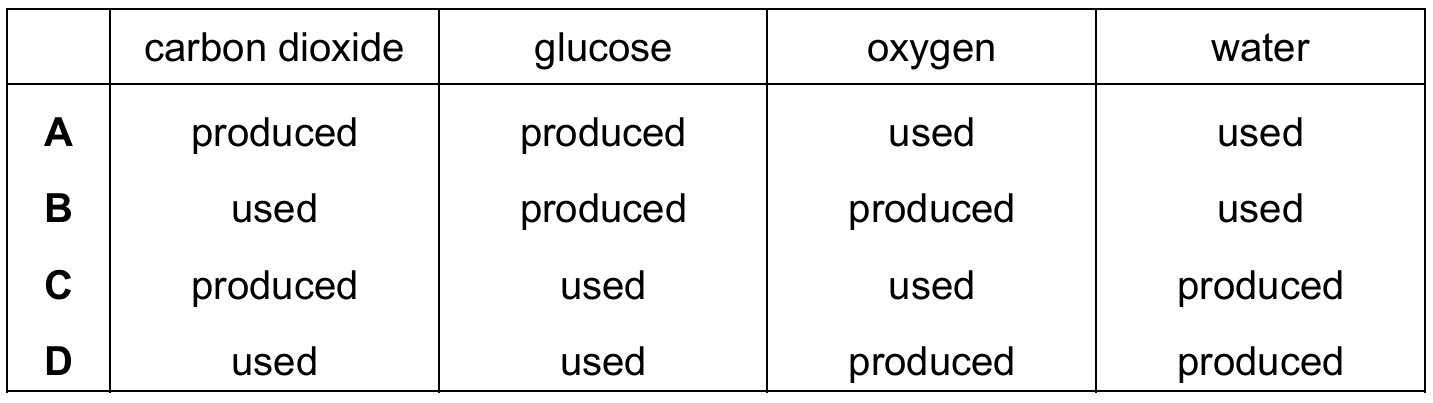
Question
Which row shows the substances used and produced in aerobic respiration?

▶️ Answer/Explanation
✅ Answer: (C)
Question
Which structure is the site of aerobic respiration in plant cells?
(B) mitochondrion
(C) nucleus
(D) ribosome
▶️ Answer/Explanation
Aerobic respiration is the process by which cells break down glucose in the presence of oxygen to produce energy in the form of $ATP$. In eukaryotic cells, including plant cells, the majority of this process occurs within the mitochondrion. While plants have chloroplasts for photosynthesis, they still require mitochondria to convert stored energy into a usable form for cellular activities. Other organelles like the nucleus (genetic control) and ribosomes (protein synthesis) serve entirely different functions. Therefore, the mitochondrion is known as the “powerhouse” of the cell for its role in respiration.
✅ Answer: (B)
Question
B It controls the amount of light entering the pupil.
C It focuses the light onto the retina.
D It refracts light entering the eye.
▶️ Answer/Explanation
The correct answer is B.
Explanation:
The iris is a muscular diaphragm that regulates light intensity by adjusting the pupil size. In bright light, circular muscles contract to constrict the pupil, protecting the retina from overexposure. In dim light, radial muscles contract to dilate the pupil, allowing more light to enter. Other options are incorrect because the optic nerve (A) carries impulses, while the cornea and lens (C and D) are responsible for refracting and focusing light.
