
▶️ Answer/Explanation
Detailed solution
(a) (i)
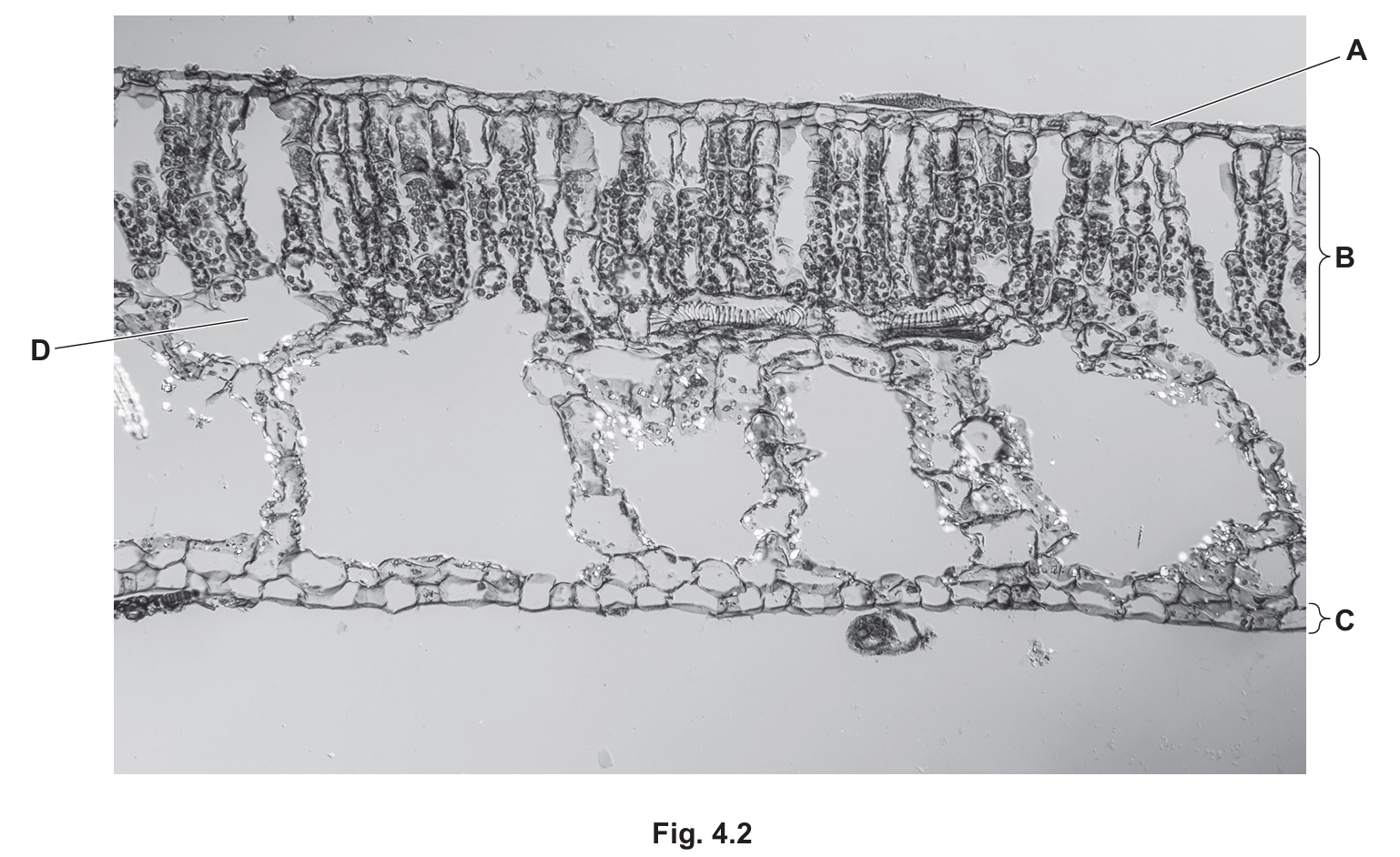
B: Palisade mesophyll
C: (Lower) epidermis
(a) (ii)
The area labelled D refers to the large air spaces (aerenchyma). Its functions include:
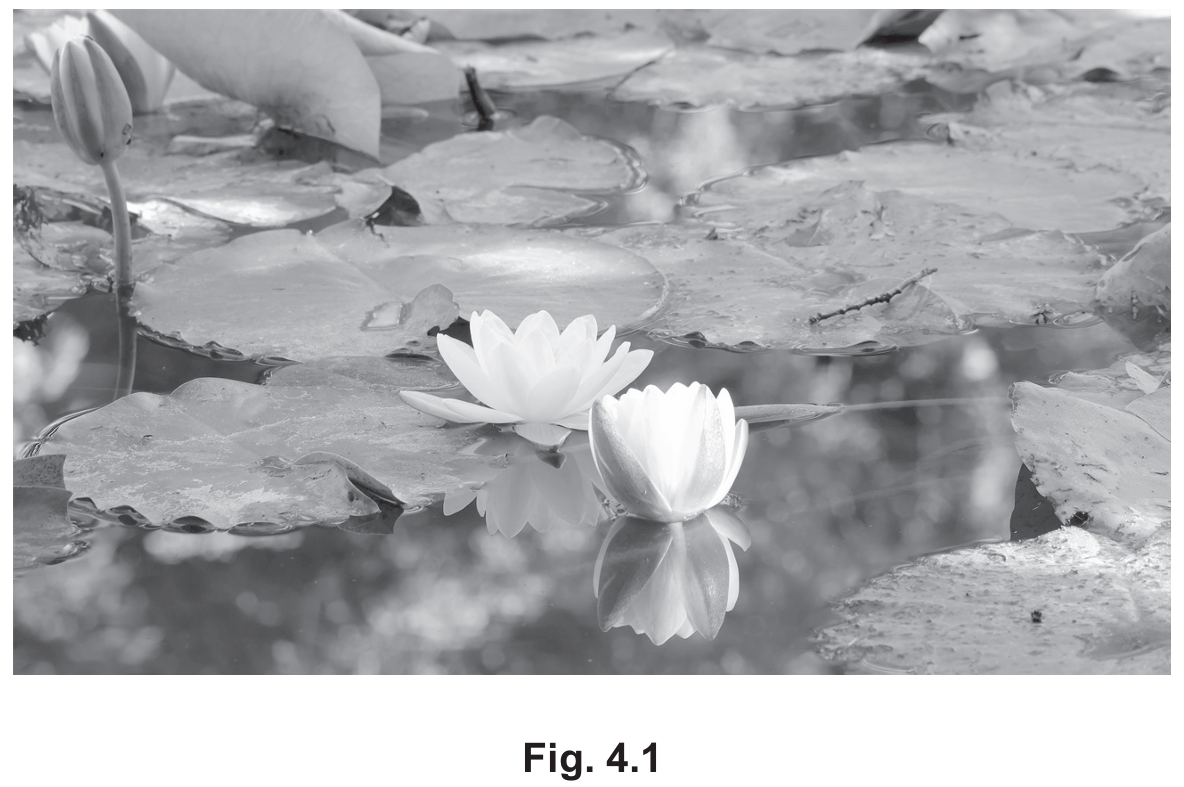
- Providing buoyancy to allow the leaf to float on the water surface to catch more light.
- Facilitating the diffusion of gases (oxygen and carbon dioxide) for photosynthesis and respiration.
(a) (iii)
The green pigment is chlorophyll. Its function is to trap light energy and transfer it into chemical energy for the synthesis of carbohydrates (photosynthesis).
(a) (iv)
Water lilies live in an aquatic environment where water availability is not a limiting factor. Therefore:
- They do not need a thick cuticle to prevent water loss.
- A thinner cuticle allows more light to penetrate to the photosynthetic palisade layer.
- It reduces the resources needed to produce the cuticle.
(b) (i)
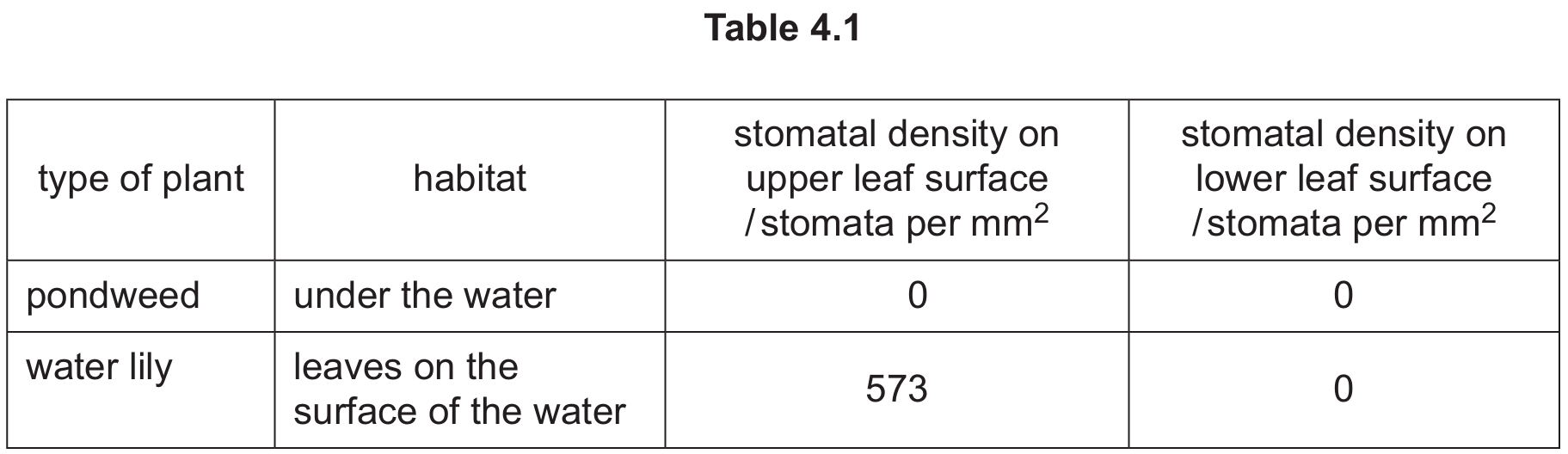
\( 57\,300 \) stomata per \( \text{cm}^2 \).
Calculation: \( 1 \text{ cm}^2 = 100 \text{ mm}^2 \). Therefore, \( 573 \times 100 = 57\,300 \).
(b) (ii)
- Pondweed (submerged): Has 0 stomata because it exchanges gases directly with the water across the leaf surface. Stomata would be ineffective under water.
- Water lily (floating): Has stomata only on the upper surface (573) to exchange gases with the air. The lower surface is in contact with water, where stomata would be blocked or flooded.
(c) (i)
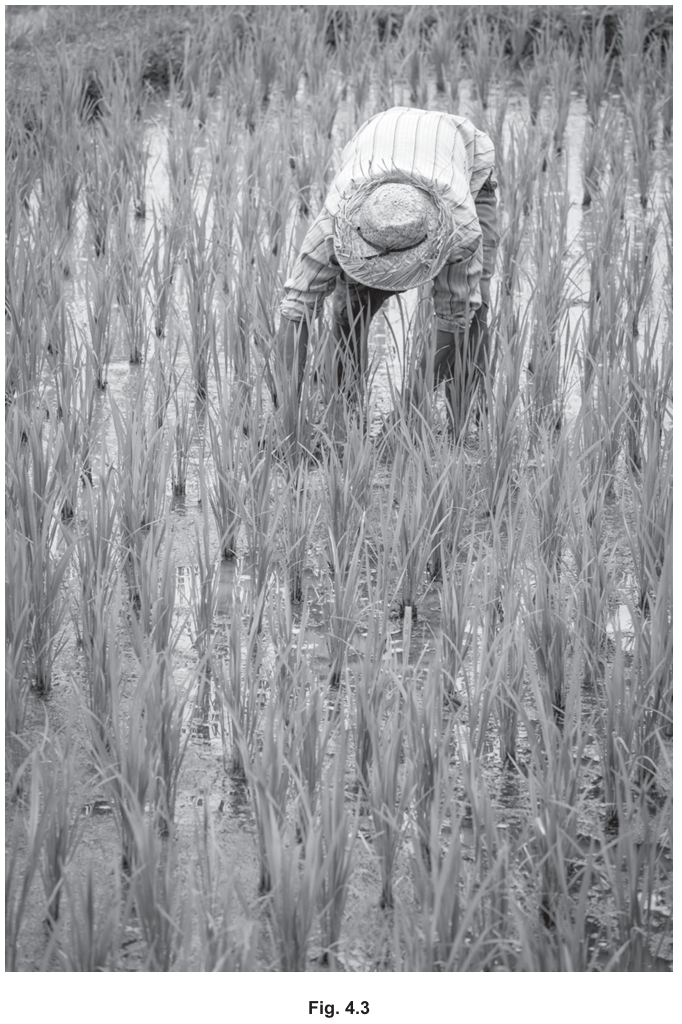
Characteristics visible include:
- Parallel veins in the leaves.
- Thin, strap-shaped leaves.
(c) (ii)
This question links respiration, active transport, and protein synthesis:
- Low oxygen limits aerobic respiration, reducing the energy (ATP) released.
- Active transport of mineral ions (like nitrates) by root hair cells requires this energy, so uptake is reduced.
- Nitrates are essential for making amino acids.
- Fewer amino acids mean the plant can synthesize fewer proteins, limiting growth.
- Additionally, anaerobic conditions promote denitrifying bacteria, which reduce soil nitrate levels further.