
Question
A mixture of glucose, yeast and water was placed in a test-tube. A balloon was attached to the open end of the test-tube. The apparatus was kept at 30 °C for one hour.
The diagram shows the apparatus at the start and after one hour, with the balloon inflated.
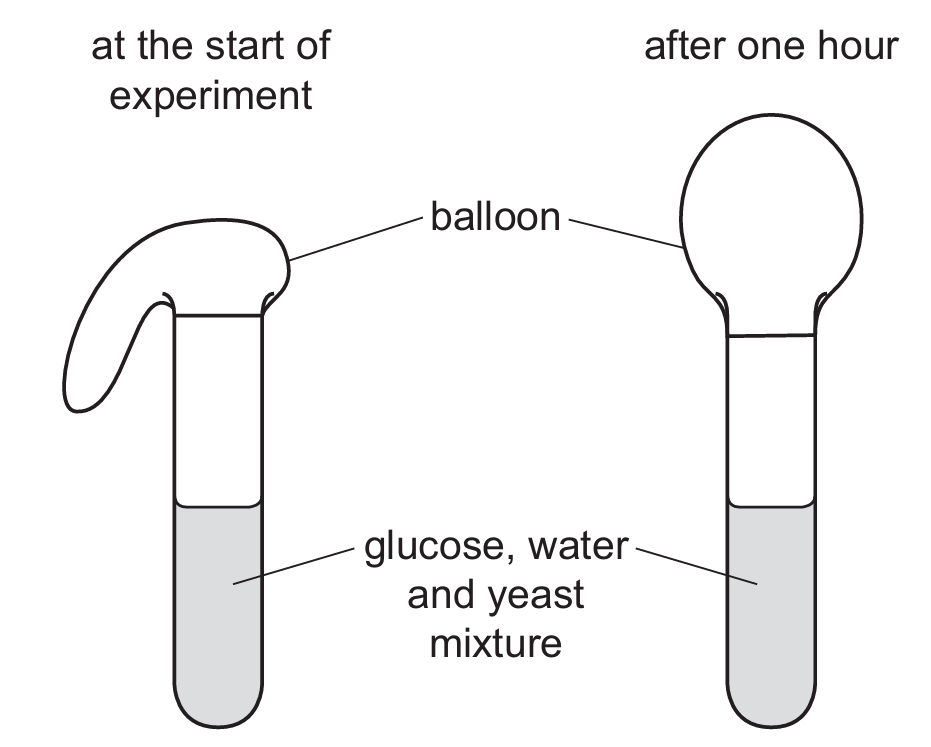
Which word equation can be used to explain what happened to the balloon after one hour?
(B) glucose → alcohol + carbon dioxide
(C) glucose → carbon dioxide + water
(D) glucose → lactic acid
▶️ Answer/Explanation
The inflation of the balloon indicates the production of a gas. In the presence of yeast (a fungus) and at the warm temperature of 30 °C, glucose undergoes anaerobic respiration, or fermentation. The products of this process are ethanol (alcohol) and carbon dioxide gas. The gas fills the balloon, causing it to inflate.
✅ Correct Equation: glucose → alcohol + carbon dioxide
✅ Answer: (B)
Question
Which substance is a product of anaerobic respiration in human muscles?
(B) carbon dioxide
(C) glucose
(D) lactic acid
▶️ Answer/Explanation
Anaerobic respiration occurs in human muscles during vigorous exercise when the oxygen supply is insufficient to meet energy demands. Unlike aerobic respiration, which breaks down glucose fully into carbon dioxide and water, anaerobic respiration in animals involves the partial breakdown of glucose into lactic acid. This process releases a small amount of energy quickly. In contrast, alcohol and carbon dioxide are products of anaerobic respiration in yeast (fermentation), and glucose is the reactant, not the product. Therefore, lactic acid is the only correct metabolic byproduct for human muscle cells in this context.
✅ Answer: (D)
Question
▶️ Answer/Explanation
The correct answer is D.
A reflex arc follows a specific unidirectional path to ensure a rapid response. It begins when a receptor detects a stimulus and sends an impulse through a sensory neurone to the central nervous system. In the spinal cord, a relay neurone passes the signal to a motor neurone. This neurone carries the impulse to the effector (muscle or gland), which performs the final action. Options A and B are incorrect as they start at the end-point, while C reverses the functional order of the neurones.