

▶️ Answer/Explanation
In the human excretory system, the ureter is the muscular tube that transports urine from the kidney to the urinary bladder. Label D points specifically to one of these long tubes. Labels A and B represent the renal blood vessels (renal artery and renal vein) which supply and drain the kidneys. Label C points to the urethra, which is the final tube that carries urine out of the body from the bladder. Therefore, the tube connecting the kidney to the lower reservoir is the ureter.
✅ Answer: (D)
✅ Answer: (D)
▶️ Answer/Explanation
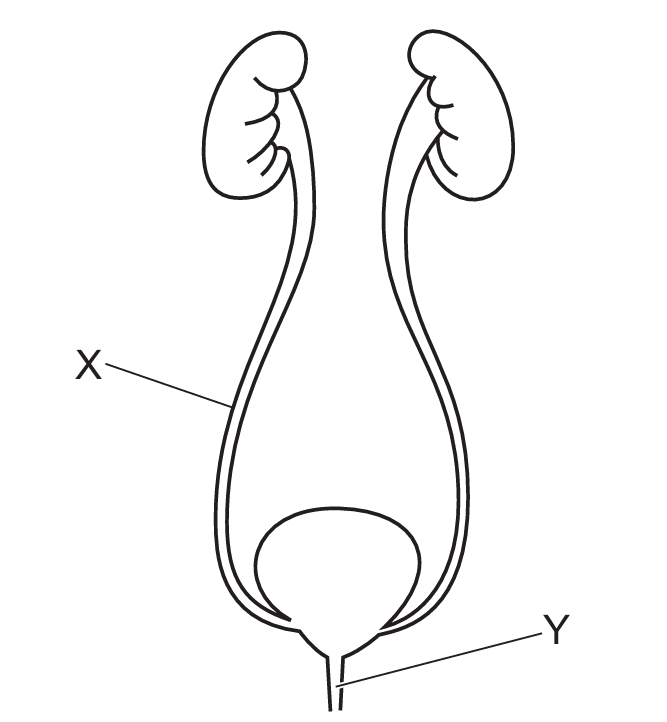
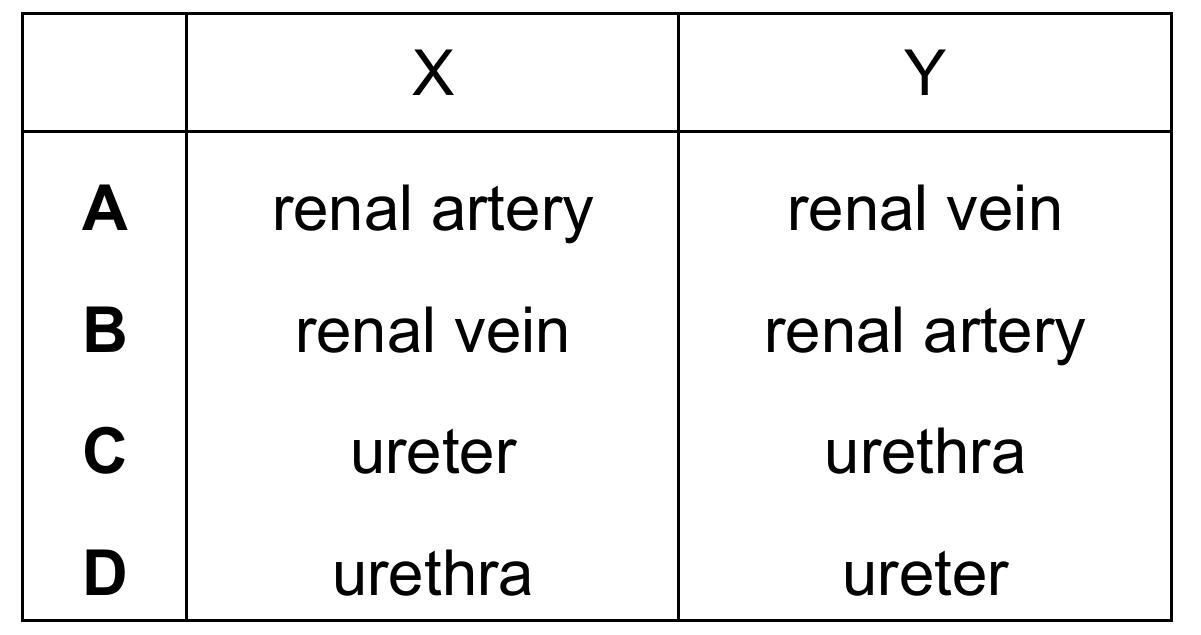
The diagram illustrates the human urinary (excretory) system. Structure $X$ represents the ureter, which is the muscular tube that transports urine from the kidney to the urinary bladder. Structure $Y$ represents the urethra, the tube through which urine is discharged from the bladder to the outside of the body. Options A and B refer to blood vessels, while Option D reverses the order of the tubes. Therefore, the correct sequence identifying the exit path of waste is ureter then urethra.
✅ Answer: (C)
✅ Answer: (C)