Question
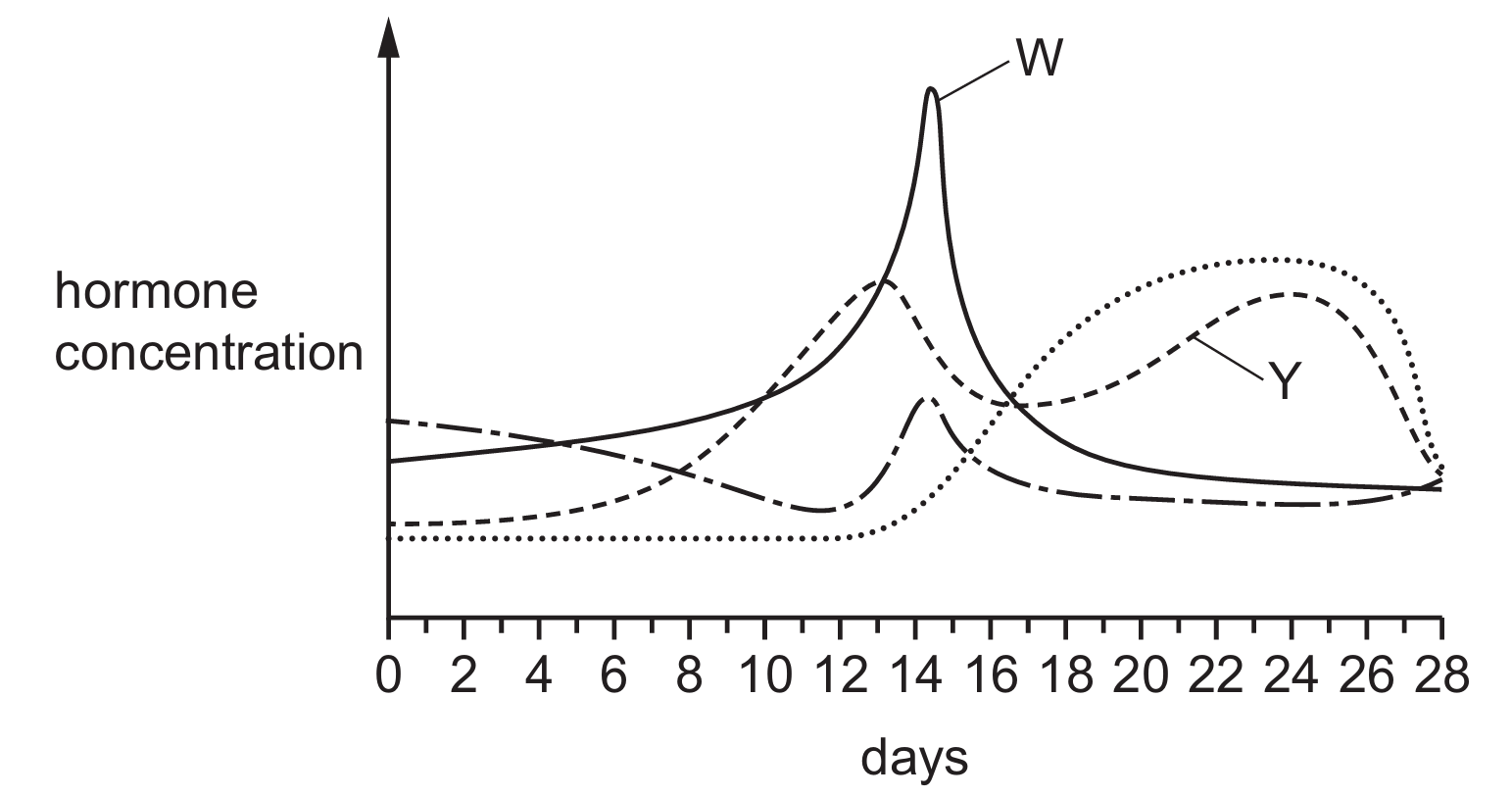
The diagram shows the changing concentrations of some hormones involved in the menstrual cycle.

Which letters identify two of the hormones?
(A) $W$ is FSH and $Y$ is oestrogen.
(B) $W$ is LH and $Y$ is oestrogen.
(C) $W$ is progesterone and $Y$ is FSH.
(D) $W$ is progesterone and $Y$ is LH.
(B) $W$ is LH and $Y$ is oestrogen.
(C) $W$ is progesterone and $Y$ is FSH.
(D) $W$ is progesterone and $Y$ is LH.
▶️ Answer/Explanation
To identify the hormones, we look at their peak times during the $28$-day cycle. Hormone $W$ shows a massive, sharp surge just before day $14$, which is characteristic of Luteinising Hormone (LH) triggering ovulation. Hormone $Y$ (dashed line) rises during the first half of the cycle, peaks before ovulation, and has a secondary rise later; this identifies it as oestrogen. In contrast, the dotted line represents progesterone, which only peaks significantly during the luteal phase (days $15$–$28$). Therefore, the combination in option B correctly identifies the labeled curves.
✅ Answer: (B)
✅ Answer: (B)
Question
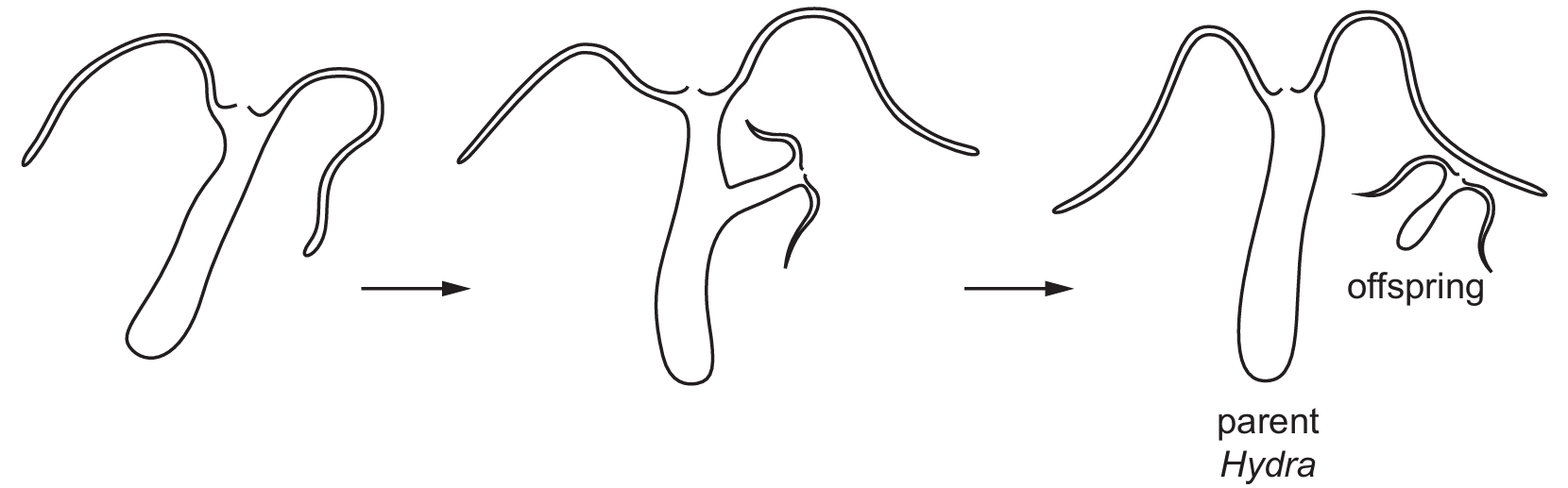
The diagram shows one parent Hydra growing and releasing an offspring from the side of its body.

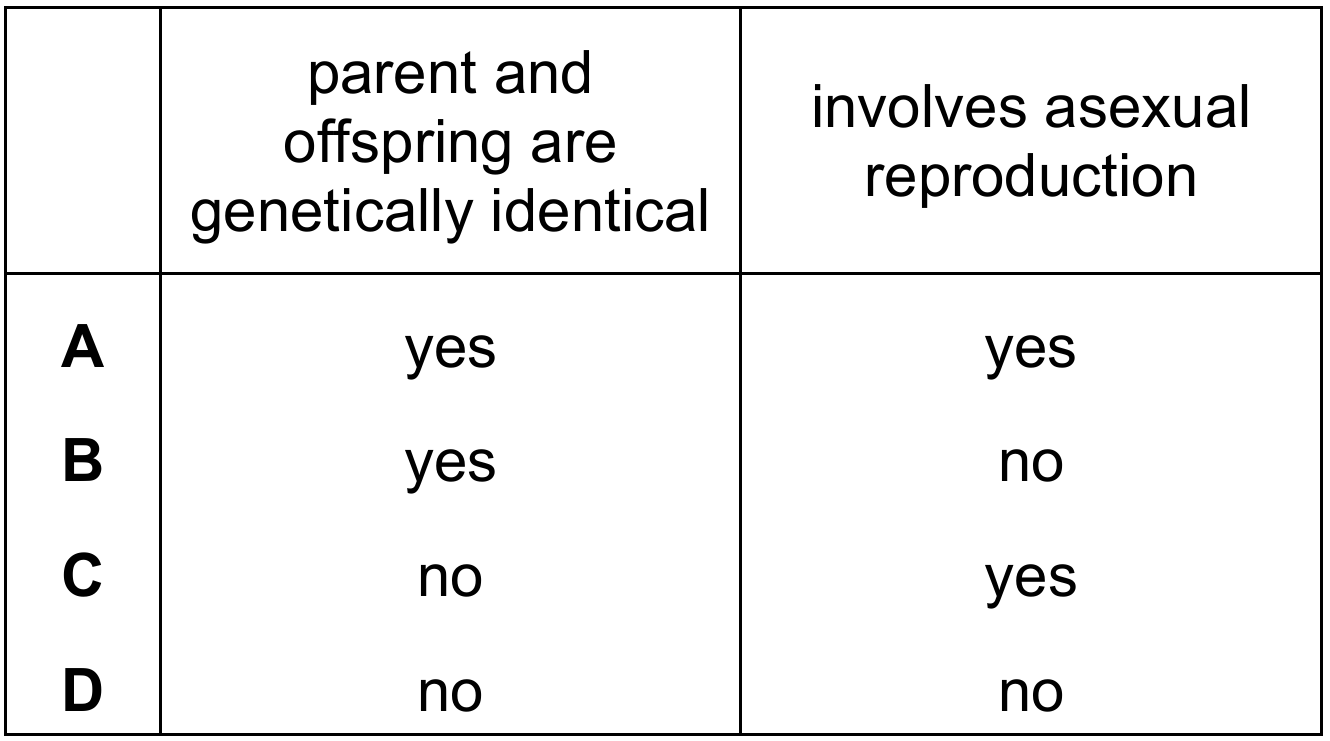
Which row is correct?

▶️ Answer/Explanation
The process shown in the diagram is budding, a form of asexual reproduction where a new organism develops from an outgrowth or bud due to cell division at one particular site. Since only one parent is involved and the process relies on mitosis, the offspring is a biological clone. This means the genetic material is copied exactly, making the parent and offspring genetically identical. Because it does not involve the fusion of gametes, it is classified as asexual reproduction. Therefore, both columns in the table should be marked “yes”.
✅ Answer: (A)
✅ Answer: (A)
Question
What can antibiotics treat?
(A) all diseases caused by pathogens
(B) cholera
(C) HIV (human immunodeficiency virus)
(D) rickets
(B) cholera
(C) HIV (human immunodeficiency virus)
(D) rickets
▶️ Answer/Explanation
Antibiotics are medications specifically designed to kill or inhibit the growth of bacteria. Cholera is caused by the bacterium Vibrio cholerae, making it treatable with antibiotics. In contrast, HIV is a viral infection, and antibiotics have no effect on viruses. Rickets is a deficiency disease (usually lack of Vitamin D or calcium), not an infection. While pathogens include bacteria, viruses, and fungi, antibiotics do not treat “all” pathogens, only bacterial ones.
✅ Answer: (B)
✅ Answer: (B)