

▶️ Answer/Explanation
(a) An allele is an alternative form of a gene.
(b) Individual 1: $gg$ / homozygous recessive.
[cite_start]Explanation: The individual has the recessive phenotype (yellow pods), which is only expressed when no dominant allele is present.
Individual 2: $Gg$ / heterozygous.
Explanation: The individual has the dominant phenotype (green) but produced offspring with the recessive phenotype (yellow). This means they must possess one dominant allele ($G$) and one recessive allele ($g$) to pass on to the yellow offspring.
(c) Punnett Square:
Gametes: $G$ and $g$ for both parents.
Offspring Genotypes: $GG$, $Gg$, $Gg$, $gg$.
Phenotypic ratio: 3 green pods : 1 yellow pod.
Part (a): Defining Alleles
Genes determine specific traits (like pod colour), but these genes can exist in different versions. These versions are called alleles. For example, the gene for pod colour has a “green” version (allele) and a “yellow” version (allele).
Part (b): Interpreting the Pedigree
Pedigree diagrams show how traits are passed down through generations.
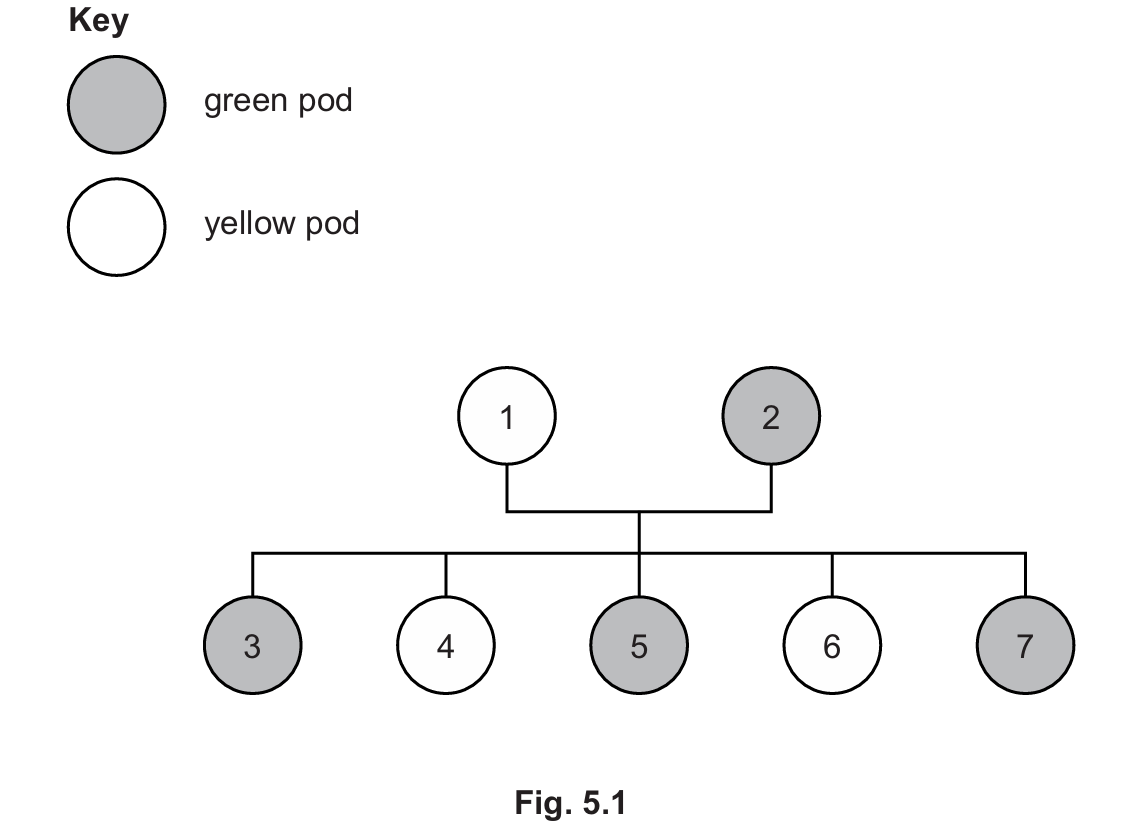
- Individual 1 (Yellow): The key indicates yellow is the recessive trait ($g$). A recessive trait is only expressed in the phenotype if the genotype is homozygous recessive ($gg$). Therefore, Individual 1 must be $gg$.
- Individual 2 (Green): This individual is green, so they must have at least one dominant allele ($G$). However, they are the parent of individuals 4 and 6, who are yellow ($gg$). For a child to be $gg$, they must inherit one $g$ from the mother and one $g$ from the father. [cite_start]Since Individual 2 passed a $g$ to the offspring, their genotype must be heterozygous ($Gg$).
Part (c): Monohybrid Cross
We are crossing two heterozygous plants ($Gg \times Gg$).We use a Punnett square to predict the offspring.
| $G$ | $g$ | |
| $G$ | $GG$ (Green) | $Gg$ (Green) |
| $g$ | $Gg$ (Green) | $gg$ (Yellow) |
There are 3 outcomes that result in a green phenotype ($GG, Gg, Gg$) and 1 outcome that results in a yellow phenotype ($gg$).
Ratio: 3 : 1.