
Question
An individual who is homozygous dominant for a characteristic has the genotype TT. Another individual is heterozygous for this characteristic.
What is the correct percentage of genotypes for the offspring resulting from a genetic cross between these two individuals?
(B) 50% TT, 50% tt
(C) 50% TT, 50% Tt
(D) 25% TT, 50% Tt, 25% tt
▶️ Answer/Explanation
Answer: (C) 50% TT, 50% Tt
Parent 1 is homozygous dominant (TT), and parent 2 is heterozygous (Tt). The cross can be set up as:
Parent 1 gametes: T, T
Parent 2 gametes: T, t
Using a Punnett square: \[ \begin{array}{c|c c} & T & t \\ \hline T & TT & Tt \\ T & TT & Tt \\ \end{array} \] The offspring genotypes are: 2 TT and 2 Tt. This gives a 50% chance of TT and 50% chance of Tt. No tt genotype appears because one parent provides only the dominant allele (T).
Question
In a species of mammal, the allele for short hair, \(H\), is dominant and the allele for long hair, \(h\), is recessive. A heterozygous individual breeds with a long-haired individual. What is the expected ratio of the phenotypes in the offspring?
(B) 75% short-haired, 25% long-haired
(C) 50% short-haired, 50% long-haired
(D) 25% short-haired, 75% long-haired
▶️ Answer/Explanation
✅ Answer: (C)
Question
The diagram shows part of a genetic diagram for the inheritance of sex in humans.
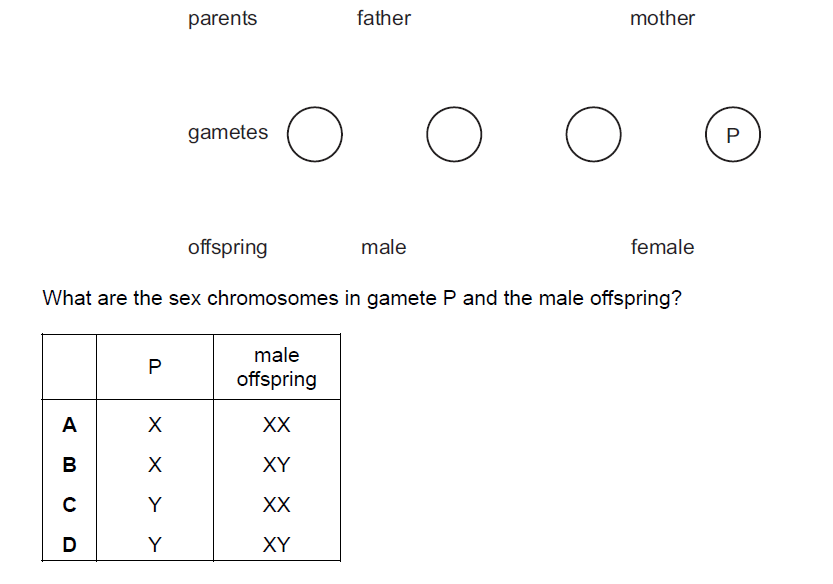
Answer/Explanation
Ans: B