Home / iGCSE Biology (0610)-18.1 Variation – iGCSE Style Questions Paper 1

iGCSE Biology (0610)-18.1 Variation – iGCSE Style Questions Paper 1

Question

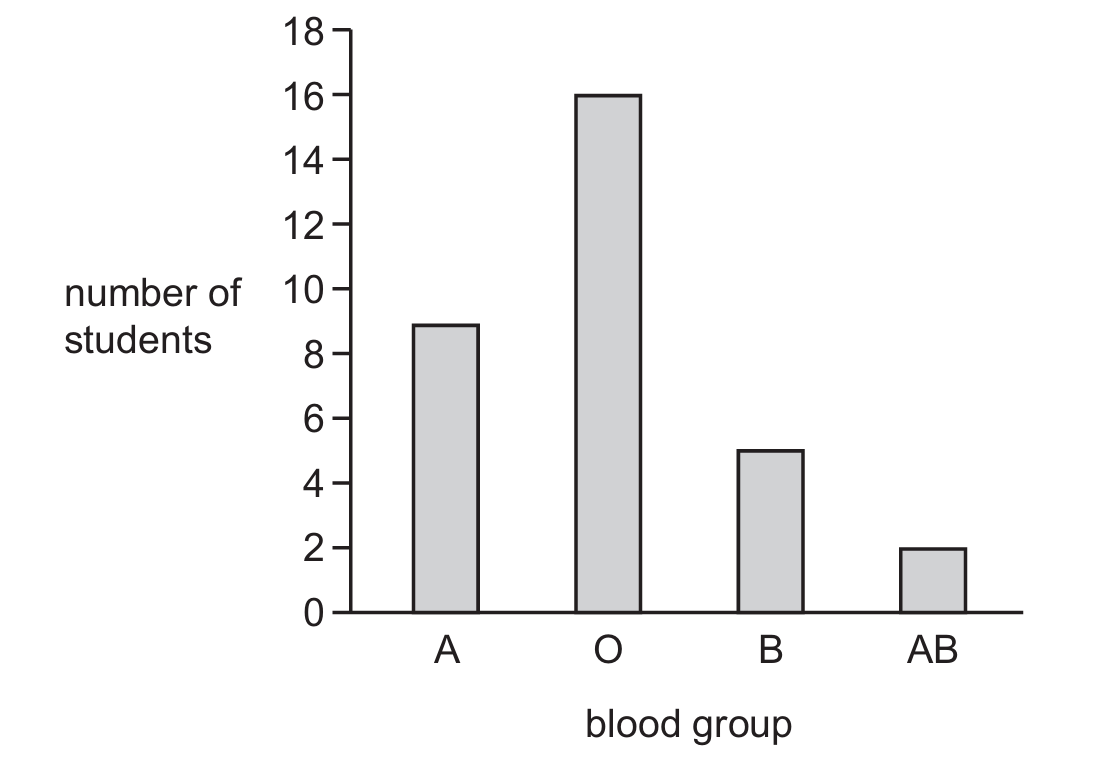
The graph shows the number of students with each blood group in a class.


What can be concluded about blood groups from the graph?

(A) Blood groups are an example of continuous variation caused by genes and the environment.
(B) Blood groups are an example of continuous variation caused by genes only.
(C) Blood groups are an example of discontinuous variation caused by genes and the environment.
(D) Blood groups are an example of discontinuous variation caused by genes only.
▶️ Answer/Explanation
Blood groups (such as A, B, AB, O) are a classic example of discontinuous variation. This means the trait falls into distinct, separate categories with no intermediates. The variation is determined only by genes (specifically, alleles of the ABO gene) and is not influenced by environmental factors. Continuous variation shows a range of values (like height) and can be affected by both genes and environment. Since blood groups are discrete and genetically fixed, the correct conclusion is that they represent discontinuous variation caused by genes only.
Answer: (D)

Question

Humans produce two types of ear wax, either wet or dry.

Which row describes the variation in human ear wax?

▶️ Answer/Explanation
The variation in ear wax is considered discontinuous because individuals fall into distinct categories (wet or dry) with no intermediates. Unlike height or weight, you cannot have a value “in between” these two specific traits. This type of variation is typically controlled by a single gene or a small number of genes, rather than being influenced by external factors. Environmental conditions do not change your ear wax type throughout your life. Therefore, the trait is determined by genes only.
Answer: (D)

Question

Which term is defined as a length of DNA that codes for a protein?
A   a gene
B   an amino acid
C   an X chromosome
D   a Y chromosome
▶️ Answer/Explanation
Detailed solution

The correct answer is A.

Explanation:

A gene is a specific segment or “length” of DNA that carries the genetic code required to build a protein. While chromosomes (C and D) are large structures that house many genes, the gene itself is the functional unit responsible for a single protein’s synthesis. Amino acids (B) are the building blocks that make up proteins, rather than the DNA sequence itself. Therefore, the term that describes the coding DNA sequence is a gene.

Scroll to Top