Question
A student measured the heights of her friends to see how they vary.
Which statements would apply to this type of variation?
2 The variation will be caused by genes and the environment.
3 The variation will be caused by genes only.
4 There will be a limited number of phenotypes with no intermediates.
B 1 and 3
C 2 and 4
D 3 and 4
▶️ Answer/Explanation
The correct answer is A
Height is an example of continuous variation, characterized by a smooth range of measurements rather than distinct categories. Consequently, Statement 1 is correct as there are infinite intermediates between the shortest and tallest heights. Statement 2 is also correct because continuous traits are polygenic and heavily influenced by environmental factors like nutrition. Statements 3 and 4 describe discontinuous variation, which does not apply to height. Thus, only 1 and 2 are accurate.
Question
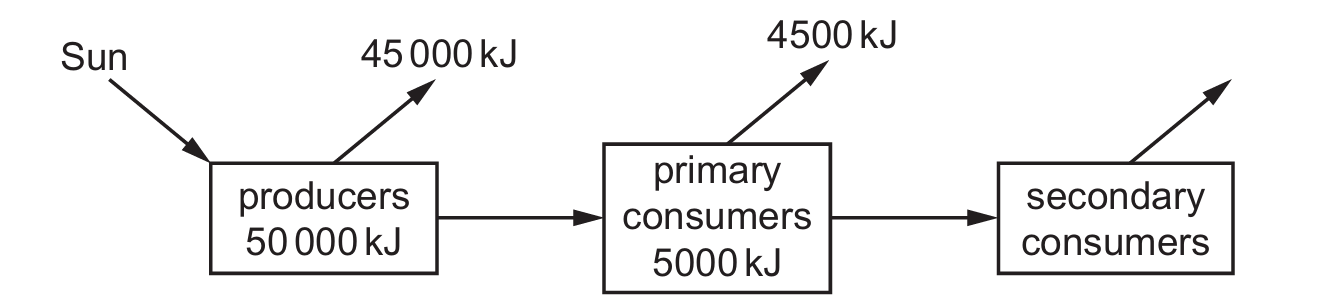
The diagram shows the energy within the producers in an ecosystem and how much is transferred to primary consumers and eventually lost to the environment.

How much energy is transferred from primary consumers to secondary consumers?
(B) 50 kJ
(C) 500 kJ
(D) 5000 kJ
▶️ Answer/Explanation
The diagram shows that producers have 50,000 kJ. According to the 10% energy transfer rule in ecology, only about 10% of the energy is passed from one trophic level to the next. The energy reaching the primary consumers is 5,000 kJ (which is 10% of 50,000 kJ). Therefore, the energy transferred from primary consumers to secondary consumers would be 10% of 5,000 kJ, which equals 500 kJ. This is consistent with the typical energy pyramid model.
✅ Answer: (C)
Question
Black truffle is a fungus that obtains nutrients from the roots of hazel trees. Deer find and eat the fungi.
What is the source of energy for this food chain?
(B) hazel trees
(C) soil
(D) the Sun
▶️ Answer/Explanation
✅ Answer: (D) the Sun
