Home / iGCSE Biology (0610)-19.2 Food chains and food webs – iGCSE Style Questions Paper 2

iGCSE Biology (0610)-19.2 Food chains and food webs – iGCSE Style Questions Paper 2

Question

In a food chain, zebras are large mammals that eat grass. The zebras have many insects living on them which suck their blood. Birds eat the insects.

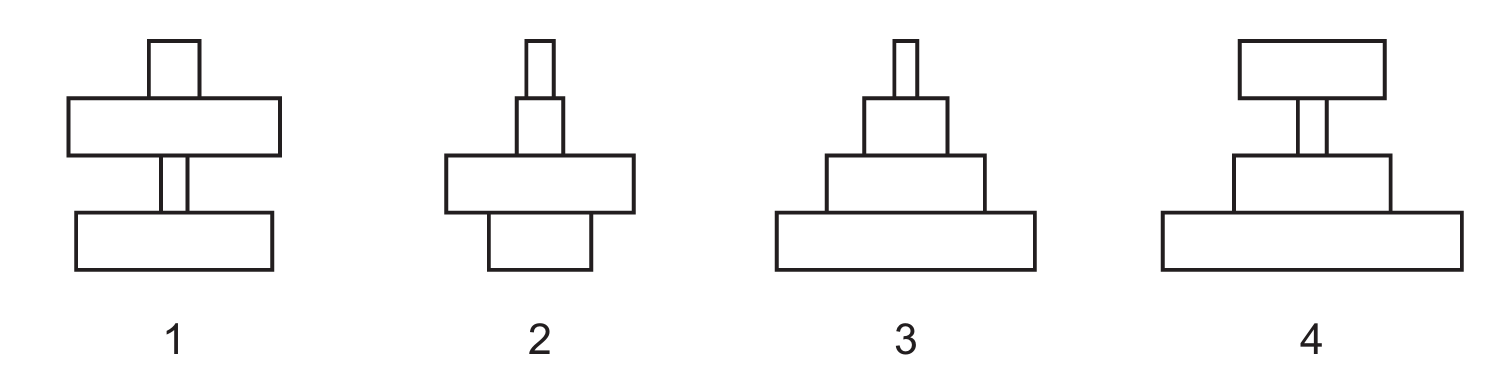
The diagrams show some biological pyramids.

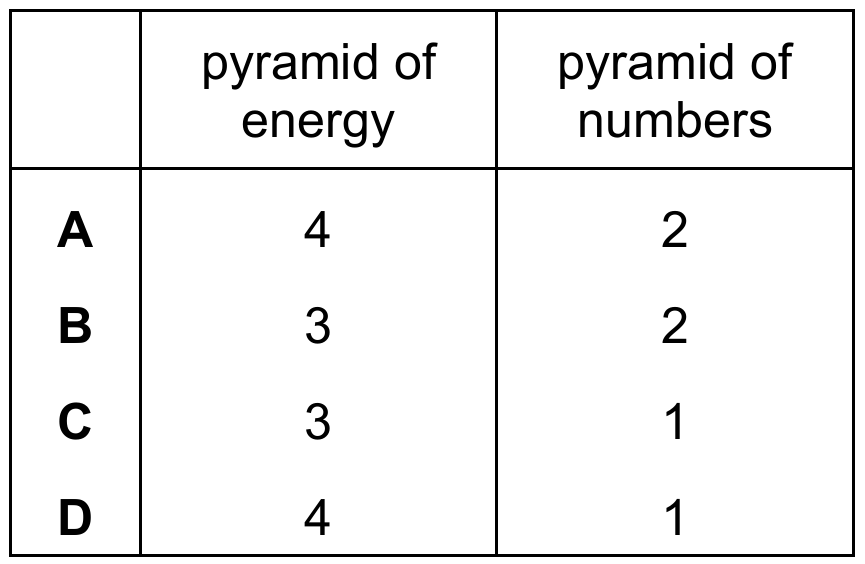
Which row identifies the types of pyramids for this food chain?

▶️ Answer/Explanation
A pyramid of energy always takes a true upright shape (Diagram $3$) because energy is lost at each trophic level (the $10\%$ rule), so it can never be inverted or “top-heavy.” For the pyramid of numbers, the food chain is: Grass $\rightarrow$ Zebra $\rightarrow$ Insects $\rightarrow$ Birds. While there is plenty of grass, there are fewer zebras. However, many insects live on a single zebra, causing the third level to widen significantly. Finally, there are fewer birds than insects. This creates a partially inverted shape where a narrow level (zebras) supports a wider level (insects), matching Diagram $1$.
Answer: (C)

Question

The diagram shows the flow of energy, in units of energy, through a food chain.

producers $\longrightarrow$ primary consumers $\longrightarrow$ secondary consumers $\longrightarrow$ tertiary consumers

$1000$ units     $100$ units      $10$ units       $1$ unit

Which percentage of energy is lost between the producers and secondary consumers?

(A) $1\%$
(B) $10\%$
(C) $90\%$
(D) $99\%$
▶️ Answer/Explanation
To find the percentage of energy lost, first identify the energy levels: producers have $1000$ units and secondary consumers have $10$ units. The amount of energy transferred is only $1\%$, calculated as $(\frac{10}{1000}) \times 100$. However, the question asks for the energy lost during this transition. The energy lost is the initial energy minus the final energy: $1000 – 10 = 990$ units. To find the percentage lost, use the formula: $\text{Percentage Lost} = (\frac{\text{Energy Lost}}{\text{Initial Energy}}) \times 100$. This gives $(\frac{990}{1000}) \times 100 = 99\%$. This massive loss occurs because energy is dissipated as heat and used for metabolic processes at each trophic level.
Answer: (D)

Question

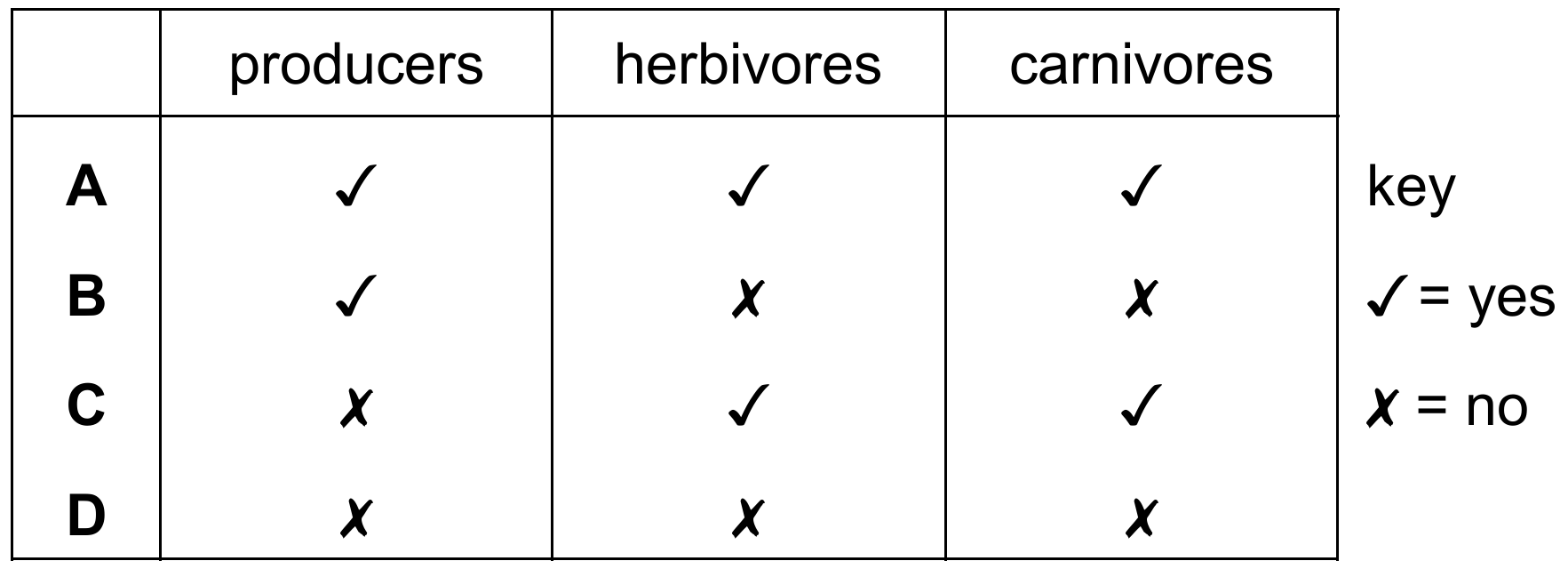
Which organisms can be sources of energy for decomposers?

▶️ Answer/Explanation
Decomposers, such as bacteria and fungi, obtain their energy by breaking down organic matter from dead organisms and waste products. Since all living things eventually die, every level of a food web—including producers (plants), herbivores (primary consumers), and carnivores (secondary/tertiary consumers)—serves as a source of energy for decomposers. This process is essential for recycling nutrients back into the ecosystem. Therefore, the correct row must show a “yes” (✓) for all three categories.
Answer: (A)
Scroll to Top