

▶️ Answer/Explanation
Primary consumers are herbivores that feed directly on producers (plants). In this food web, aquatic plants are the producers. Water beetles and large fish are at higher trophic levels—they feed on tadpoles, which are primary consumers, making them secondary consumers.
✅ Answer: (C) water beetles and large fish
✅ Answer: (C) water beetles and large fish
▶️ Answer/Explanation
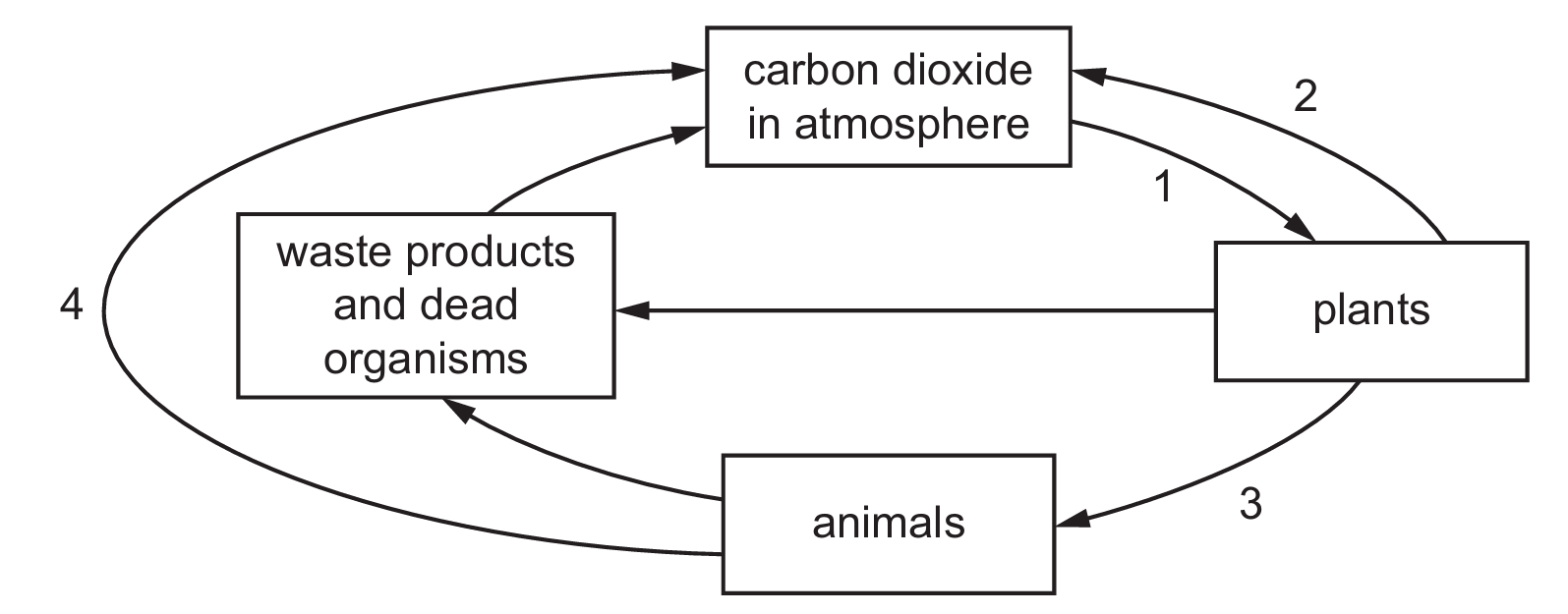
Respiration is the process by which living organisms release energy from food, resulting in the release of $CO_2$ back into the atmosphere. In the diagram, arrow $2$ shows carbon moving from plants to the atmosphere, while arrow $4$ shows carbon moving from animals to the atmosphere. Both represent the release of $CO_2$ via respiration. Conversely, arrow $1$ represents photosynthesis (taking $CO_2$ in), and arrow $3$ represents feeding (transferring carbon through the food chain). Therefore, the arrows pointing toward the atmospheric carbon dioxide from living organisms identify the respiratory phase.
✅ Answer: (C)
✅ Answer: (C)
▶️ Answer/Explanation
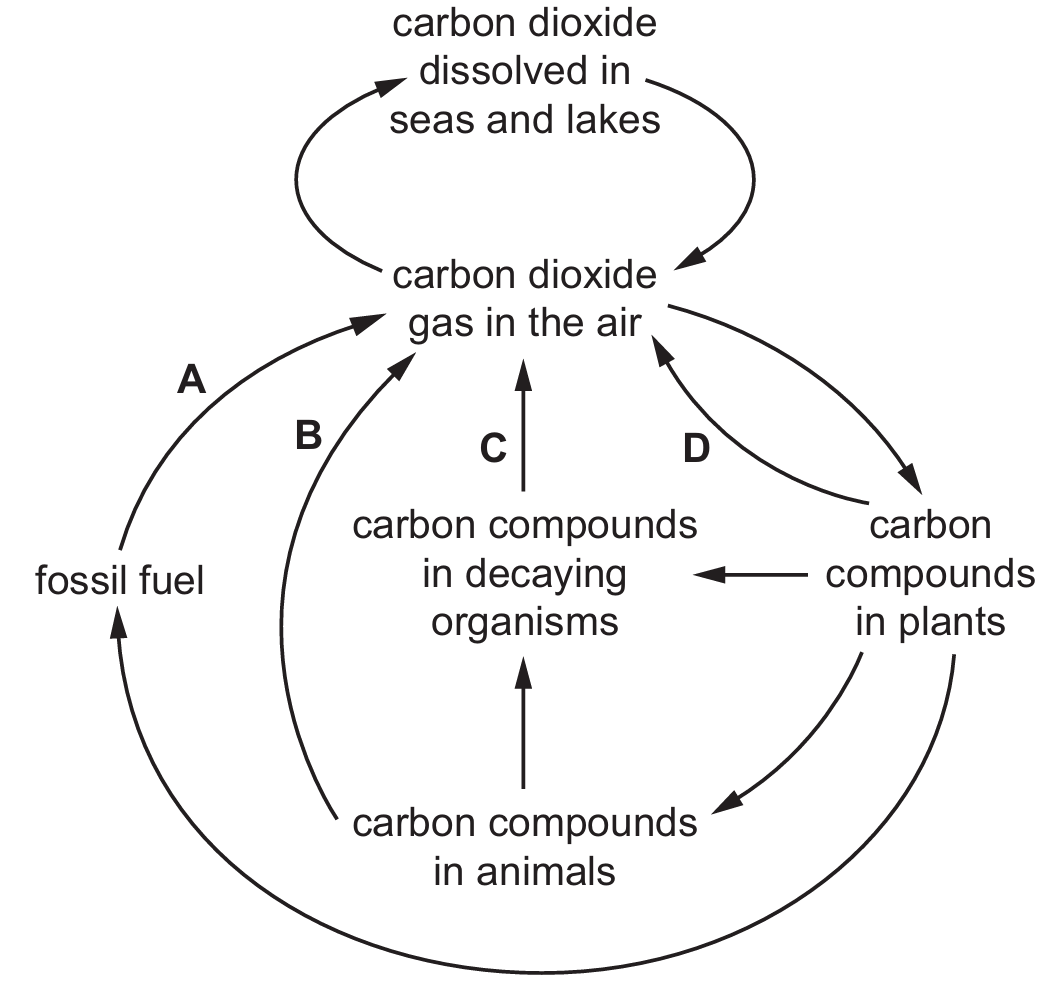
The question asks for a process involving substances made “millions of years ago.” In the carbon cycle, ancient organic matter from plants and animals that was buried and subjected to heat and pressure over millions of years forms fossil fuels. Arrow A represents the combustion of these fossil fuels, which releases stored carbon back into the atmosphere as carbon dioxide ($CO_2$). In contrast, arrows B, C, and D represent respiration or decomposition from modern organisms, which occur on much shorter timescales. Therefore, process A is the only one linking prehistoric photosynthesis to modern atmospheric carbon.
✅ Answer: (A)
✅ Answer: (A)