Question
A student makes a drawing of an animal.
The length of the animal in the drawing is $30 \text{ mm}$.
The actual length of the animal is $200 \text{ mm}$.
What is the magnification of the student’s drawing?
(B) $\times 6.67$
(C) $\times 15$
(D) $\times 6000$
▶️ Answer/Explanation
✅ Answer: (A)
Question

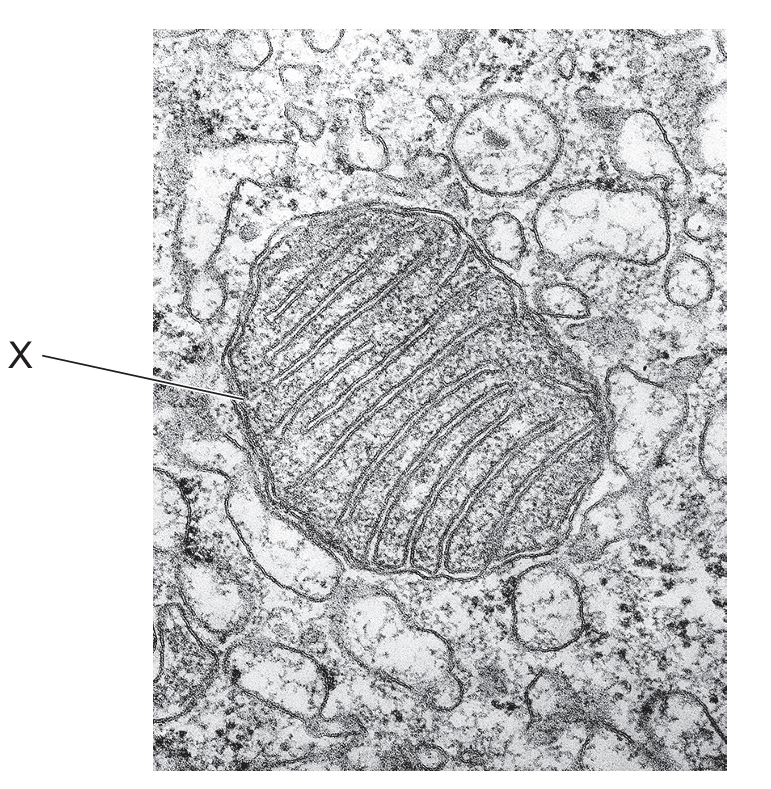
- A chloroplast
- B mitochondrion
- C ribosome
- D vacuole
▶️ Answer/Explanation
The correct answer is B.
Identification:
The image displays a transmission electron micrograph (TEM) of an organelle with a distinct double membrane structure. The label \(X\) points to the inner membrane, which is folded inwards to form finger-like projections called cristae. This folded structure is the hallmark characteristic of a mitochondrion. The cristae serve to increase the surface area available for the electron transport chain and ATP synthesis during aerobic respiration.
Question
B actual size \(\times\) image size
C image size \(-\) actual size
D image size \(\div\) actual size
▶️ Answer/Explanation
The correct answer is D.
Magnification is a measure of how much larger a specimen appears compared to its real size. The general formula for calculating magnification is:
$$ \text{Magnification} = \frac{\text{Image size}}{\text{Actual size}} $$
This can also be written as image size \(\div\) actual size.
