
▶️ Answer/Explanation
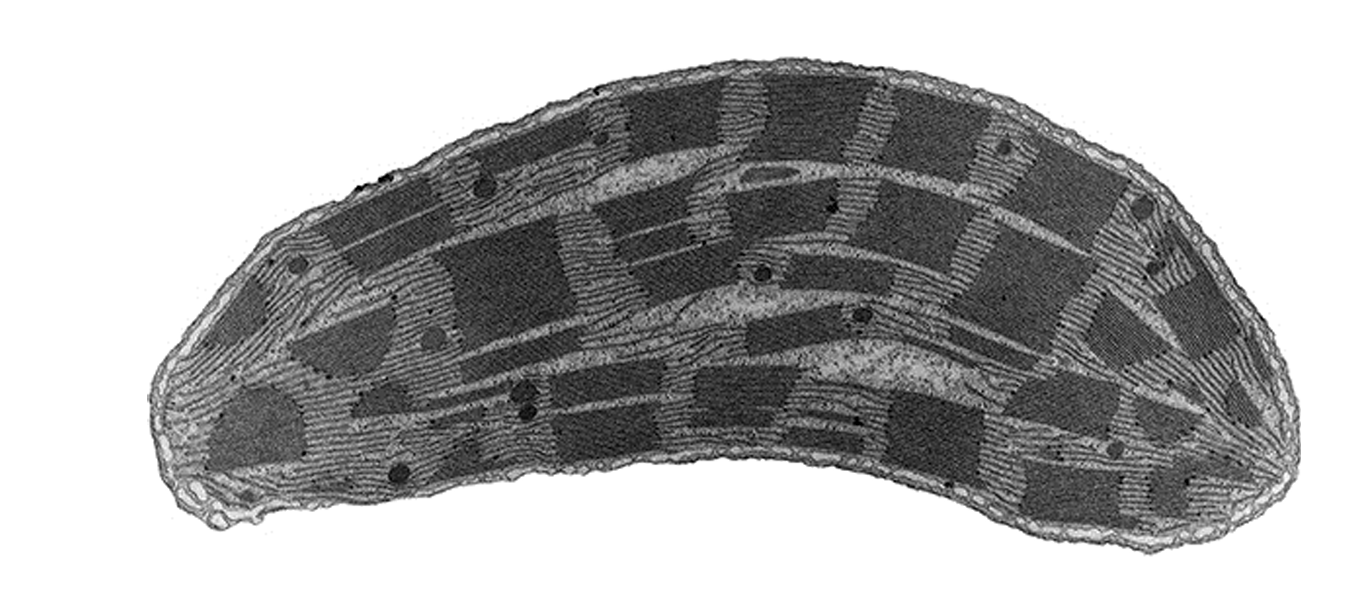
To find the magnification, we use the formula: $\text{Magnification} = \frac{\text{Image size}}{\text{Actual size}}$.
First, we must convert both measurements to the same units. Since $1\text{ cm} = 10\,000\text{ }\mu\text{m}$, the image length is $5 \times 10\,000 = 50\,000\text{ }\mu\text{m}$.
Now, substitute the values into the formula: $\text{Magnification} = \frac{50\,000\text{ }\mu\text{m}}{5\text{ }\mu\text{m}}$.
This simplifies to $10\,000$, which is expressed as $\times 10\,000$.
Comparing this to the given options, choice (C) is the correct calculation.
✅ Answer: (C)
First, we must convert both measurements to the same units. Since $1\text{ cm} = 10\,000\text{ }\mu\text{m}$, the image length is $5 \times 10\,000 = 50\,000\text{ }\mu\text{m}$.
Now, substitute the values into the formula: $\text{Magnification} = \frac{50\,000\text{ }\mu\text{m}}{5\text{ }\mu\text{m}}$.
This simplifies to $10\,000$, which is expressed as $\times 10\,000$.
Comparing this to the given options, choice (C) is the correct calculation.
✅ Answer: (C)
▶️ Answer/Explanation
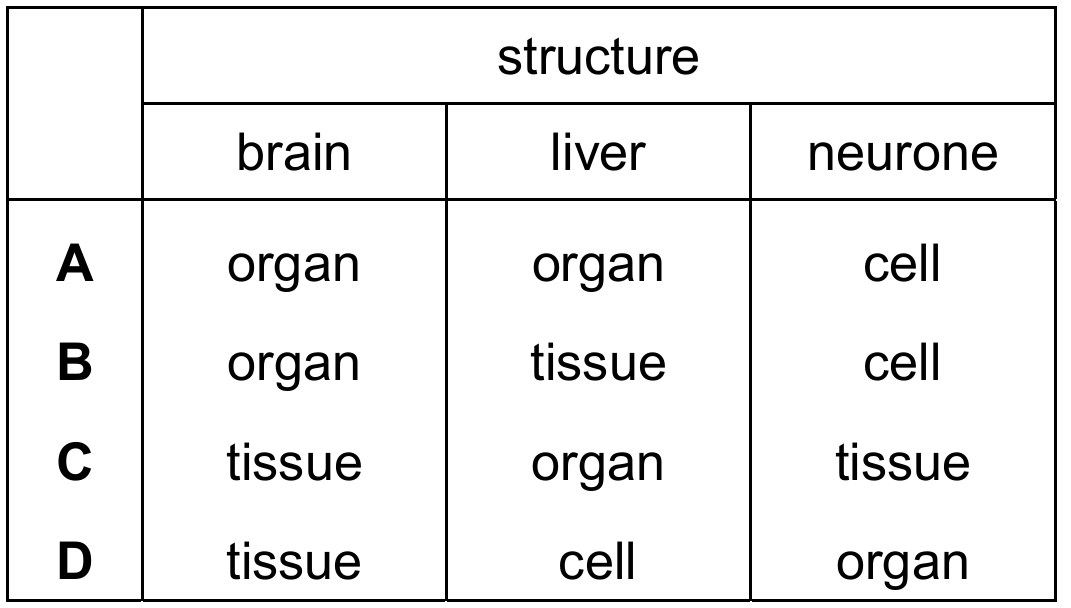
Biological organization follows a hierarchy: cells group to form tissues, and tissues group to form organs. A neurone is a single nerve cell, which is the basic functional unit of the nervous system. The brain and the liver are both complex structures made of multiple types of tissues working together to perform specific physiological functions, classifying them both as organs. Row A correctly identifies both the brain and liver as organs and the neurone as a cell.
✅ Answer: (A)