
▶️ Answer/Explanation
(a)
An adaptive feature is an inherited feature that helps an organism to survive and reproduce (or breed/produce offspring) in its environment.
(b)
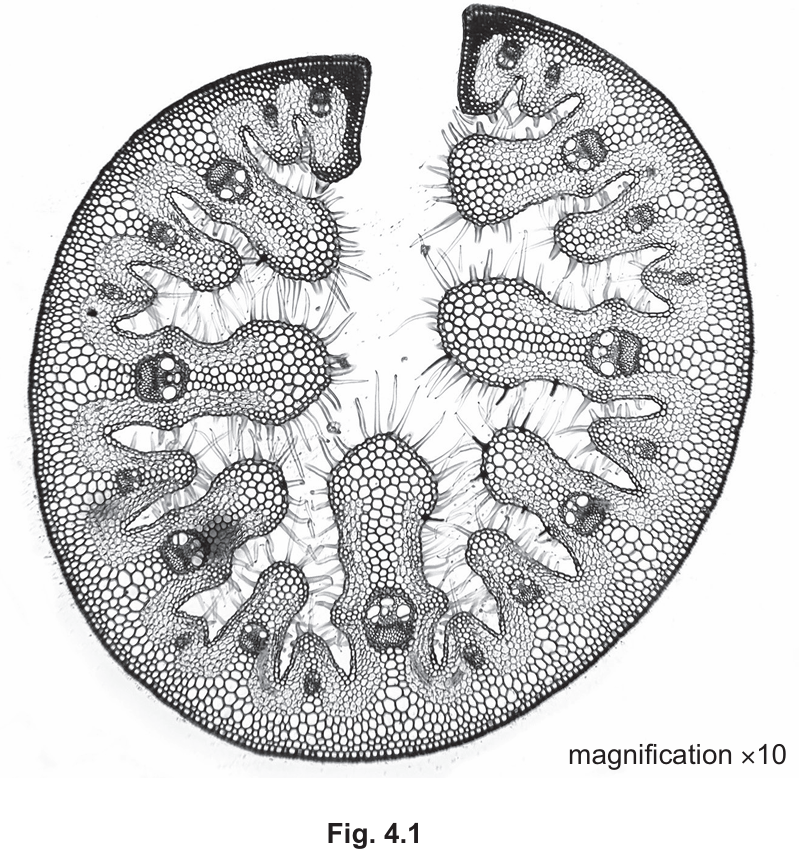
Based on the cross-section of the marram grass leaf (Fig. 4.1), the visible xerophytic features include:
- Rolled or curled leaf: The leaf is rolled inwards to reduce the surface area exposed to the drying effects of the wind and to trap moist air inside.
- Hairs: Epidermal hairs are visible lining the inside of the roll. These trap water vapour, creating a humid microclimate that reduces the water potential gradient and slows down transpiration.
- Sunken stomata: The stomata are located in pits or grooves on the inner surface (often protected by the hairs), further shielding them from air currents.
- Thick cuticle: A thick waxy layer on the outer surface prevents water loss through the epidermis.
(c) (i)
To convert micrometers (\(\mu\text{m}\)) to millimeters (mm), you divide by 1000 (since \(1 \text{ mm} = 1000 \, \mu\text{m}\)). $$ 1.276 \div 1000 = 0.001276 \text{ mm} $$ Alternatively expressed as \(1.276 \times 10^{-3} \text{ mm}\).
(c) (ii)
Cellulose. (This is the standard structural carbohydrate found in the cell walls of all plants, including xerophytes).
(c) (iii)
Adaptations of a xerophyte stem may include:
- Swollen / Succulent: The stem acts as a water storage organ (e.g., in cacti).
- Photosynthetic (Green): The stem contains chloroplasts to carry out photosynthesis, allowing the plant to reduce leaf size (or modify leaves into spines) to minimize water loss.
- Thick waxy cuticle: To reduce evaporation from the stem surface.
(d)
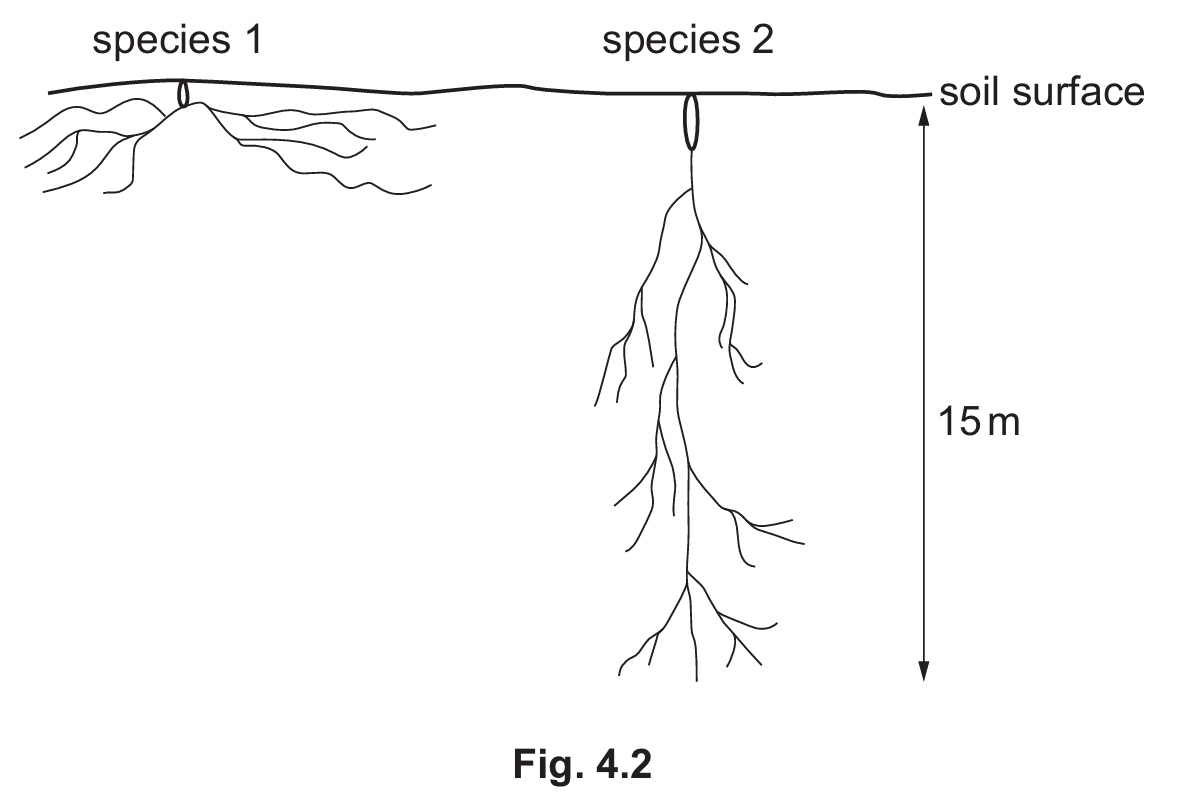
The two species show different root adaptations for water absorption in dry environments:
- Species 1 (Shallow, spreading roots): The roots are shallow and spread out over a wide area close to the soil surface.
Adaptation: This allows the plant to absorb water quickly and immediately after light rainfall before it evaporates from the surface soil. - Species 2 (Deep, vertical roots): The roots grow very deep into the soil (tap roots).
Adaptation: This allows the plant to access deep water sources or the water table, which provides a supply of water even when the surface soil is completely dry.