
Home / iGCSE Biology (0610)-21.1 Biotechnology and genetic modification- iGCSE Style Questions Paper 1

iGCSE Biology (0610)-21.1 Biotechnology and genetic modification- iGCSE Style Questions Paper 1

Question

The flow chart shows some of the processes involved in making biofuel.

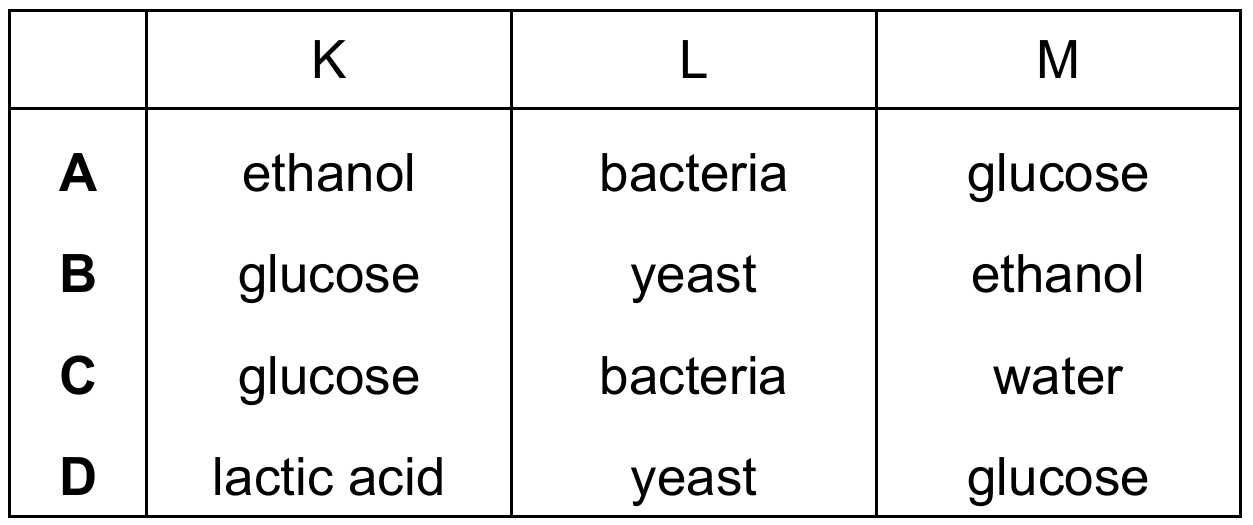
What are represented by $K$, $L$ and $M$ in the diagram?

▶️ Answer/Explanation
The process described is the production of bioethanol. First, plant biomass is processed to extract glucose ($K$), which serves as the substrate. Next, yeast ($L$) is added to perform anaerobic respiration (fermentation). During this biological process, the yeast breaks down the glucose to produce ethanol ($M$) and carbon dioxide. Since the goal is to create biofuel, ethanol is the specific product extracted at the end of the sequence.
Answer: (B)

Question

Which feature makes bacteria useful in genetic modification?

(A) can make complex molecules
(B) have a cell membrane
(C) have a cell wall
(D) reproduce slowly
▶️ Answer/Explanation
Bacteria are ideal for genetic modification because they possess the cellular machinery required to synthesize complex organic molecules, such as proteins, based on the genetic instructions inserted into them. A classic example is the production of human insulin. Furthermore, bacteria often contain plasmids—small, circular $DNA$ strands—that are easily manipulated and used as vectors. Their rapid reproduction rate also allows for the quick scaling of production, which contradicts option (D). While they do have cell walls and membranes, these are common to many cell types and are not the specific functional reason they are utilized as biological “factories.”
Answer: (A)

Question

Why are bacteria useful in biotechnology and genetic modification?
A   They can cause decomposition.
B   They can make complex molecules.
C   They have a cell wall.
D   They have a slow reproduction rate.
▶️ Answer/Explanation
Detailed solution

The correct answer is B.

Explanation:
Bacteria are ideal for biotechnology because they contain plasmids—small loops of DNA that are easily manipulated to carry foreign genes. By inserting specific genetic sequences, scientists turn bacteria into “biological factories” capable of synthesizing complex molecules like human insulin. Unlike other options, their utility relies on their rapid reproduction and shared genetic code, which allows them to translate human DNA into functional proteins. This process enables the efficient, large-scale production of life-saving medicines and industrial enzymes.

Scroll to Top