Home / iGCSE Biology (0610)-21.1 Biotechnology and genetic modification- iGCSE Style Questions Paper 2

iGCSE Biology (0610)-21.1 Biotechnology and genetic modification- iGCSE Style Questions Paper 2

Question

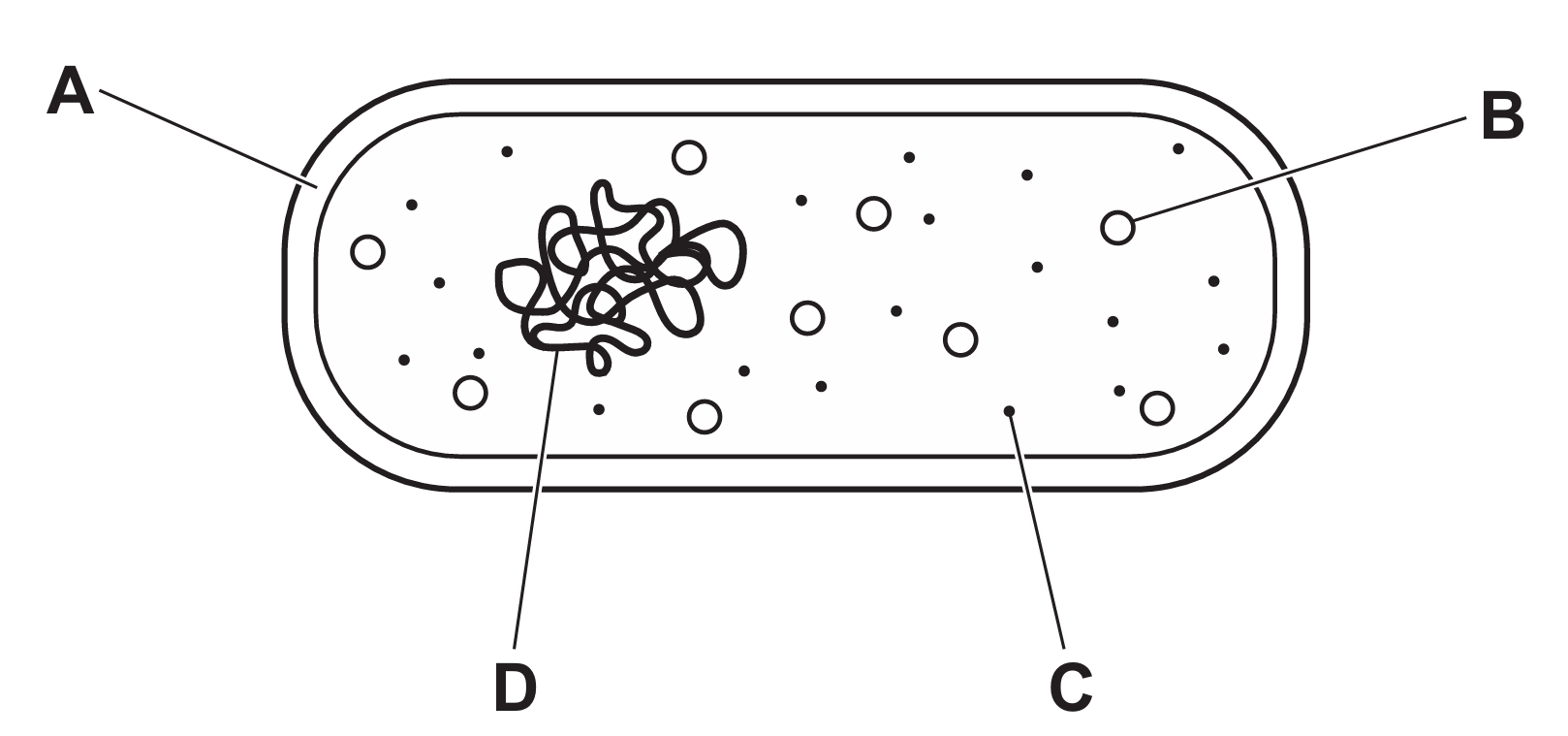
The diagram shows a bacterial cell.

Which cell structure makes bacteria useful in genetic modification?

▶️ Answer/Explanation
The correct structure is B, which represents a plasmid. Plasmids are small, circular loops of extra-chromosomal DNA found in bacteria that are separate from the main nucleoid (D). In genetic engineering, plasmids are highly useful because they can be easily isolated, cut using restriction enzymes, and joined with foreign genes to act as vectors. Once the recombinant plasmid is reinserted into a bacterium, the cell will express the new genetic information. This mechanism is widely used to mass-produce substances like human insulin.
Answer: (B)

Question

Which features make bacteria useful in biotechnology?

$1$   They are unaffected by antibiotics.
$2$   They do not contain plasmids.
$3$   They make complex molecules.
$4$   They reproduce rapidly.
A   $1$ and $2$ B   $1$ and $4$ C   $2$ and $3$ D   $3$ and $4$
▶️ Answer/Explanation

Bacteria are ideal for biotechnology because they can be engineered to synthesize complex molecules, such as human insulin, which would be difficult to produce chemically. Their ability to reproduce rapidly through binary fission allows for the quick mass production of these desired substances in large fermenters.

Conversely, statements $1$ and $2$ are incorrect: bacteria are generally susceptible to antibiotics (unless specifically engineered for resistance markers), and their plasmids are actually essential tools in biotechnology for transferring foreign DNA. Therefore, only points $3$ and $4$ are correct.
Answer: (D)

Question

Which term describes the number of different species living in an area?

(A) biodiversity
(B) conservation
(C) ecosystem
(D) population
▶️ Answer/Explanation
The correct term is biodiversity, which specifically refers to the variety of life in a particular habitat or ecosystem. While “population” refers to individuals of a single species and “ecosystem” includes both living organisms and their physical environment, biodiversity focuses on the richness and variety of species present. High biodiversity is often an indicator of a healthy, resilient environment. In contrast, conservation is the practice of protecting these species, rather than a measure of their variety. Therefore, the number of distinct species in a given area is the primary metric for biological diversity.
Answer: (A)
Scroll to Top