Home / iGCSE Biology (0610) 3.1 Diffusion iGCSE Style Questions Paper 1

iGCSE Biology (0610) 3.1 Diffusion iGCSE Style Questions Paper 1

Question

Which process moves oxygen from the soil into a root hair cell?

(A) diffusion
(B) osmosis
(C) respiration
(D) ventilation
▶️ Answer/Explanation
Oxygen moves from an area of higher concentration in the soil air spaces into the root hair cell, where its concentration is lower, by the passive physical process of diffusion. Osmosis specifically refers to the movement of water molecules across a semipermeable membrane. Respiration is a chemical process that uses oxygen, but it is not the mechanism of entry. Ventilation refers to bulk airflow in animals, not gas entry into plant cells.
Answer: (A) diffusion

Question

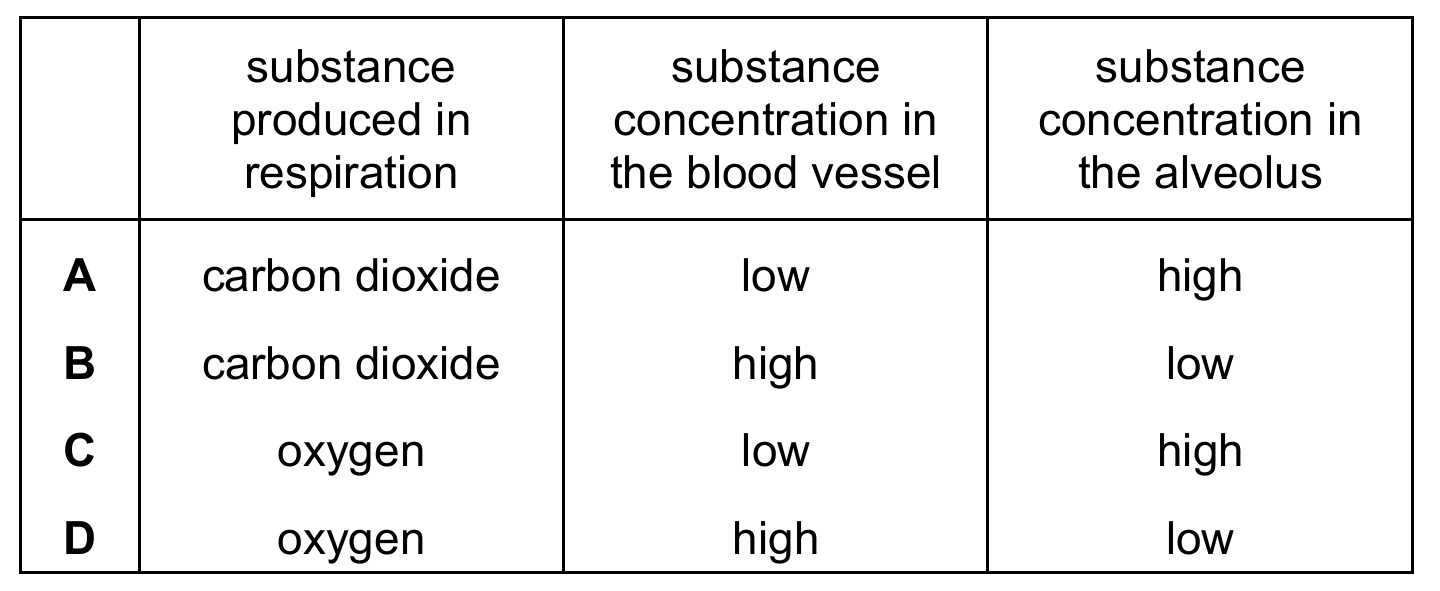
The table shows the concentration of gases in a blood vessel and in an alveolus.

Which row shows the conditions that cause a substance produced in respiration in humans to diffuse from the blood vessel into the alveolus?

▶️ Answer/Explanation
In human respiration, carbon dioxide is the primary gaseous waste product generated in cells. For diffusion to occur from the blood vessel into the alveolus, there must be a concentration gradient where the concentration is high in the blood and low in the alveolar air space. This allows the gas to move naturally down its gradient to be exhaled. Oxygen is a reactant, not a product, of aerobic respiration, so options (C) and (D) are incorrect based on the question’s criteria.
Answer: (B)

Question

What increases the rate of diffusion of oxygen into a cell?
A   decreasing the concentration gradient
B   decreasing the surface area
C   increasing the diffusion distance
D   increasing the temperature
▶️ Answer/Explanation
Detailed solution

The correct answer is D.

Reasoning:
Diffusion is the net movement of particles from an area of higher concentration to an area of lower concentration. Several factors affect the rate of this passive process:

  • Temperature (Option D): Increasing the temperature increases the kinetic energy of the oxygen molecules. This causes them to move more rapidly and collide more frequently, leading to a faster rate of diffusion into the cell.
Scroll to Top