
Question
Which statement describes the net movement of particles by active transport in animal cells?
(B) from a higher concentration to a lower concentration across a cell wall
(C) from a lower concentration to a higher concentration across a cell membrane
(D) from a lower concentration to a higher concentration across a cell wall
▶️ Answer/Explanation
✅ Answer: (C)
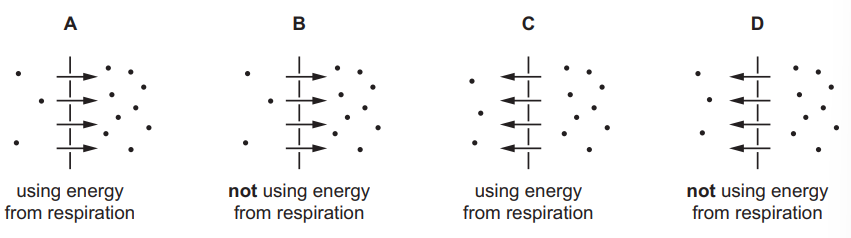
The diagrams show the movement of particles across a membrane. The arrows show the direction of movement.
Which diagram shows active transport?
▶️ Answer/Explanation
Ans: A
Active transport involves the movement of particles against their concentration gradient (from low to high concentration), requiring energy (ATP). In the given diagrams, option A correctly depicts this process, as particles are moving from a region of lower concentration (outside the cell) to a region of higher concentration (inside the cell). This distinguishes it from passive transport (diffusion or osmosis), which occurs without energy input.
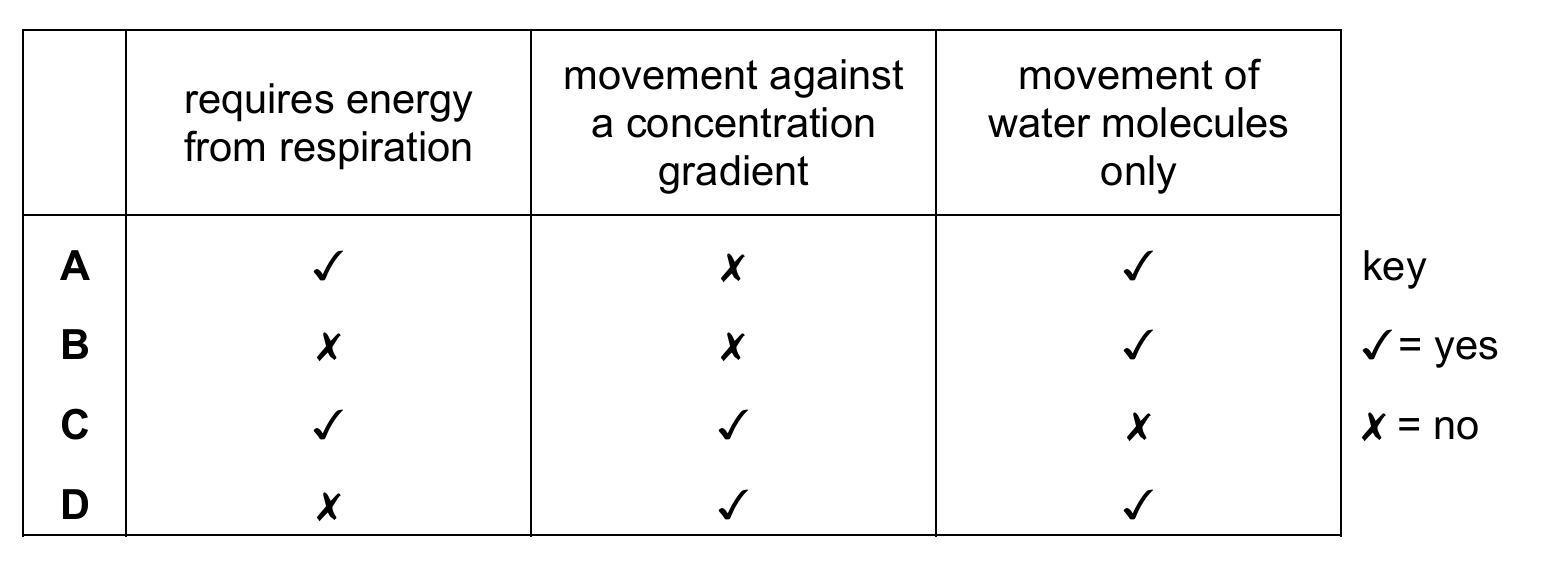
Which row shows the features of active transport?
▶️ Answer/Explanation
Ans: C
Active transport requires energy (✓) and moves substances against their concentration gradient (✓). It’s not limited to water (✗). Only row C matches these criteria, making it the correct answer.