


▶️ Answer/Explanation
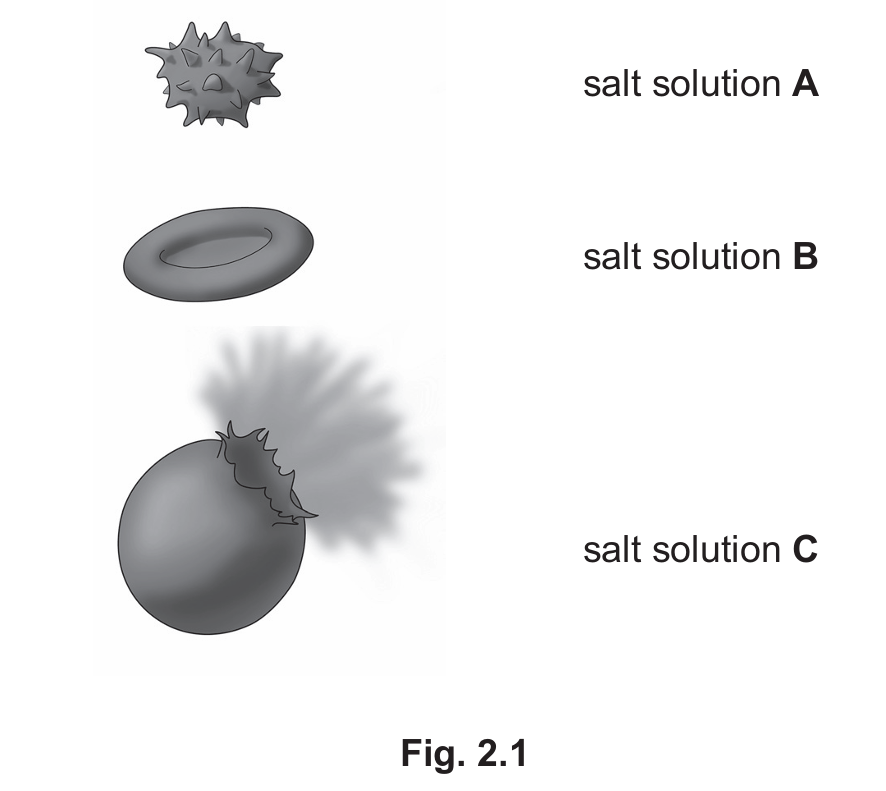
(a) (i) Salt solution: B
Explanation: The cell retains its normal biconcave shape and is neither swollen nor shrunken (crenated). This indicates that the solution is isotonic to the cell cytoplasm, meaning there is no net movement of water by osmosis.
(a) (ii) Increasing salt concentration: C $\rightarrow$ B $\rightarrow$ A
Explanation:
• C is the lowest concentration (hypotonic); water enters the cell, causing it to swell and burst (haemolysis).
• B is isotonic; the concentration matches the cell.
• A is the highest concentration (hypertonic); water leaves the cell by osmosis, causing it to shrink and become wrinkled (crenation).
(b) Any two from:
• Ions (e.g., $Na^+$, $Cl^-$)
• Nutrients (e.g., glucose, amino acids)
• Urea
• Hormones
• Carbon dioxide (as bicarbonate ions)
• Plasma proteins (e.g., fibrinogen, antibodies).
(c) Appearance:
The plant cell will become turgid (swollen/firm). Because distilled water has a higher water potential than the cell sap, water enters the cell via osmosis. The vacuole increases in size, pushing the cytoplasm against the cell wall. Unlike the animal cell in solution C, the plant cell does not burst because the rigid cell wall provides structural support.
(d) Table 2.1 Completion:
| Statement | Diffusion | Osmosis |
|---|---|---|
| happens in all living cells | $\checkmark$ | $\checkmark$ |
| particles move randomly | $\checkmark$ | $\checkmark$ |
| always involves a partially permeable membrane | $\checkmark$ | |
| ions move down a concentration gradient | $\checkmark$ |
Note: Osmosis specifically refers to the movement of water molecules through a partially permeable membrane.
(e) Active transport
Explanation: Active transport is the movement of particles from a region of lower concentration to a region of higher concentration (against a concentration gradient). This process requires energy from respiration.