

▶️ Answer/Explanation
(a)
Enzymes are proteins. All proteins are made up from a chain of smaller molecules called amino acids.
All proteins contain the chemical elements carbon, hydrogen and nitrogen (or oxygen).
(Note: Proteins consist of Carbon, Hydrogen, Oxygen, and Nitrogen. Since there are three blanks, listing any three of these from the list is acceptable, but Nitrogen is the key element distinguishing proteins from carbohydrates and fats).
(b)
A catalyst is a substance that increases the rate of a chemical reaction and is not changed by the reaction (it can be used again).
(c)
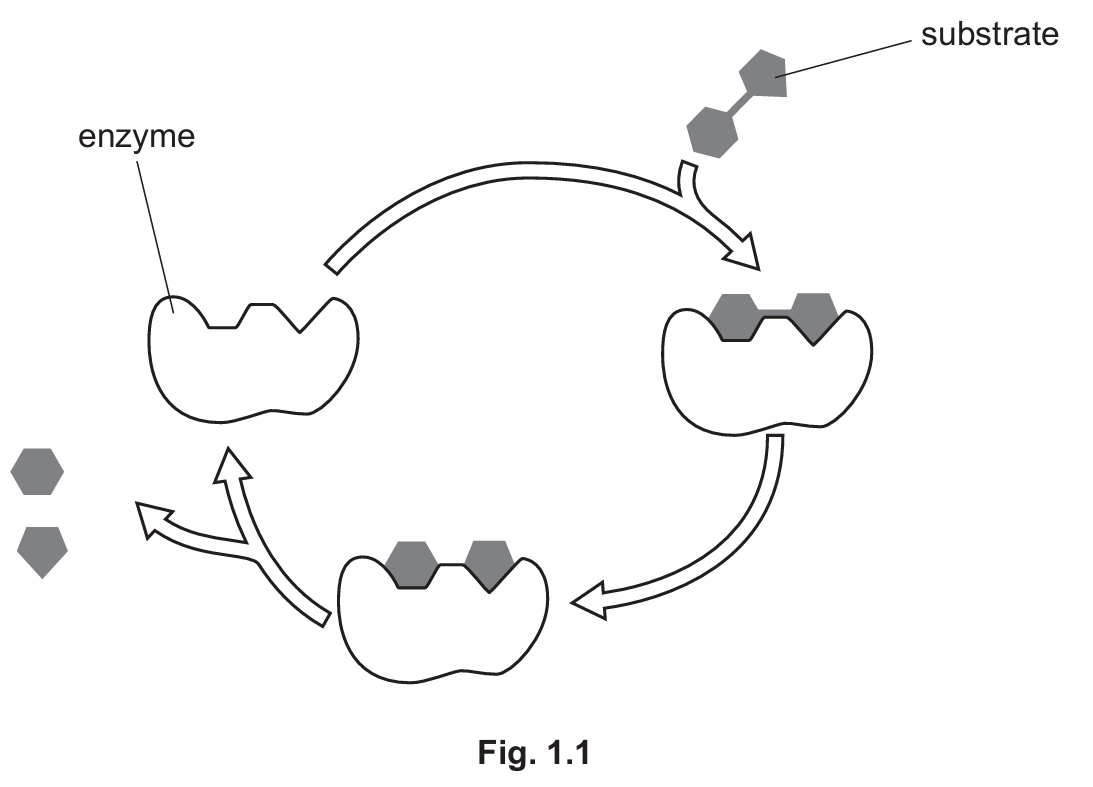
Using the “lock and key” hypothesis shown in Fig 1.1:
- The substrate has a specific shape that is complementary to the enzyme’s active site.
- The substrate binds to the active site to form an enzyme-substrate complex.
- The reaction occurs (breakdown or synthesis), and products are formed.
- The products leave the active site, and the enzyme remains unchanged.
(d)(i)
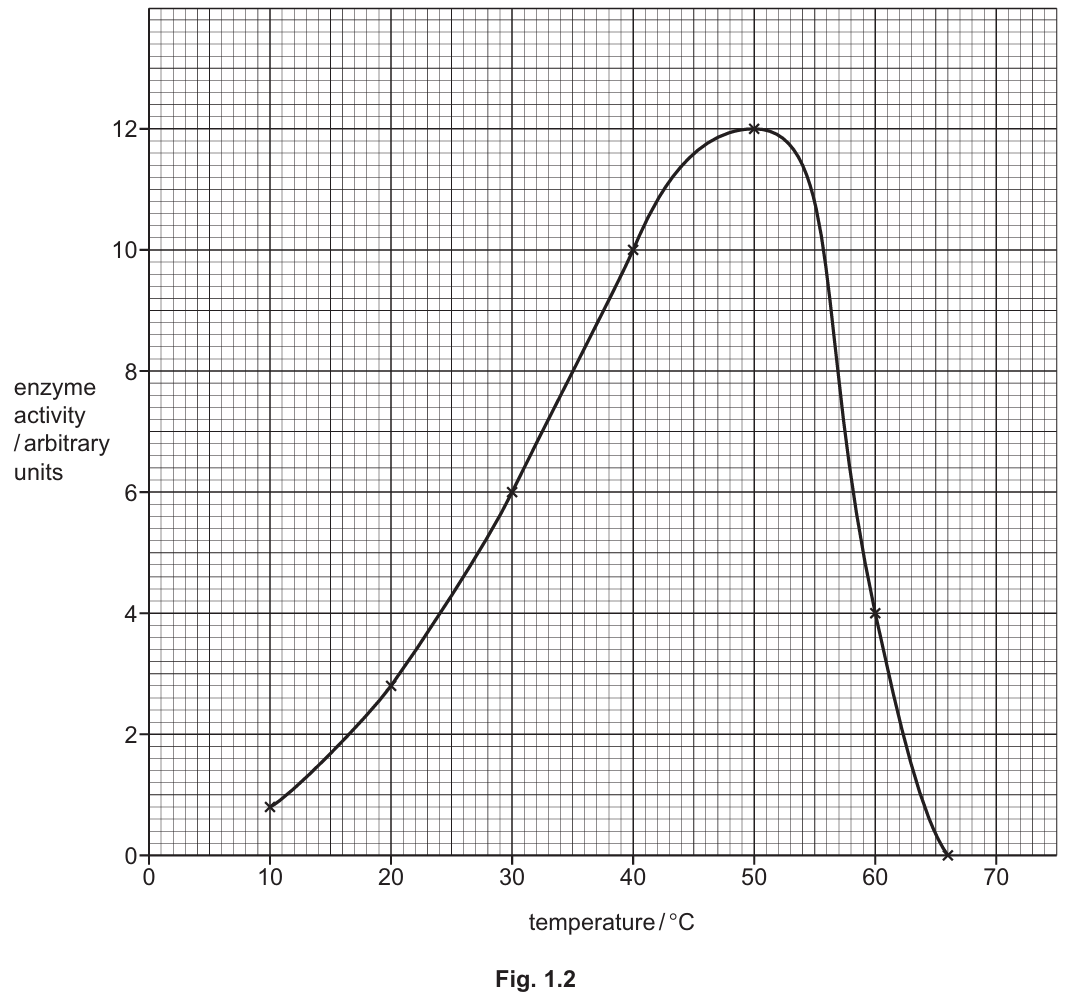
Optimum temperature: \(50 \pm 1\) \(^\circ\text{C}\).
(This is the temperature corresponding to the peak of the curve on the graph).
(d)(ii)
Temperature: \(66\) \(^\circ\text{C}\).
Explanation: There is zero activity / no enzyme activity at this point.
(At this temperature, the enzyme has denatured, meaning the active site has lost its shape and can no longer bind to the substrate).
(d)(iii)
Calculation:
At \(40~^\circ\text{C}\), activity = \(10\) arbitrary units.
At \(20~^\circ\text{C}\), activity = \(2.8\) arbitrary units (each small square on the y-axis represents \(0.4\) units; the point is 2 squares above 2).
Difference: \(10 – 2.8 = \mathbf{7.2}\) arbitrary units.
(d)(iv)
Sketch:
The curve should have the same shape as the bacterial enzyme (gradual rise to a peak, then sharp decline). The optimum (peak) should be shifted to the left, centered around \(37~^\circ\text{C}\) \(\pm 2\).