Home / iGCSE Biology (0610)-6.2 Leaf structure – iGCSE Style Questions Paper 1

iGCSE Biology (0610)-6.2 Leaf structure – iGCSE Style Questions Paper 1

Question

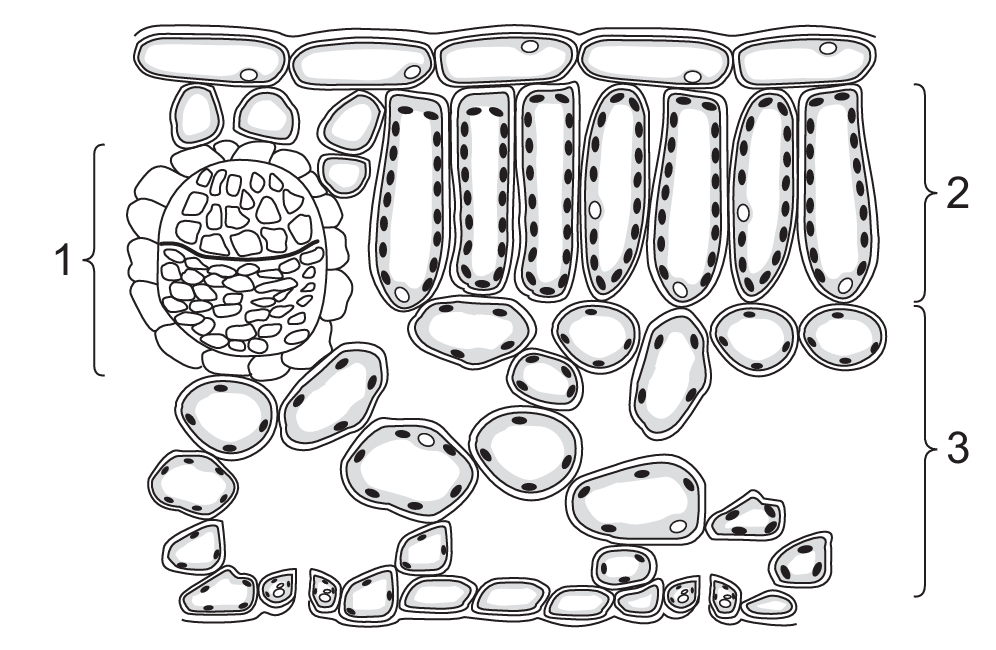
The diagram shows a cross-section of a leaf.

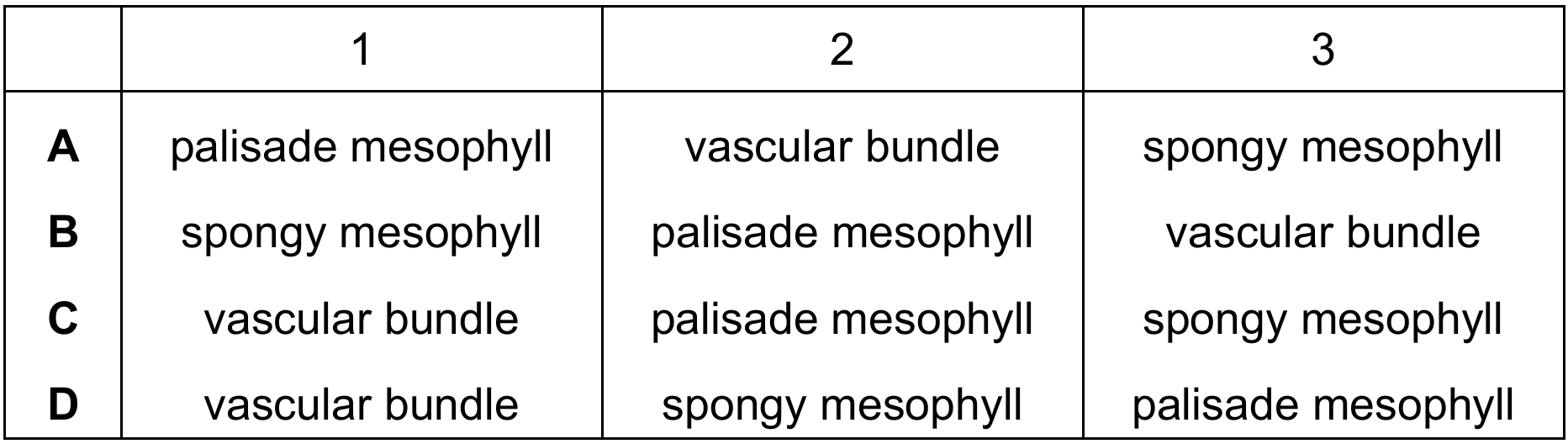
Which layer of the leaf contains the most chloroplasts?

▶️ Answer/Explanation
The palisade mesophyll layer is specifically adapted to maximize photosynthesis. It is located just below the upper epidermis, where it receives the most direct sunlight. The cells in this layer are vertically elongated and packed closely together, containing the highest density of chloroplasts compared to any other leaf tissue. While the spongy mesophyll also contains chloroplasts, they are fewer in number and separated by air spaces. The epidermis layers (upper and lower) are generally transparent and contain few to no chloroplasts, except in the guard cells.
Answer: (B)

Question

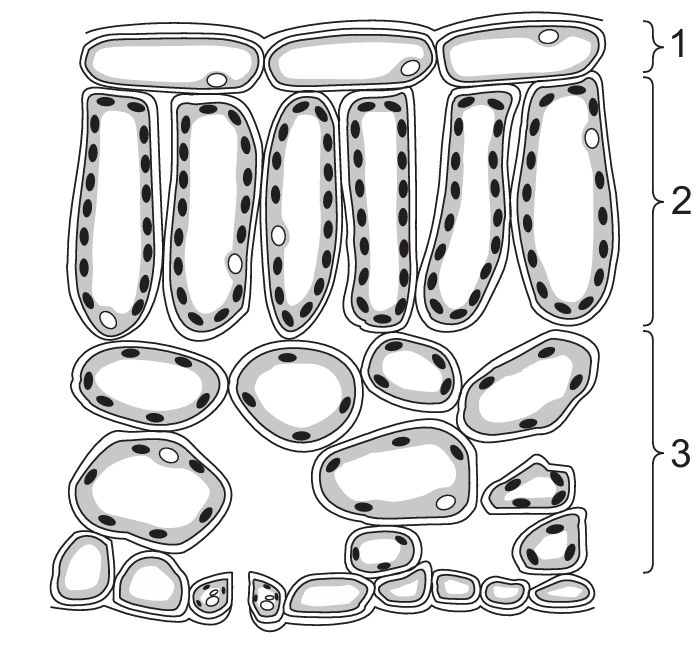
The diagram shows part of a cross-section of a leaf.

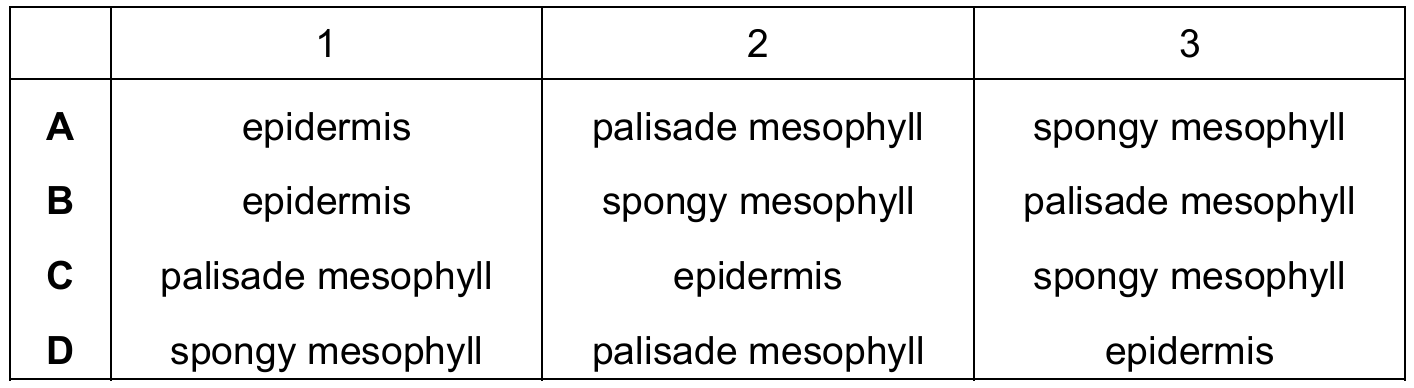
What are tissues $1$, $2$ and $3$?

▶️ Answer/Explanation
Tissue $1$ represents the upper epidermis, a thin, transparent outer layer of cells that protects the leaf. Tissue $2$ is the palisade mesophyll, characterized by tall, cylindrical cells packed with chloroplasts to maximize light absorption for photosynthesis. Tissue $3$ is the spongy mesophyll, which contains irregularly shaped cells with large air spaces between them to facilitate gas exchange. By identifying these layers from the top of the leaf downwards, we can see that they follow the sequence of epidermis, palisade, and then spongy tissue. This matches the arrangement shown in the cross-section diagram.
Answer: (A)

Question

In a cross-section of a leaf, what is the correct order of structures moving from the upper surface of the leaf towards the lower surface of the leaf?

(A) cuticle, epidermis, palisade mesophyll, spongy mesophyll
(B) cuticle, epidermis, spongy mesophyll, palisade mesophyll
(C) epidermis, cuticle, palisade mesophyll, spongy mesophyll
(D) epidermis, cuticle, spongy mesophyll, palisade mesophyll
▶️ Answer/Explanation
The structure of a typical dicotyledonous leaf is organized in layers to optimize photosynthesis and minimize water loss. The outermost layer on the top is the cuticle, a waxy, non-cellular coating that prevents desiccation. Directly beneath the cuticle lies the upper epidermis, a single layer of cells that protects internal tissues. Moving deeper, the palisade mesophyll consists of tightly packed, column-shaped cells rich in chloroplasts to capture maximum sunlight. Below this is the spongy mesophyll, characterized by loosely arranged cells with air spaces to facilitate gas exchange. Therefore, moving from the upper to the lower surface, the sequence follows the order described in option A.
Answer: (A)
Scroll to Top