Home / iGCSE Biology (0610)-7.3 Physical digestion – iGCSE Style Questions Paper 1

iGCSE Biology (0610)-7.3 Physical digestion – iGCSE Style Questions Paper 1

Question

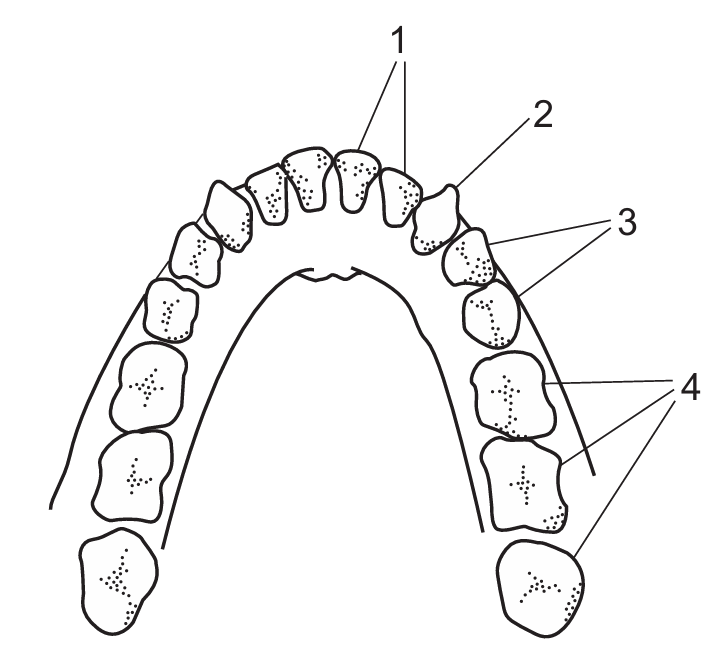
The diagram shows human teeth in the mouth.
Which types of teeth can be used to grind food?
A   (1, 2, 3) and (4)
B   (2, 3) and (4) only
C   (3) and (4) only
D   (4) only
▶️ Answer/Explanation
Detailed solution

The correct answer is C.

To solve this, identify the function of each labeled tooth: 1 represents incisors (cutting) and 2 represents canines (tearing). In contrast, 3 represents premolars and 4 represents molars. Both premolars and molars possess broad, ridged surfaces specifically adapted for crushing and grinding food into a paste. Because both types 3 and 4 share this mechanical function, the correct choice is 3 and 4 only.
Question

Which two parts of the mouth are teeth embedded in?

(A) cement and pulp
(B) enamel and dentine
(C) gums and bone
(D) pulp and bone
▶️ Answer/Explanation

Teeth are securely anchored in the mouth through a combination of soft and hard tissues. The root of the tooth is seated within sockets in the jawbone (maxilla or mandible), providing structural stability for chewing. Overlying this bone is the gingiva, commonly known as the gums, which provides a protective seal around the neck of the tooth. While structures like cementum help attach the tooth to the bone via ligaments, the “embedding” refers to the surrounding environment of the gums and bone. Options A, B, and D are incorrect because they include internal components of the tooth itself, such as enamel, dentine, or pulp.

Answer: (C)

Question

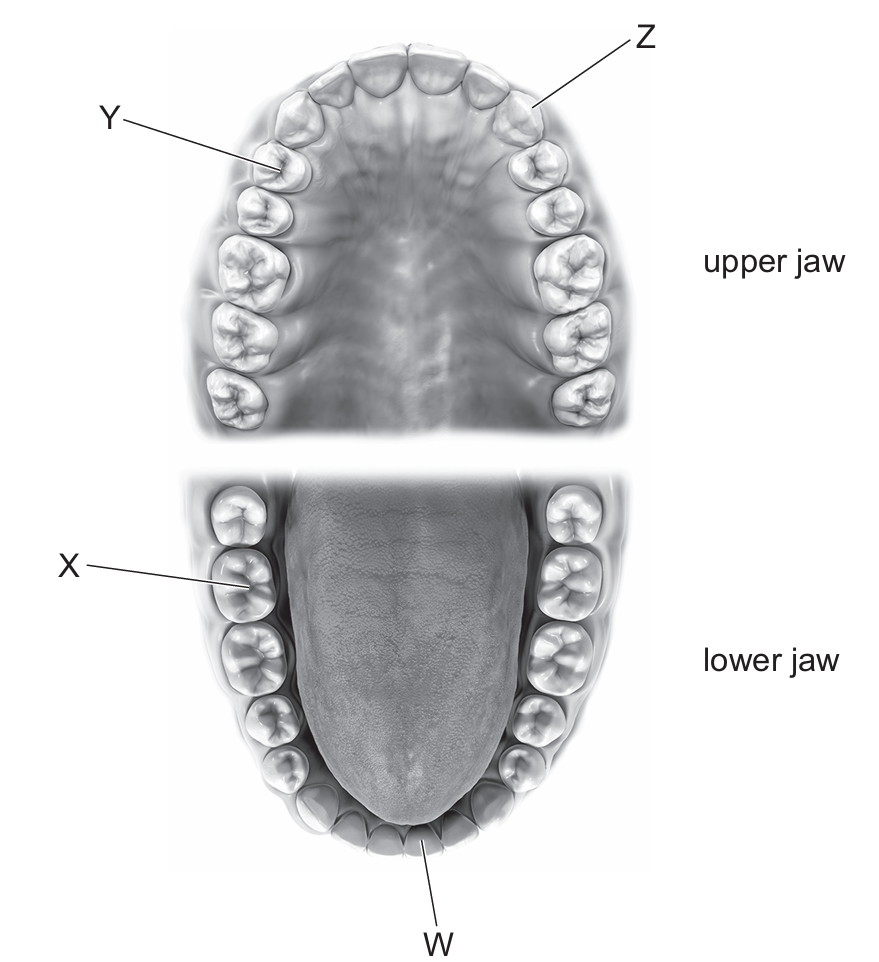
The diagram shows four different types of teeth in the upper and lower jaws in a human mouth.

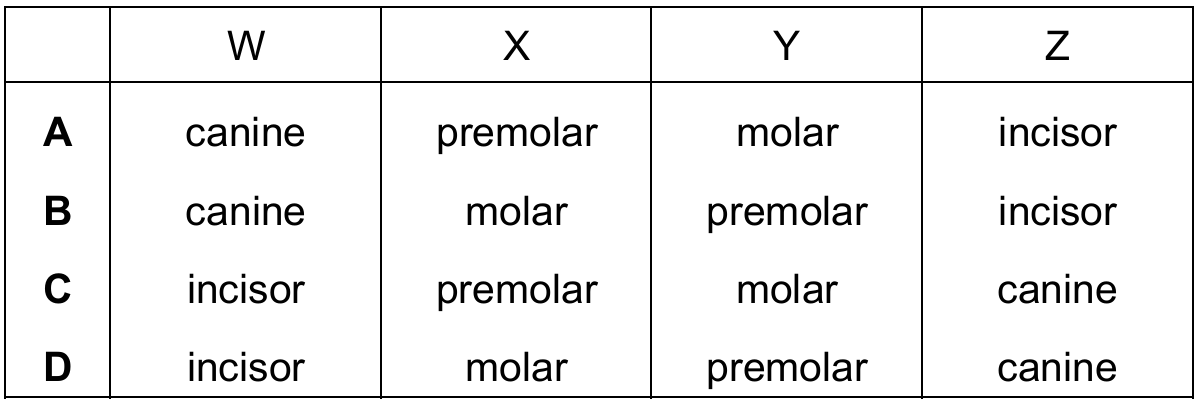
Which letters identify the types of teeth shown in the diagram?

▶️ Answer/Explanation
To identify the teeth, we look at their position and shape. Label $W$ points to the front-most teeth, the incisors, used for biting. Label $Z$ points to the pointed teeth next to them, the canines, used for tearing. Moving further back, $Y$ identifies the premolars, which have two cusps, while $X$ points to the molars at the very back, which have larger surface areas for grinding. Matching these identifications to the table confirms that row $D$ is the correct sequence.
Answer: (D)
Scroll to Top