
▶️ Answer/Explanation
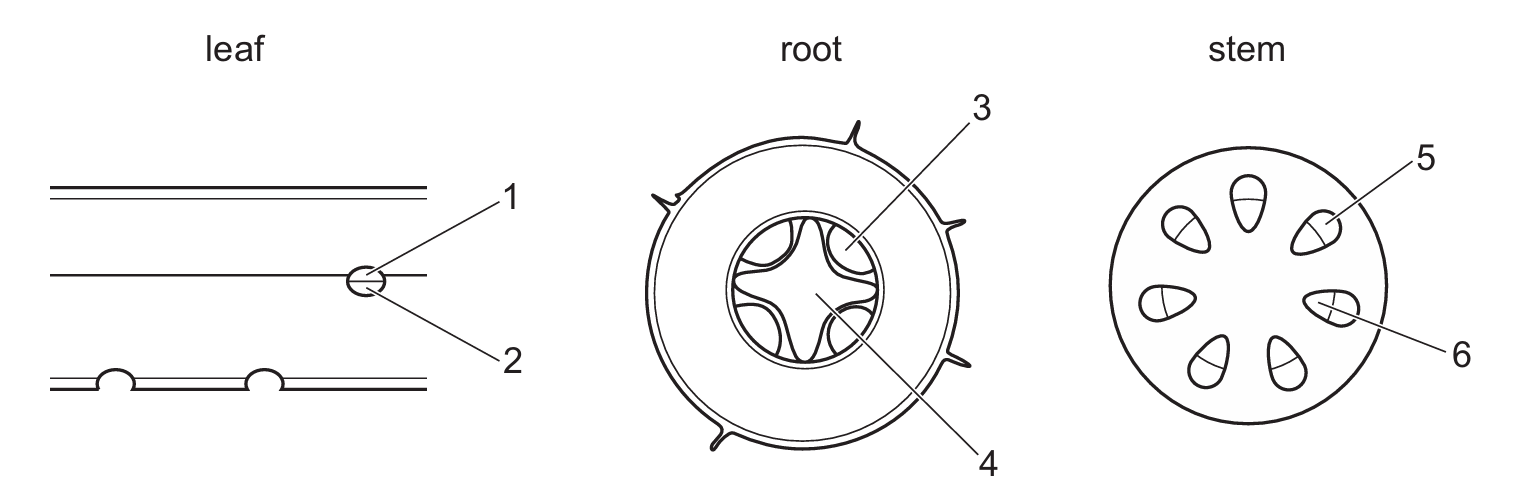
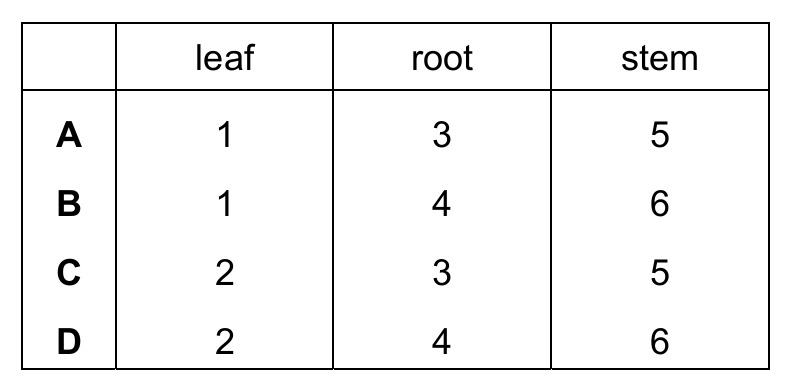
To identify the xylem, we look for its characteristic central or internal positioning in vascular bundles. In the leaf, xylem ($1$) is located on the upper side of the vascular bundle to facilitate water transport to the mesophyll. In the root, the xylem ($4$) forms a central X-shaped or star-shaped core to provide structural support. In the stem, the vascular bundles are arranged in a ring where the xylem ($6$) is situated towards the center (inner side) of the stem, while phloem faces the outside. Matching these positions leads to row B.
✅ Answer: (B)
✅ Answer: (B)
▶️ Answer/Explanation
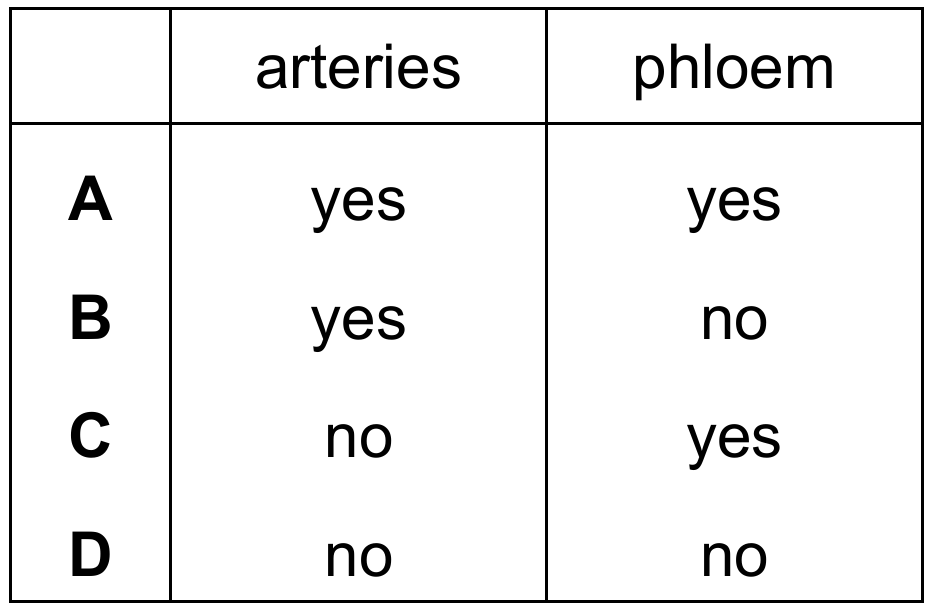
In humans, amino acids are absorbed into the bloodstream from the small intestine and are transported in the plasma to various cells via arteries. In plants, amino acids (along with sucrose) are transported through the phloem from sources, such as leaves or storage organs, to sinks where they are needed for growth. Since both structures are responsible for the translocation of these nutrients in their respective organisms, the correct answer must indicate “yes” for both columns.
✅ Answer: (A)
✅ Answer: (A)
▶️ Answer/Explanation
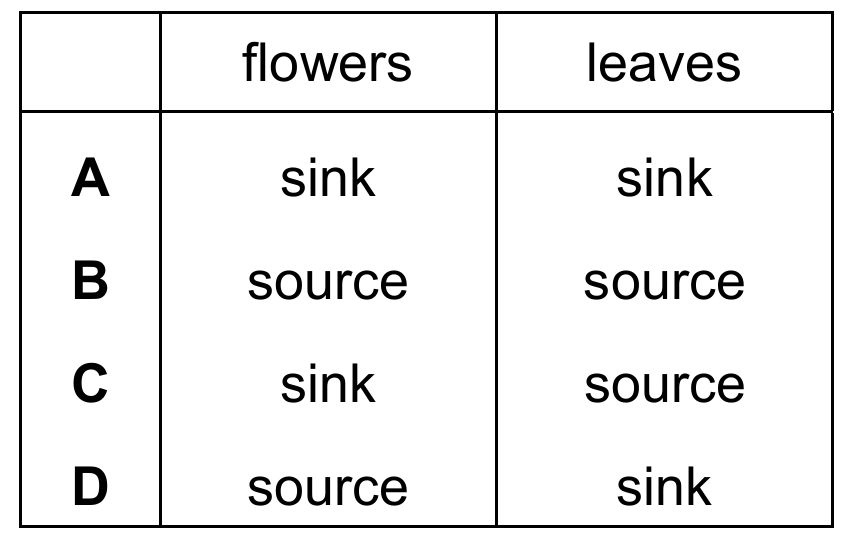
In plant biology, a source is an organ that produces or releases sugars (like mature leaves via photosynthesis), while a sink is an organ that consumes or stores them. In spring, the green leaves are actively photosynthesizing, making them the primary source of sucrose for the plant. The flowers are rapidly developing reproductive structures that do not photosynthesize significantly; instead, they require high amounts of energy to grow and bloom, thus acting as a major metabolic sink. Therefore, sugars are translocated through the phloem from the leaves to the flowers.
✅ Answer: (C)
✅ Answer: (C)