Home / iGCSE Biology (0610)-8.2 Water uptake – iGCSE Style Questions Paper 2

iGCSE Biology (0610)-8.2 Water uptake – iGCSE Style Questions Paper 2

Question

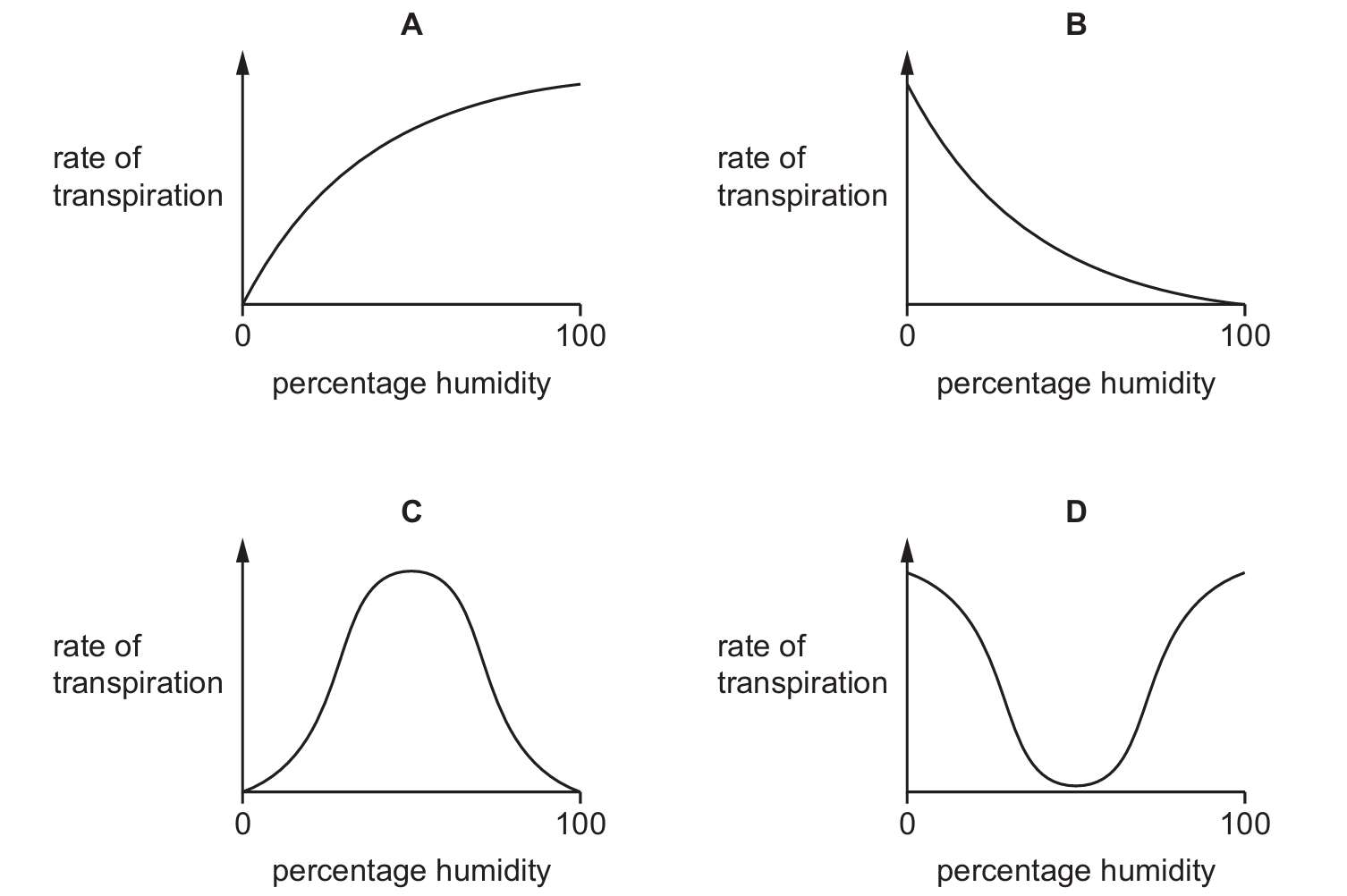
Which graph shows the effect of humidity in the air on the rate of transpiration in a plant?

▶️ Answer/Explanation
Transpiration is the process of water vapor loss from the internal tissues of a plant to the external atmosphere, primarily through the stomata. This movement is driven by a water potential gradient between the moist interior of the leaf and the drier air outside. When the percentage humidity in the air is low ($0\%$), the air is dry, creating a steep concentration gradient that causes water to evaporate rapidly. As humidity increases towards $100\%$, the air becomes saturated with water vapor, significantly reducing the gradient and slowing down the rate of evaporation. Therefore, the rate of transpiration is inversely proportional to the humidity of the surrounding air, which is correctly illustrated by the downward curve in Graph B.
Answer: (B)
Question

Parts of a plant are listed.

  1. mesophyll cells
  2. root cortex cells
  3. root hair cells
  4. xylem vessels

What is the pathway taken by water in the plant?

▶️ Answer/Explanation
Solution

Ans: D

Water absorption begins at the root hair cells (3), moves through the root cortex cells (2), enters the xylem vessels (4) for upward transport, and finally reaches the mesophyll cells (1) in leaves for photosynthesis. Thus, the correct sequence is 3 → 2 → 4 → 1 (Option D).

Question

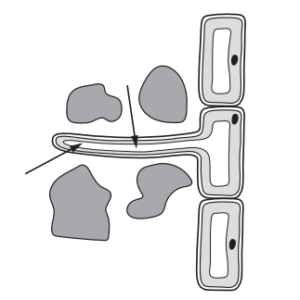
The arrows show the movement of substances from the soil into a root hair cell.

Which substances move from the soil into the root hair cell?

▶️ Answer/Explanation
Solution

Ans: D water and mineral ions

Root hair cells absorb water (via osmosis) and mineral ions (via active transport) from the soil. Glucose is not absorbed from the soil—it is synthesized by the plant during photosynthesis. Carbon dioxide and oxygen are exchanged in leaves, not roots. Thus, the correct answer is D.

Scroll to Top