
Question
Which processes occur during transpiration?
- Water diffuses from the air spaces into the mesophyll cells.
- Water evaporates from surfaces of mesophyll cells into air spaces.
- Water from air spaces evaporates through stomata.
- Water vapour from air spaces diffuses through stomata.
(B) 1 and 4
(C) 2 and 3
(D) 2 and 4
▶️ Answer/Explanation
Transpiration begins with liquid water evaporating from the moist surfaces of mesophyll cells into the intercellular air spaces (process 2). This water vapor then diffuses out of the leaf through the stomata, driven by a concentration gradient (process 4). Process 1 describes the reverse movement (into cells), which does not occur during transpiration. Process 3 incorrectly states that evaporation happens through stomata; evaporation occurs at the cell surfaces inside the leaf, not at the stomata.
✅ Answer: (D) 2 and 4
▶️ Answer/Explanation
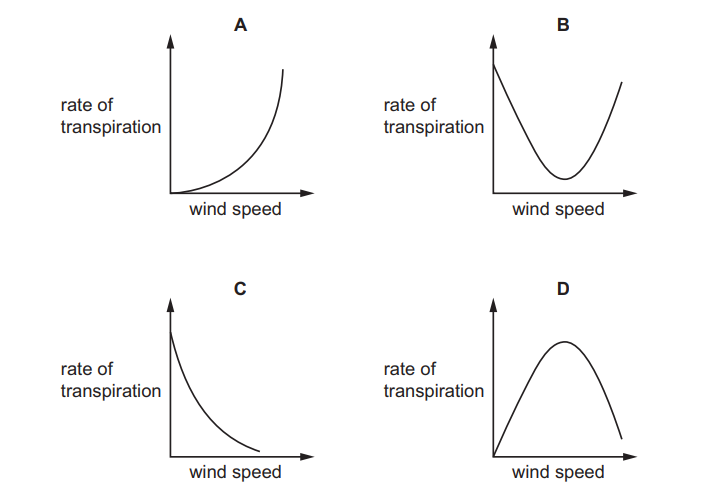
Ans: A
Increasing wind speed enhances the rate of transpiration by removing the moist air around the stomata, creating a steeper water vapor gradient. This causes more water to evaporate from the leaf surface.
Graph A correctly depicts this relationship, showing a steady rise in transpiration rate as wind speed increases. The other graphs either show no effect (B/C) or a decrease (D), which contradicts biological principles.
The diagram shows the pathway of water molecules through a leaf and out to the environment.
mesophyll cell → process X → air space → process Y → stomata
Which statements are correct?
- Process X is active transport.
- Process X is evaporation.
- Process Y is diffusion.
- Process Y is osmosis.
A) 1 and 3
B) 1 and 4
C) 2 and 3
D) 2 and 4
▶️ Answer/Explanation
Ans: C
Process X (mesophyll cell → air space): Water evaporates from the mesophyll cell surfaces into the air spaces. This is evaporation (Statement 2), not active transport (Statement 1 is incorrect).
Process Y (air space → stomata): Water vapor diffuses out through the stomata. This is diffusion (Statement 3), not osmosis (Statement 4 is incorrect).
Since Statements 2 and 3 are correct, the answer is C (2 and 3).