Question
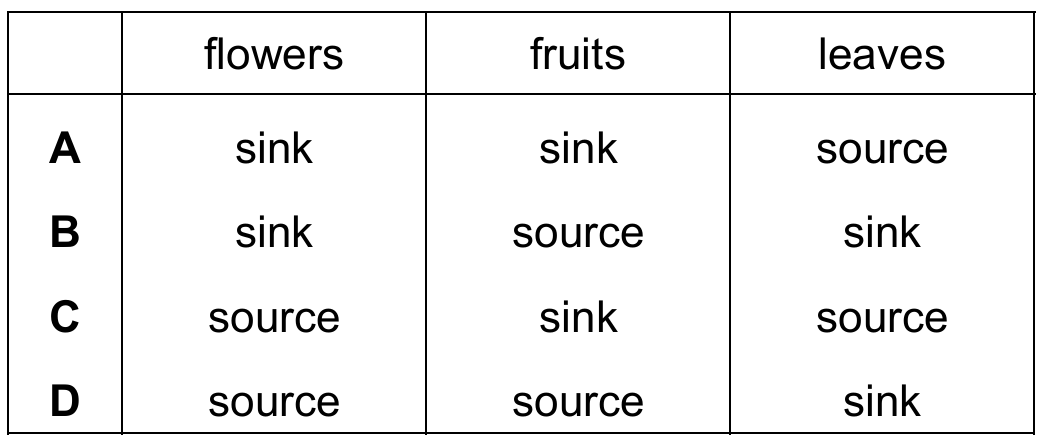
During the growing season, tomato plants produce flowers and fruits.
Which parts of a growing tomato plant are sources, and which parts are sinks?

▶️ Answer/Explanation
In plant physiology, a source is an organ that produces or mobilizes photosynthates (like sucrose), while a sink is an organ that consumes or stores them. During the growing season, mature leaves act as the primary sources because they perform photosynthesis. Conversely, flowers and fruits are actively growing or developing organs that require a high energy supply but do not produce enough food themselves; therefore, they function as sinks. This movement of nutrients occurs through the phloem tissue. Consequently, row A correctly identifies the roles of these plant parts.
✅ Answer: (A)
Question
What is translocation?
(B) the movement of starch and water from source to sink
(C) the movement of sucrose and amino acids from source to sink
(D) the movement of sucrose and mineral ions from sink to source
▶️ Answer/Explanation
Translocation is the process by which organic molecules, primarily sucrose and amino acids, are transported through the phloem of a plant. This movement occurs from “sources,” such as photosynthesizing leaves, to “sinks,” such as growing roots or developing fruits. Unlike transpiration, which only moves water and minerals upward in the xylem, translocation can move substances in multiple directions depending on where the plant needs energy. Starch is not moved directly because it is insoluble; it must be converted to sucrose first. Therefore, the transport of sucrose and amino acids from source to sink defines the process.
✅ Answer: (C)
Question
Which statements describe sources and sinks?
$1$ Palisade mesophyll cells only act as sinks.
$2$ Roots can act as sinks.
$3$ Sink cells only receive glucose from the phloem.
$4$ Spongy mesophyll cells can act as sources.
(B) $1$, $3$ and $4$ only
(C) $1$ and $3$ only
(D) $2$ and $4$ only
▶️ Answer/Explanation
✅ Answer: (D)
