

▶️ Answer/Explanation
In the human double circulatory system, the heart acts as the central pump that drives blood through two main circuits. In this schematic, Organ B represents the heart because it is the intersection point where blood is received from the lungs (Organ A) and pumped out to the rest of the body (Organs C and D).
Following the arrows, we see that blood flows from B to the lungs for oxygenation and then returns to B. From there, B pumps the oxygenated blood to the systemic organs (C and D) before it returns to B again to repeat the cycle. This central positioning and the direction of flow confirm that B is the muscular pump maintaining circulation.
✅ Answer: (B)
▶️ Answer/Explanation
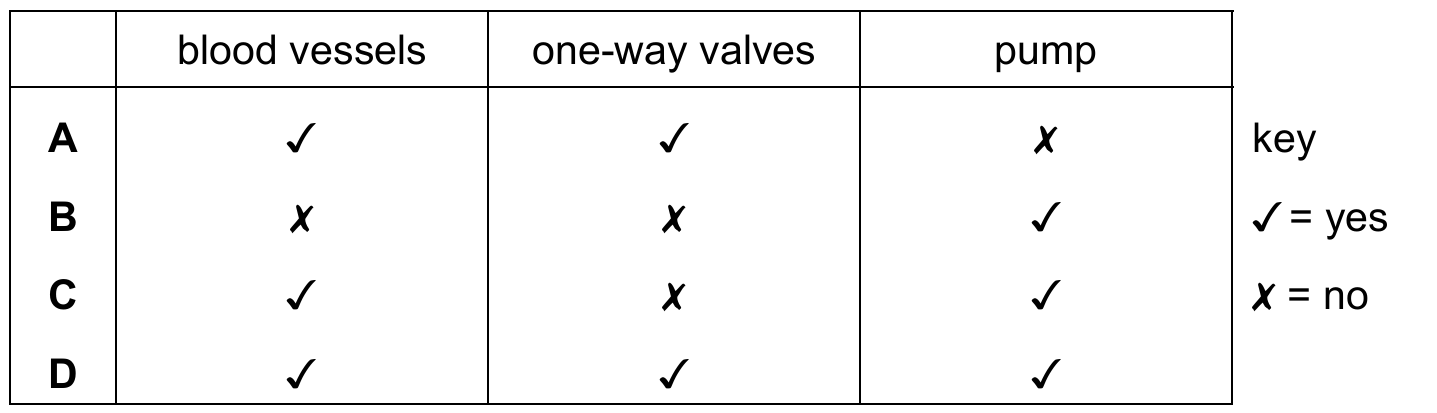
The correct answer is D.
The human circulatory system is a complex transport network that requires three essential features to function. First, it needs the heart to act as a muscular pump to drive blood flow. Second, it requires a system of blood vessels (arteries, veins, and capillaries) to contain and guide the fluid. Finally, it utilizes one-way valves within the heart and veins to prevent backflow and ensure blood moves in a single direction. Since all three components are integral to the system, Row D is the correct choice.