
Question
B blood clotting
C transport of oxygen
D transport of urea
▶️ Answer/Explanation
The correct answer is A.
Reasoning:
- White blood cells are essential for the immune system, primarily functioning to defend the body by producing antibodies and engulfing pathogens.
- Platelets are responsible for blood clotting (B) to prevent excessive bleeding.
- Red blood cells contain hemoglobin specifically for the transport of oxygen (C).
- Plasma, the liquid component of blood, facilitates the transport of urea (D) and other dissolved nutrients/wastes.
- Therefore, antibody production is the only white blood cell function listed.
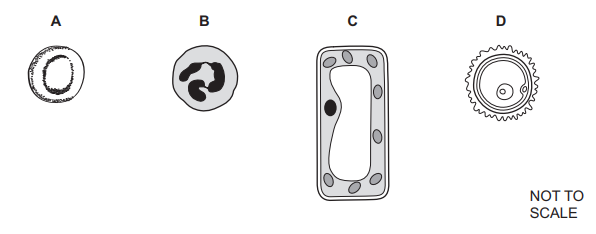
Which diagram represents a cell responsible for the transport of oxygen?
▶️ Answer/Explanation
Ans: A
The cell responsible for oxygen transport is the red blood cell (erythrocyte), represented by diagram A. These cells contain hemoglobin, which binds and carries oxygen throughout the body.
Other diagrams likely show different cell types: B might represent a nerve cell (neurons transmit signals, not oxygen), C could be a plant cell (involved in photosynthesis, not oxygen transport), and D might depict a muscle cell (uses oxygen but doesn’t transport it). Thus, only A fits the question’s requirement.
The photomicrograph shows two blood cells.
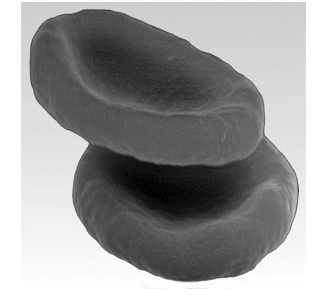
What is the function of these cells?
A) to carry out phagocytosis
B) to produce antibodies
C) to transport oxygen
D) to transport vitamins
▶️ Answer/Explanation
Ans: C
The photomicrograph shows red blood cells (erythrocytes), identifiable by their biconcave shape and lack of nuclei. Their primary function is to transport oxygen using the pigment hemoglobin.
Phagocytosis (A) is performed by white blood cells, antibody production (B) by lymphocytes, and vitamin transport (D) is not a primary role of erythrocytes. Thus, C is correct.