Home / iGCSE Chemistry (0620) Core:12.2 Acid–base titrations: Exam Style Questions Paper 1

iGCSE Chemistry (0620) Core:12.2 Acid–base titrations: Exam Style Questions Paper 1- New Syllabus

Question

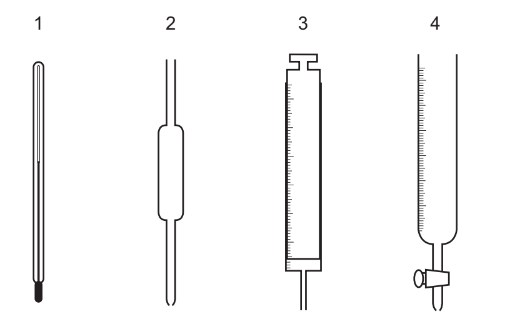
The concentration of acids and alkalis can be determined by titration. Which pieces of equipment are needed to perform a titration?

A. 1 and 2
B. 1 and 3
C. 2 and 3
D. 2 and 4

▶️ Answer/Explanation
A titration requires two key pieces of volumetric glassware that allow precise measurement of liquid volumes. A burette (piece 2) is essential as it allows the controlled, measured addition of one solution (the titrant) drop by drop into the other solution, with readings taken before and after to determine the exact volume added. A volumetric pipette (piece 4) is used to deliver a precise, fixed volume of the other solution into the conical flask before the titration begins, ensuring accuracy and reproducibility. A measuring cylinder (piece 1) is not precise enough for titration work, and a beaker (piece 3) cannot deliver or measure accurate volumes of solution. Together, the burette and volumetric pipette are the two essential pieces of equipment for performing an accurate acid-base titration.
Answer: (D)

Question

A scientist uses a titration to calculate the concentration of acid in a sample of lemon juice.

A measured volume of aqueous lemon juice and a few drops of an indicator are added to a flask.

The aqueous lemon juice is then titrated against 0.1 mol/dm³ aqueous sodium hydroxide.

Which piece of apparatus is used to add the aqueous sodium hydroxide to the flask?

A. a burette
B. a delivery tube
C. a measuring cylinder
D. a volumetric pipette

▶️ Answer/Explanation
In a titration, the solution of known concentration — here the 0.1 mol/dm³ sodium hydroxide — is the titrant and is always delivered from a burette, because a burette can dispense variable volumes with high precision (readable to ±0.05 cm³), which is essential for locating the exact end-point. A volumetric pipette is used to transfer a fixed, precise volume of the analyte (the lemon juice) into the flask, not to add the titrant. A measuring cylinder lacks the precision required for titration work, and a delivery tube is used for directing gases in gas-collection experiments, not for liquid addition in titrations.
Answer: (A)

Question

A salt, S, is dissolved in water and three tests are carried out on the solution formed.

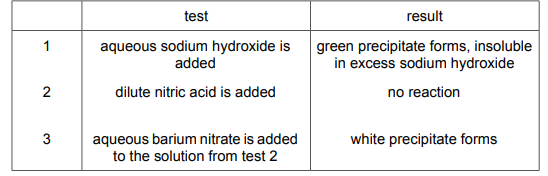
Table of test results: Test 1 - sodium hydroxide added, light blue precipitate, insoluble in excess. Test 2 - aqueous ammonia added, light blue precipitate, soluble in excess. Test 3 - dilute nitric acid and then aqueous barium nitrate added, white precipitate.

What is the identity of S?
A copper(II) chloride
B copper(II) sulfate
C iron(II) chloride
D iron(II) sulfate

▶️ Answer/Explanation
The light blue precipitate with both NaOH and aq. ammonia (soluble in excess ammonia) identifies the cation as copper(II) (Cu²⁺). The white precipitate with acidified barium nitrate confirms the presence of sulfate ions (SO₄²⁻). Therefore, the salt is copper(II) sulfate. Options A and C are incorrect because chloride would not give a precipitate with barium nitrate. Option D is incorrect because iron(II) forms a green, not light blue, precipitate.
Answer: (B) copper(II) sulfate
Scroll to Top