

▶️ Answer/Explanation
Propene (\(\mathrm{CH_3CH=CH_2}\)) undergoes addition reactions across the C=C double bond:
+ H₂ → propane (\(\mathrm{CH_3CH_2CH_3}\))
+ Br₂ → 1,2-dibromopropane (\(\mathrm{CH_3CHBrCH_2Br}\))
+ H₂O (steam) → mainly propan-2-ol (\(\mathrm{CH_3CH(OH)CH_3}\)) according to Markovnikov’s rule.
Option (D) shows the structures representing these products.
✅ Answer: (D)
+ H₂ → propane (\(\mathrm{CH_3CH_2CH_3}\))
+ Br₂ → 1,2-dibromopropane (\(\mathrm{CH_3CHBrCH_2Br}\))
+ H₂O (steam) → mainly propan-2-ol (\(\mathrm{CH_3CH(OH)CH_3}\)) according to Markovnikov’s rule.
Option (D) shows the structures representing these products.
✅ Answer: (D)
▶️ Answer/Explanation
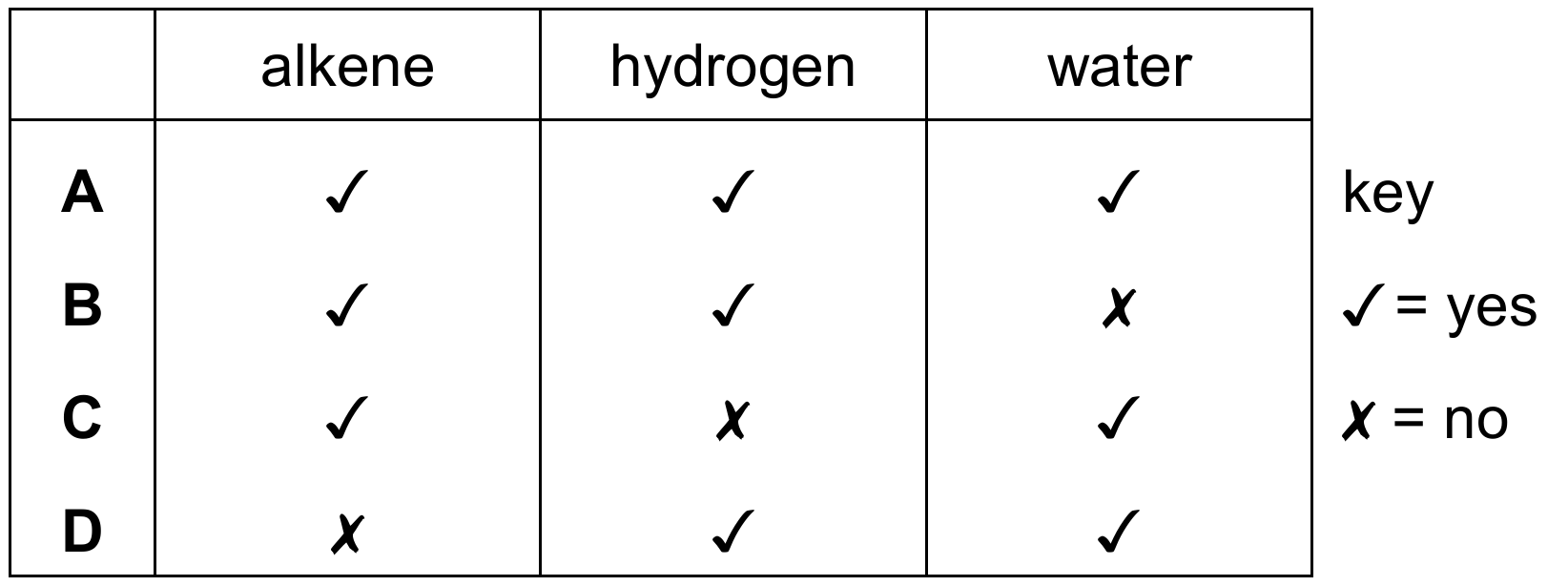
Cracking of a large alkane involves breaking long-chain hydrocarbons into smaller, more useful molecules. The primary products are alkanes and alkenes. Hydrogen can also be produced in some cracking processes, but water is not a product of alkane cracking.
✅ Answer: (B)
✅ Answer: (B)