iGCSE Chemistry 0620 Extended - 11.6 Alcohols- Exam Style Questions Paper 2- New Syllabus
Question
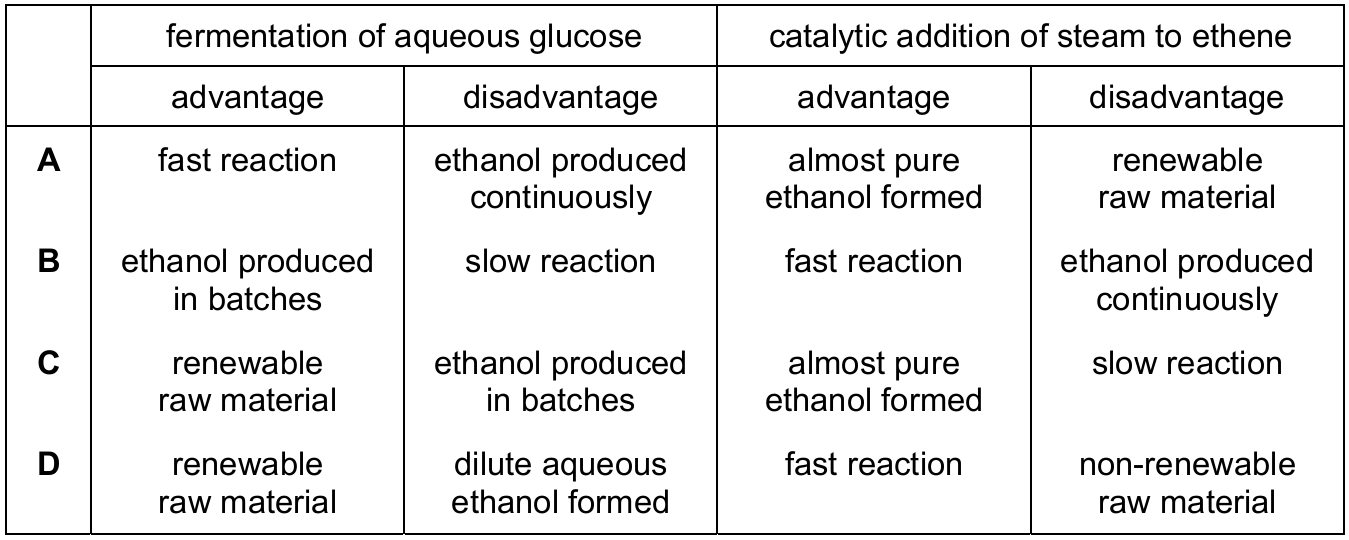
Ethanol is produced by fermentation of aqueous glucose or by catalytic addition of steam to ethene.
Which row shows advantages/disadvantages?

▶️ Answer/Explanation
✅ Answer: (D)
Question
Ethanol can be made by the fermentation of aqueous glucose and by the catalytic addition of steam to ethene.
What are two advantages of making ethanol by the catalytic addition of steam to ethene rather than by the fermentation of aqueous glucose?
A. faster reaction and renewable raw materials
B. purer product and faster reaction
C. renewable raw materials and continuous process
D. uses more energy and forms a purer product
▶️ Answer/Explanation
✅ Answer: (B)
Question
Ethanol can be made by fermentation of sugar, using yeast. This produces a mixture of ethanol and water. How is ethanol separated from this mixture?
A. distilling the mixture using a fractionating column
B. filtering the mixture
C. heating to evaporate most of the water, and allowing the ethanol to crystallise
D. heating to evaporate the water
▶️ Answer/Explanation
Correct Answer: A
Explanation: The fermentation mixture contains ethanol (boiling point 78°C) and water (boiling point 100°C). Since they are miscible liquids with different boiling points, fractional distillation is used to separate them. The fractionating column allows the more volatile ethanol to vaporise first, then condense and be collected separately from water. Filtering would remove solids, not separate dissolved liquids. Ethanol does not crystallise; it is a liquid. Evaporating water would leave ethanol, but this is inefficient and less pure.
✅ Distilling the mixture using a fractionating column.
