iGCSE Chemistry 0620 Extended - 11.8 Polymers- Exam Style Questions Paper 2- New Syllabus
Question
The diagrams represent four monomers.
![]()
The monomers each react in a 1:1 ratio with the dicarboxylic acid shown.
![]()
How many of the four monomers shown can react with the dicarboxylic acid to form a polymer?
A. 1
B. 2
C. 3
D. 4
▶️ Answer/Explanation
✅ Answer: (B)
Question
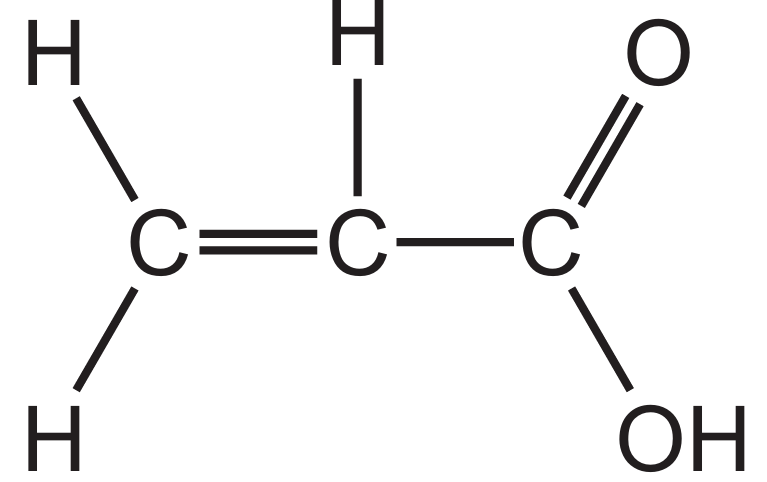
Propeneic acid is an organic compound that is both an alkene and a carboxylic acid.
Its structure is shown.

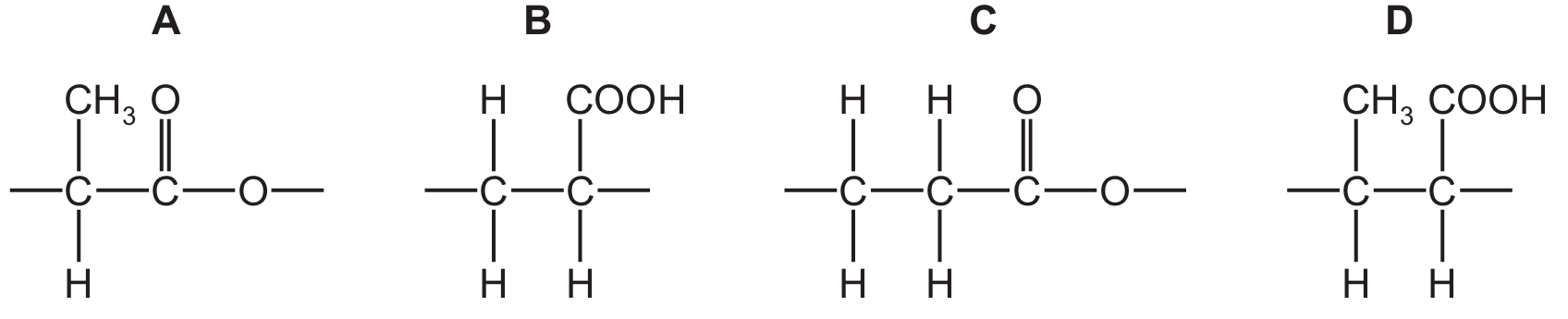
Which structure represents one repeat unit of the addition polymer formed from propeneic acid?

▶️ Answer/Explanation
✅ Answer: (B)
Question
Which statement about addition polymers or condensation polymers is correct?
A. Addition polymers only contain carbon and hydrogen atoms.
B. One of the monomers used to make a polyester is a diamine.
C. Addition polymers contain carbon-carbon double bonds in the main chain.
D. Water is an additional product in the formation of a protein from amino acids.
▶️ Answer/Explanation
Correct Answer: D
Explanation: Proteins are natural polyamides formed by condensation polymerisation of amino acid monomers. In condensation polymerisation, a small molecule (usually water) is eliminated as the polymer forms. When two amino acids join, a water molecule is released, forming a peptide bond. Addition polymers (like poly(ethene)) contain only single C-C bonds in the main chain and can contain atoms other than C and H (e.g., PVC contains Cl). Polyesters are made from a dicarboxylic acid and a diol, not a diamine (polyamides use diamines).
✅ Water is an additional product in the formation of a protein from amino acids.