Home / iGCSE Chemistry 0620 Extended – 12.2 Acid–base titrations- Exam Style Questions Paper 2

iGCSE Chemistry 0620 Extended - 12.2 Acid–base titrations- Exam Style Questions Paper 2- New Syllabus

Question

The concentration of acids and alkalis can be determined by titration.

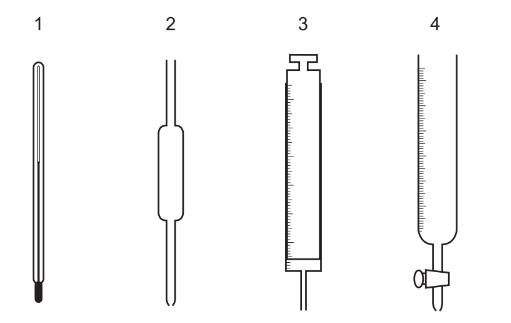
Which pieces of equipment are needed to perform a titration?

Titration equipment options table

▶️ Answer/Explanation
A standard acid-base titration requires three key pieces of equipment: a burette (to deliver a precise, variable volume of one solution), a volumetric pipette (to measure an accurate, fixed volume of the other solution into the flask), and a suitable indicator (to show the end-point of the reaction by a colour change). A conical flask holds the solution being titrated. The correct option must include the burette, volumetric pipette, and indicator — all three are essential.
Answer: (D)

Question

What is used to identify the end-point of an acid–base titration?

A) balance
B) measuring cylinder
C) indicator
D) volumetric pipette

▶️ Answer/Explanation
Solution

Ans: C

In an acid-base titration, the end-point is detected using an indicator, which changes color at the equivalence point (when moles of acid = moles of base). A balance measures mass, a measuring cylinder provides approximate volumes, and a volumetric pipette delivers precise liquid amounts—none detect the reaction completion. Thus, the correct answer is C) indicator.

Question

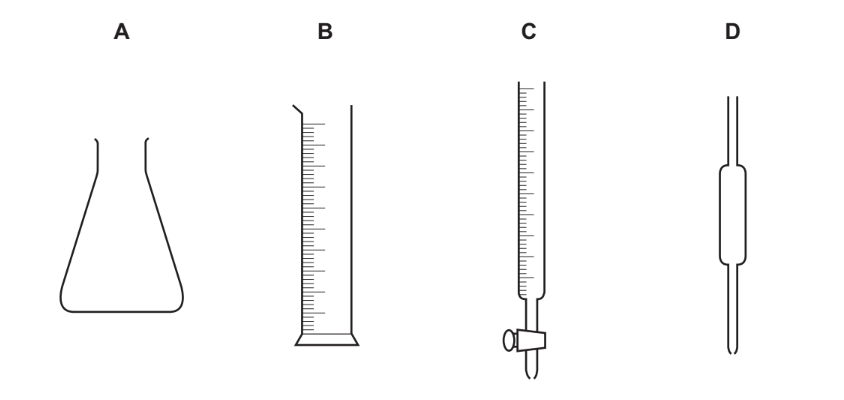
Which piece of apparatus is used to measure variable quantities of liquid in a titration?

▶️ Answer/Explanation
Solution

Ans: C

In a titration, a burette (apparatus C) is used to measure and dispense variable volumes of liquid with high precision. Key features:

  • Graduated scale for accurate volume readings.
  • A stopcock to control liquid flow dropwise.
  • Designed specifically for titrations to determine the exact endpoint.

Other options (A: beaker, B: measuring cylinder, D: pipette) lack the precision or controllability needed for titrations.

Scroll to Top