
▶️ Answer/Explanation
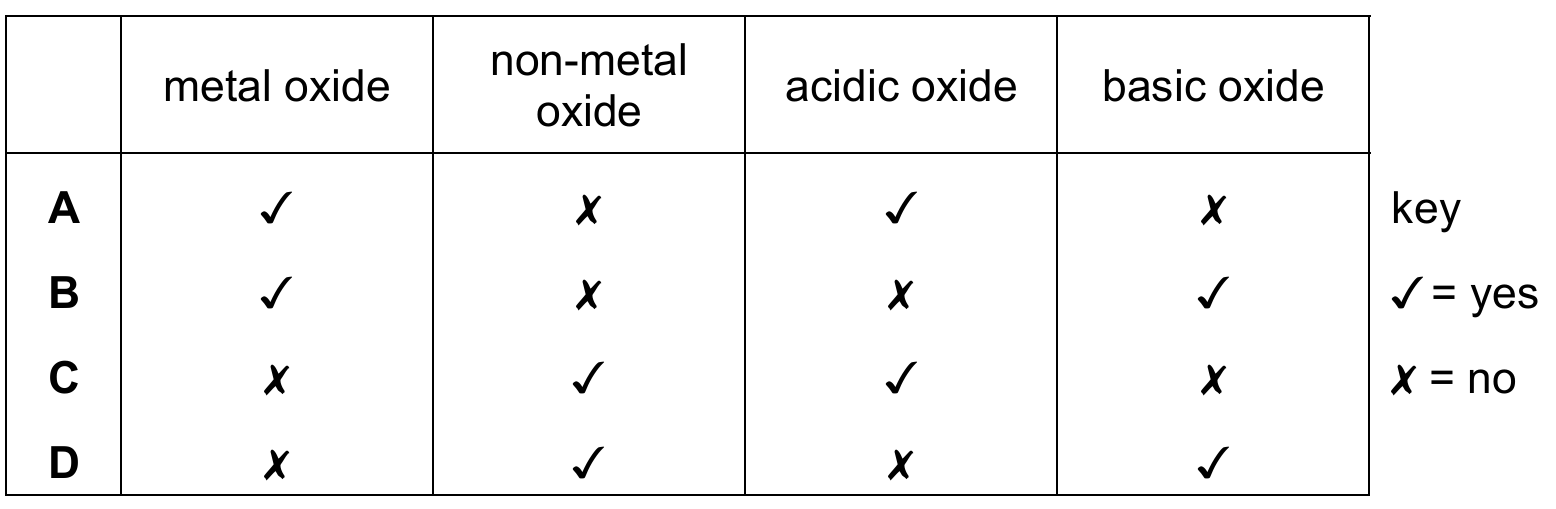
Phosphorus is a non-metal. Non-metals form non-metal oxides, which are usually acidic. The low pH of 1 confirms it is an acidic oxide.
✅ Answer: (C)
✅ Answer: (C)
Four metal oxides are listed.
Which metal oxides are amphoteric?
A. 1 and 4
B. 1 only
C. 2, 3 and 4
D. 2 and 3 only
Correct Answer: A (1 and 4)
Explanation: Amphoteric oxides react with both acids and bases to form salts and water. According to the syllabus (section 7.2), \(\mathrm{Al_2O_3}\) (aluminium oxide) and \(\mathrm{ZnO}\) (zinc oxide) are amphoteric. CaO (calcium oxide) is basic, and CuO (copper(II) oxide) is basic.
✅ \(\mathrm{Al_2O_3}\) and \(\mathrm{ZnO}\) are amphoteric.
Phosphorus is an element in Group V of the Periodic Table.
It burns in air to form an oxide that dissolves in water to form a solution with a pH of 1.
Which row describes this oxide of phosphorus?
Which metal oxide reacts with aqueous sodium hydroxide to form a salt and water?
A. calcium oxide
B. copper(II) oxide
C. sodium oxide
D. aluminium oxide