Home / iGCSE Chemistry 0620 Extended – 9.2 Uses of metals- Exam Style Questions Paper 2

iGCSE Chemistry 0620 Extended - 9.2 Uses of metals- Exam Style Questions Paper 2- New Syllabus

Question

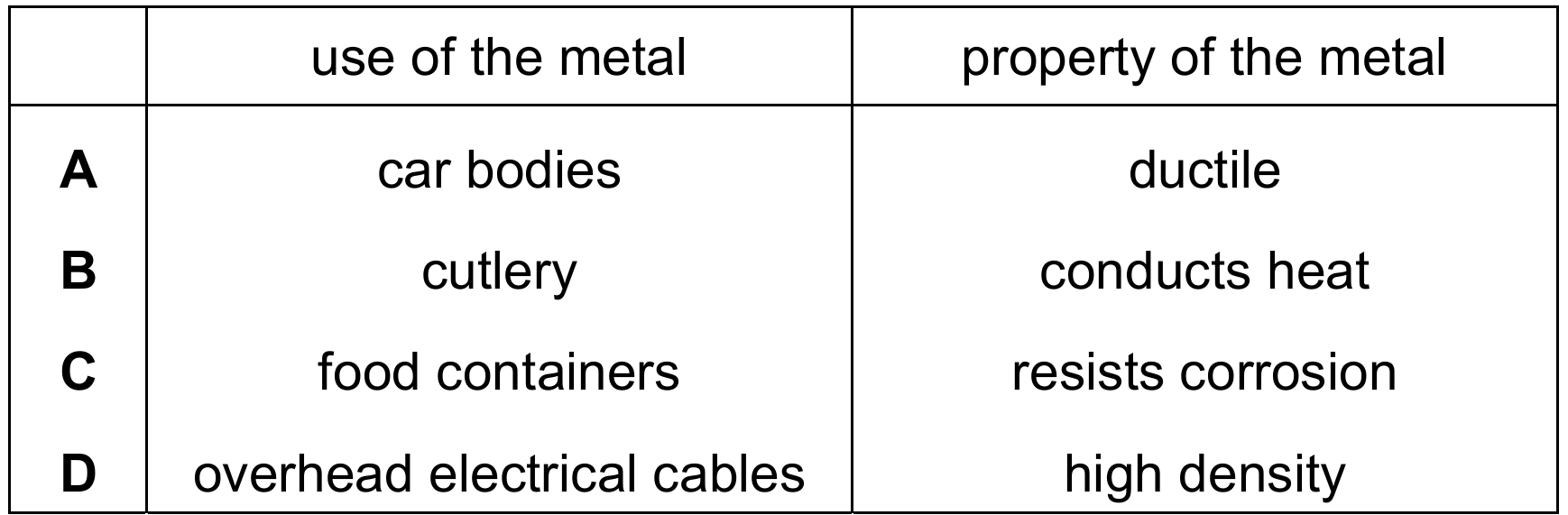
Uses of metals depend on their properties.
Which property is necessary for the use given?

▶️ Answer/Explanation
Aluminium is extensively utilized to manufacture food containers because it forms a protective, non-reactive oxide layer on its surface that completely resists corrosion by food acids. Car bodies require malleability (not ductility), cutlery requires resistance to rusting over thermal conductivity, and overhead cables strictly require a low density to avoid sagging.
Answer: (C)

Question

Which statement about the properties and uses of copper is correct?

A. It is used in electrical wiring, and it is ductile.
B. It is mixed with tin to make the alloy brass.
C. It is used in overhead electrical cables because it has a low density.
D. It is used in takeaway food containers because of its resistance to corrosion.

▶️ Answer/Explanation
Copper’s primary use in electrical wiring is because it has excellent electrical conductivity and is highly ductile, meaning it can be drawn into thin wires without breaking. Option B is wrong because copper and tin make bronze, not brass. Option C is wrong because overhead cables usually use aluminium due to its lower density. Option D is wrong because aluminium, not copper, is typically used for takeaway containers.
Answer: (A)

Question

Which statement about copper or aluminium is correct?

A. Aluminium is more dense than copper.
B. Aluminium is less reactive than copper.
C. Copper has high ductility.
D. Copper has poor electrical conductivity.

▶️ Answer/Explanation
Let’s evaluate the options: Aluminium is renowned for its remarkably low density compared to transition metals like copper, making option A false. Aluminium is located significantly higher in the reactivity series than copper, making option B false. Copper is an outstanding electrical conductor used worldwide in wiring, ruling out option D. Option C is entirely correct because copper is highly ductile, meaning it can easily be pulled and stretched into thin conducting wires without snapping.
Answer: (C)
Scroll to Top