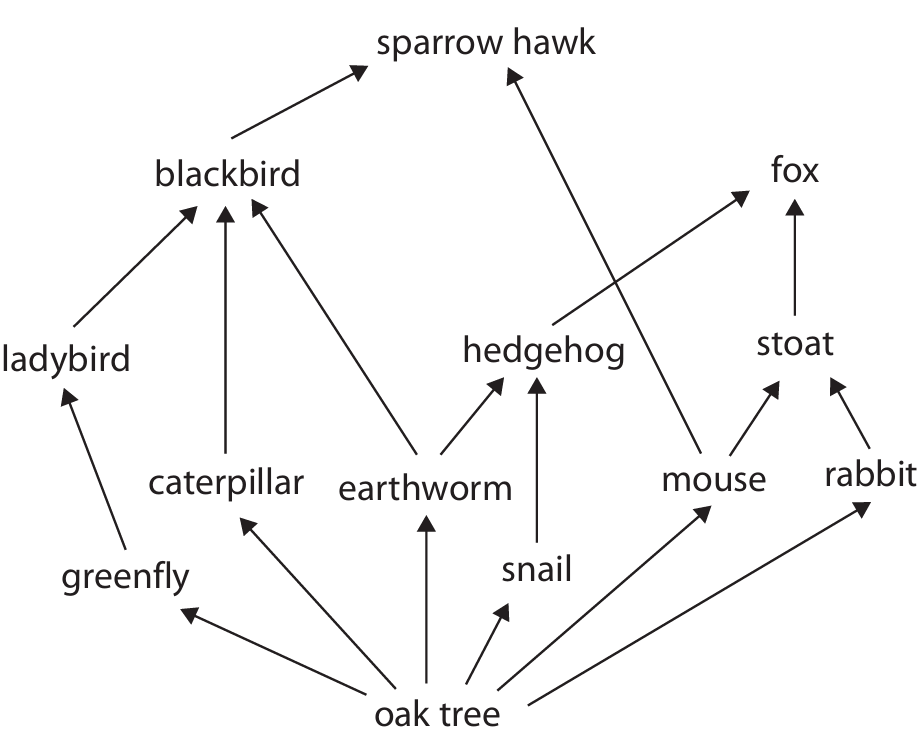
This food web comes from a woodland ecosystem.

(a) (i) Which organism is the producer?
A) caterpillar
B) earthworm
C) oak tree
D) stoat
(ii) Which organism is a secondary consumer?
A) caterpillar
B) earthworm
C) fox
D) ladybird
(iii) Which organism is both a secondary and a tertiary consumer?
A) blackbird
B) earthworm
C) fox
D) stoat
(b) A farmer is using a pesticide in fields next to the woodland. The pesticide is reducing the numbers of greenfly and caterpillars in the woodland.
(i) Explain what effect this may have on the blackbirds in the woodland.
(ii) Describe a different method the farmer could use to reduce the number of greenfly on his crops.
Most-appropriate topic codes (Edexcel IGCSE Biology):
• 4(d): Human influences on the environment — parts (b)(i), (b)(ii)
• 5(a): Food production — part (b)(ii)
▶️ Answer/Explanation
(a)(i) C (oak tree)
The oak tree is the producer because it can produce its own food via photosynthesis. It forms the base of the food web.
A is not correct because a caterpillar is a consumer (primary).
B is not correct because an earthworm is a decomposer/consumer.
D is not correct because a stoat is a tertiary consumer.
(a)(ii) D (ladybird)
A secondary consumer is an organism that feeds on primary consumers. In this web, the ladybird eats greenfly (a primary consumer).
A is not correct because a caterpillar is a primary consumer (eats producer).
B is not correct because an earthworm is a decomposer/primary consumer.
C is not correct because a fox can be a secondary or tertiary consumer, but is not exclusively a secondary consumer in this context.
(a)(iii) A (blackbird)
The blackbird is both a secondary and tertiary consumer because its diet includes both primary consumers (like caterpillars, snails) and secondary consumers (like ladybirds).
B is not correct because an earthworm is not a secondary/tertiary consumer.
C is not correct because a fox is primarily a tertiary consumer.
D is not correct because a stoat is a tertiary consumer.
(b)(i)
An explanation that makes reference to three of the following points:
• The number of blackbirds may decrease / population falls / some may die or migrate. (1 mark)
• There is less food available for blackbirds, as they eat caterpillars and ladybirds. (1 mark)
• Ladybirds also have less food (greenfly), reducing their numbers, which further reduces the blackbird’s food source. (1 mark)
• Blackbirds may switch to eating more earthworms, but this may not fully compensate. (1 mark)
• Blackbirds could consume pesticide directly or via bioaccumulation, which may poison them. (1 mark)
(Maximum 3 marks)
(b)(ii)
A description that makes reference to the following:
• Use biological control. (1 mark)
• Introduce a natural predator of greenfly, such as more ladybirds or lacewings. (1 mark)
• The predator will eat / consume / prey on the greenfly, reducing their population. (1 mark)
This method avoids the harmful side-effects of chemical pesticides on non-target species and the environment.
A student investigates the effect of different concentrations of sucrose on potato tissue. The student first makes a series of sucrose solutions using this dilution table.
| Test tube | Volume of 1 molar sucrose solution in cm³ | Volume of distilled water in cm³ | Concentration of sucrose solution in mole per litre |
|---|---|---|---|
| 1 | 20 | 0 | 1.0 |
| 2 | 16 | 0.8 | |
| 3 | 12 | 8 | 0.6 |
| 4 | 8 | 12 | 0.4 |
| 5 | 4 | 16 | 0.2 |
| 6 | 0 | 20 | 0.0 |
(a) Complete the table by writing the volume of distilled water for test tube 2.
(b) This is the student’s method.
Step 1: Cut six equal-size cylinders of potato each 5 cm in length.
Step 2: Dry the cut surfaces using filter paper.
Step 3: Measure the mass of each cylinder.
Step 4: Place one cylinder of potato in each of the six test tubes containing:
- 20 cm³ of 1 molar (1.0 mole per litre) sucrose solution,
- 20 cm³ of 0.8 molar sucrose solution,
- 20 cm³ of 0.6 molar sucrose solution,
- 20 cm³ of 0.4 molar sucrose solution,
- 20 cm³ of 0.2 molar sucrose solution,
- 20 cm³ of distilled water.
Step 5: Put a bung in each test tube and leave the test tubes for one hour.
Step 6: Remove the cylinders from each test tube.
Step 7: Dry the cylinders with filter paper.
Step 8: Measure the mass of each cylinder again.
Explain the reason for step 7 in the student’s method.
(c) The table shows the student’s results.
| Concentration of sucrose solution in mole per litre | Original mass in g | Final mass in g | Change in mass in g | Percentage change in mass (%) |
|---|---|---|---|---|
| 1.0 | 2.1 | 1.8 | -0.3 | -14 |
| 0.8 | 2.1 | 1.9 | -0.2 | -9.5 |
| 0.6 | 2.2 | 2.2 | 0.0 | 0.0 |
| 0.4 | 2.2 | 2.3 | ||
| 0.2 | 2.1 | 2.2 | 0.1 | 4.8 |
| 0.0 | 2.1 | 2.3 | 0.2 | 9.5 |
(i) Calculate the percentage change in mass for the 0.4 mole per litre sucrose solution.
(ii) Comment on the effect of the different concentrations of sucrose on the potato tissue.
Most-appropriate topic codes (Edexcel IGCSE Biology):
• Appendix 4: Mathematical skills — part (c)(i)
• Appendix 5: Command word taxonomy — parts (b), (c)(ii)
▶️ Answer/Explanation
(a) 4 cm³
Explanation: The total volume in each test tube is 20 cm³. For test tube 2, 16 cm³ of 1M sucrose is used. To find the water volume: \(20 – 16 = 4\) cm³.
(b) An explanation that makes reference to two of the following:
• To remove surface moisture / liquid (1)
• So that the surface moisture does not add to / alter / affect the mass / affect results (1)
• So a valid comparison can be made with the pre-solution (dried) cylinder (1)
Explanation: If the cylinder is not dried after removal from the solution, the extra liquid on its surface would increase its measured mass. This would give an inaccurate reading for the mass change due to osmosis alone. Drying ensures only the mass of the potato tissue itself is measured.
(c)(i) \(4.5\%\) (allow \(4.55\) or \(4.545\))
Working:
Change in mass = Final mass – Original mass = \(2.3 – 2.2 = 0.1\) g
Percentage change = \(\frac{\text{change in mass}}{\text{original mass}} \times 100 = \frac{0.1}{2.2} \times 100 \approx 4.545\%\)
(c)(ii) An answer that makes reference to five of the following: (5 marks)
1. The potato loses mass in higher sucrose concentrations (\(1.0\) M, \(0.8\) M) (1)
2. The potato gains mass in lower sucrose concentrations (\(0.0\) M, \(0.2\) M, \(0.4\) M) (1)
3. This is because water moves out of or into the potato cells (1)
4. By the process of osmosis (1)
5. Water moves from an area of higher water potential (dilute solution / potato) to an area of lower water potential (concentrated solution) (1)
6. There is no change in mass in the \(0.6\) M solution (1)
7. This shows the potato tissue and the \(0.6\) M solution have the same water potential / are isotonic (1)
Explanation: In solutions more concentrated than the potato cell contents (hypertonic), water leaves the cells by osmosis, causing the potato to lose mass. In solutions less concentrated (hypotonic), water enters the cells, causing mass gain. The concentration where no net movement occurs (\(0.6\) M) is isotonic to the potato cells.
(a) A student investigates the differences between inhaled and exhaled air using this apparatus.

(i) They use solution X to compare the concentration of carbon dioxide in inhaled and exhaled air. Give the name of solution X.
(ii) Explain the changes that will take place in solution X in test tube A and in test tube B.
(iii) Other than concentration of carbon dioxide, state one other difference between exhaled air and inhaled air.
(b) Another student investigated the effect of the duration of exercise on their breathing rate.
These are their results.
| Duration of exercise in seconds | Breathing rate in breaths per minute |
|---|---|
| 0 | 22 |
| 30 | 26 |
| 60 | 28 |
| 90 | 32 |
| 120 | 35 |
| 150 | 38 |
| 180 | 42 |
| 210 | 40 |
| 240 | 40 |
(i) Give the independent variable in this investigation.
(ii) Plot a line graph to show the effect of duration of exercise on breathing rate.Join the points with straight lines.
(iii) Describe the effect of duration of exercise on breathing rate.
(iv) Give one way the student could improve the reliability of their investigation.
Most-appropriate topic codes (Edexcel IGCSE Biology):
• 2(f): Respiration — part (a)(iii) link
• 3: Experimental skills and data analysis — parts (b)(i), (b)(ii), (b)(iii), (b)(iv)
▶️ Answer/Explanation
(a)(i) • limewater / hydrogen carbonate indicator / sodium hydrogen carbonate / sodium bicarbonate / bicarbonate indicator / eq
Explanation: Limewater (calcium hydroxide solution) is a standard test for carbon dioxide, turning cloudy/milky. Hydrogen carbonate indicator is also commonly used, changing color based on \(CO_2\) concentration (e.g., from red to yellow with high \(CO_2\)).
(a)(ii) An explanation that makes reference to three of the following:
• Tube A (inhaled air) stays clear / shows no (significant) change / eq (1)
• Tube B (exhaled air) goes cloudy / milky / turns yellow (if using hydrogen carbonate indicator) / eq (1)
• Because exhaled air has a much higher concentration of carbon dioxide / \(CO_2\) / eq (1)
• The carbon dioxide reacts with the limewater to form insoluble calcium carbonate (which causes the cloudiness) / eq (1)
Explanation: Inhaled air contains approximately 0.04% \(CO_2\), while exhaled air contains about 4% \(CO_2\). The higher \(CO_2\) in exhaled air produces a visible reaction with the indicator solution.
(a)(iii) • (exhaled air is) warmer / has less oxygen / has more water vapour / eq (1)
Explanation: During respiration in the body, energy is released as heat, warming the exhaled air. Also, oxygen is used up, and the air is saturated with water vapour from the moist lining of the respiratory system.
(b)(i) • duration (of exercise) / time / eq (1)
Explanation: The independent variable is the one that is deliberately changed or manipulated by the investigator. Here, it’s the duration of exercise in seconds.
(b)(ii) A line graph that scores marks for:
• Scales linear and covering at least 2 big squares on the y-axis and 3 on the x-axis (1)
• Points correctly plotted within a small square tolerance (1)
• Straight lines drawn connecting all points in order (1)
• Axes correct way round: Duration (s) on x-axis, Breathing rate (breaths/min) on y-axis (1)
• Both axes labelled with correct quantity and unit (1)
Note: A sketch would show a generally increasing trend from 0s to 180s, peaking at 42 breaths/min, then a slight dip and plateau from 210s to 240s at 40 breaths/min.
(b)(iii) A description that includes two of the following:
• Breathing rate increases (with duration) until 180 seconds / up to 42 breaths per minute / eq (1)
• (After 180 seconds) it decreases slightly / from 42 to 40 breaths per minute (between 180 and 210 seconds) / eq (1)
• (After 210 seconds) it then levels out / becomes constant / plateaus at 40 breaths per minute / eq (1)
Explanation: The initial increase is due to the body’s demand for more oxygen and removal of \(CO_2\) during exercise. The slight decrease and plateau may indicate the body reaching a steady state or the subject tiring.
(b)(iv) • repeat (the investigation) / use more students / people / take more readings / eq (1)
Explanation: Repeating the investigation and calculating a mean, or using more subjects, improves reliability by reducing the effect of random errors or individual variation.
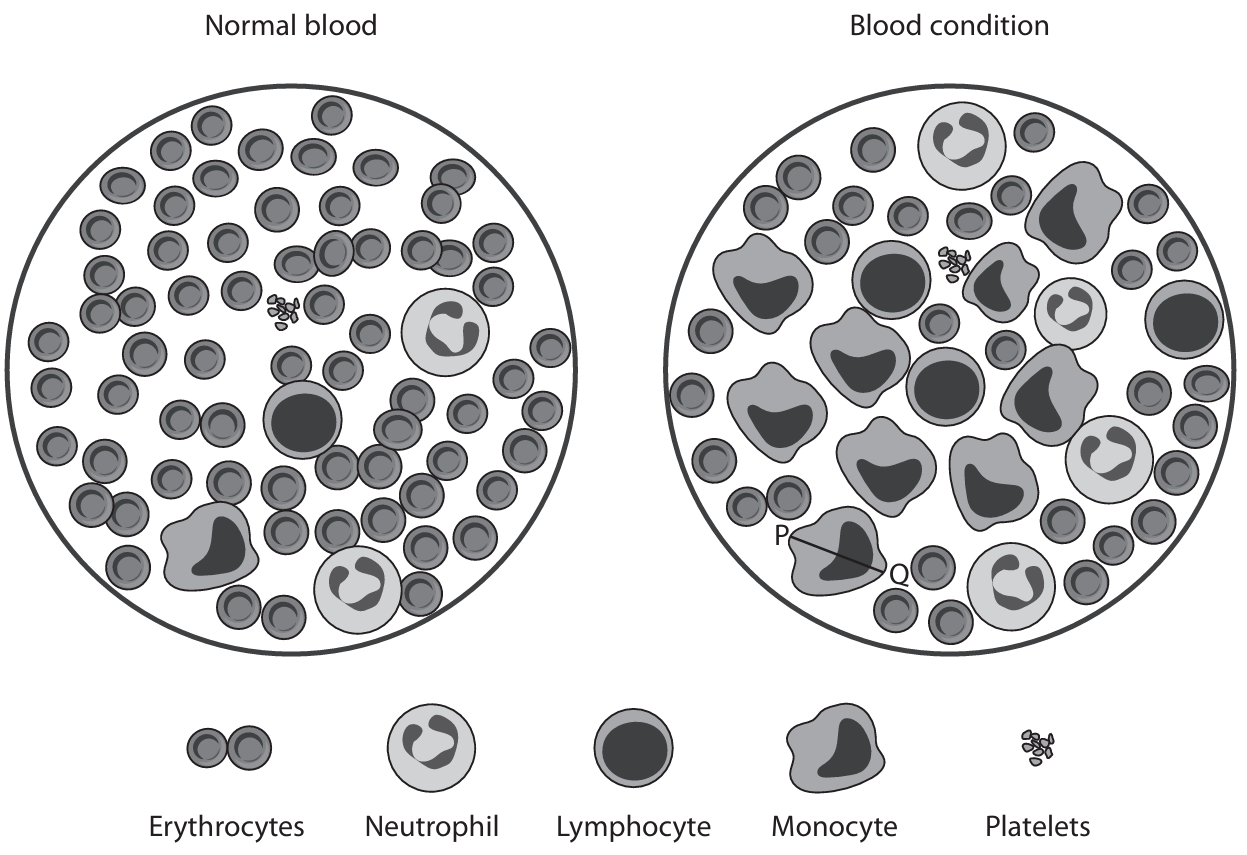
The diagram shows two samples of blood seen using a high power microscope. One sample is of normal blood and the other sample is from a patient with a blood condition.

(a) State two differences between the normal blood sample and the sample from the patient with the blood condition.
(b) The line P-Q shown on the diagram has an actual length of \( 25 \; \mu m \).
\( [1000 \; \mu m = 1 \; mm] \)
Calculate the magnification of the diagram.
(c) In a healthy person \( 1 \; cm^3 \) of blood contains \( 5.0 \times 10^9 \) red blood cells.
An adult has \( 5.0 \) litres (\( 5.0 \; dm^3 \)) of blood in their body.
Calculate the number of red blood cells in the body of a healthy adult. Give your answer in standard form.
\( [1 \; dm^3 = 1000 \; cm^3] \)
(d) Using the information from the diagram and your own knowledge, comment on the likely effect of the blood condition on the patient.
Most-appropriate topic codes (Edexcel IGCSE Biology):
• Appendix 3: Mathematical skills — parts (b), (c)
• 2(j): Co-ordination and response (Homeostasis) — part (d)
▶️ Answer/Explanation
(a) An answer that makes reference to two of the following:
• More red cells / erythrocytes in the blood condition (1).
• Fewer lymphocytes in the blood condition (1).
• Fewer monocytes in the blood condition (1).
• Fewer neutrophils in the blood condition (1).
If no reference to a named white blood cell, allow “fewer white blood cells” for 1 mark.
(b)
• Measure the line P-Q from the diagram (e.g., 14 mm) (1).
• Convert actual length to mm: \( 25 \; \mu m = 25 / 1000 = 0.025 \; mm \).
• Magnification = Image size / Actual size = \( \frac{14}{0.025} \).
• Magnification = \( \times 560 \) (allow range 520–600) (1).
Full working required for full marks.
(c)
• Volume of blood in \( cm^3 \): \( 5.0 \; dm^3 = 5.0 \times 1000 = 5000 \; cm^3 \).
• Number of red blood cells = \( (5.0 \times 10^9) \times 5000 \).
• \( = 2.5 \times 10^{13} \) (2).
Answer must be in standard form.
(d) An answer that makes reference to four of the following logical points, showing cause and effect:
1. Condition shows more red cells, but they may contain less haemoglobin (e.g., in some anaemias) (1).
2. This leads to less oxygen transport (1).
3. Resulting in less energy / ATP production via respiration (1).
4. Causing symptoms like tiredness, shortness of breath, or lactic acid buildup (1).
5. Diagram shows fewer white blood cells (lymphocytes, monocytes, neutrophils), which could mean a reduced immune response (1).
6. Leading to fewer antibodies produced or less phagocytosis (1).
7. Therefore, the patient may be more susceptible to infections (1).
Answers should link the observed differences to physiological effects on the patient.
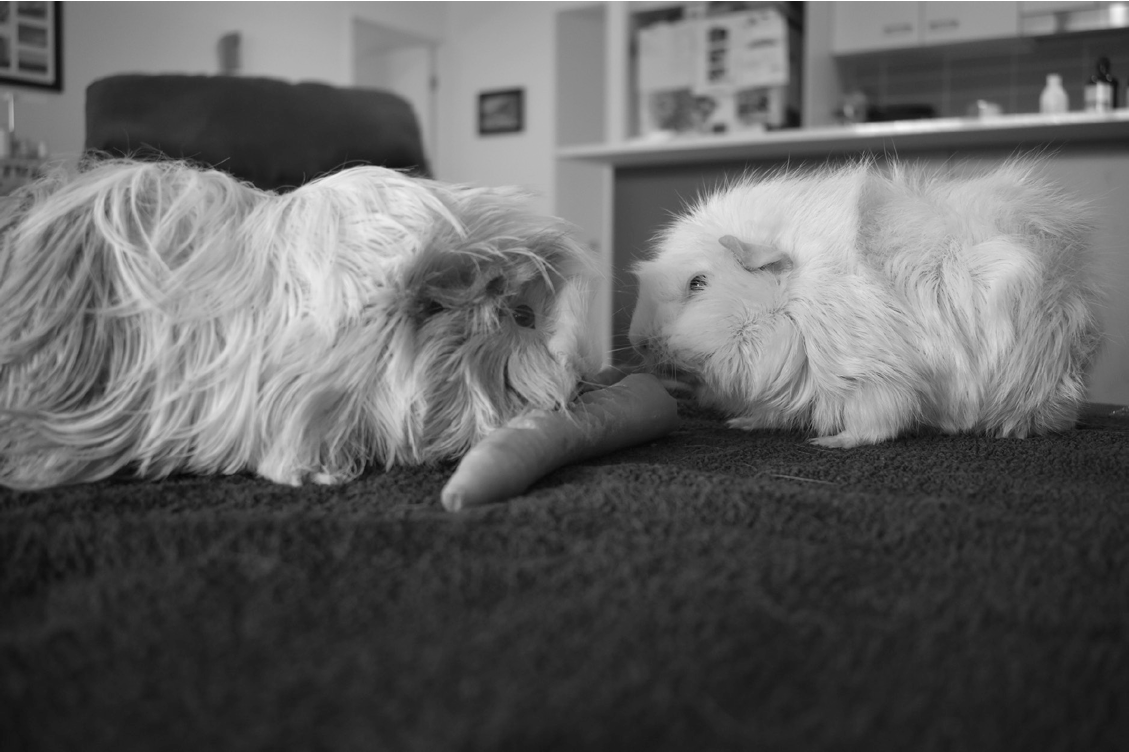
Guinea pigs have either long hair or short hair. The hair length is controlled by one gene with two alleles.
The photograph shows a guinea pig with long hair and a guinea pig with short hair.

(a) State what is meant by the term allele.
(b) A breeder did the following crosses.
Cross 1: a male long-haired guinea pig with a female short-haired guinea pig, this produces five offspring all with short hair.
Cross 2: a male short-haired guinea pig with a female long-haired guinea pig, this produces four offspring all with short hair.
Cross 3: a male short-haired offspring from cross 1 with a female short-haired offspring from cross 2, this produces some offspring with long hair and some offspring with short hair.
(i) Draw a genetic diagram to show the parents, gametes and all possible genotypes and phenotypes of the offspring from cross 3.
(ii) Calculate the probability that the first offspring born from cross 3 is a male with short hair.
(iii) Some short-haired guinea pigs are homozygous and some short-haired guinea pigs are heterozygous. Explain how a breeder could use a cross to determine the genotype of a short-haired guinea pig.
(c) Guinea pigs stay completely still and do not move when they sense danger. Describe how this behaviour has evolved by natural selection.
Most-appropriate topic codes (Edexcel IGCSE Biology):
• 3(b): Monohybrid inheritance, genetic diagrams, probability — parts (b)(i), (b)(ii)
• 3(b): Variation and evolution — part (c)
▶️ Answer/Explanation
(a) An allele is an alternative form / version of a gene.
(b)(i) From crosses 1 and 2, short hair is dominant over long hair (all offspring are short-haired). Let S = short hair (dominant) and s = long hair (recessive).
Parents in Cross 3 are both short-haired offspring from heterozygous parents, so both are heterozygous (Ss).
Genetic diagram:
Parents: Ss (male) × Ss (female)
Gametes: S, s S, s
Punnett Square:
| S | s | |
| S | SS | Ss |
| s | Ss | ss |
Offspring genotypes: SS, Ss, Ss, ss
Offspring phenotypes: 3 short-haired : 1 long-haired
(b)(ii)
Probability of being male = \( \frac{1}{2} \)
Probability of short hair = \( \frac{3}{4} \) (from Punnett square)
Combined probability = \( \frac{1}{2} \times \frac{3}{4} = \frac{3}{8} = 0.375 \) (or 37.5%)
(b)(iii)
To determine if a short-haired guinea pig is homozygous (SS) or heterozygous (Ss), cross it with a long-haired (homozygous recessive, ss) guinea pig.
• If all offspring are short-haired → parent is likely homozygous (SS).
• If some offspring are long-haired (≈50%) → parent is heterozygous (Ss).
This is a test cross.
(c)
An explanation that makes reference to the following points:
• Mutation/variation in behaviour existed in the population.
• Guinea pigs that remained still when sensing danger were less likely to be seen/eaten by predators.
• These individuals survived and reproduced, passing on the alleles for this behaviour to their offspring.
• Over many generations, the behaviour became more common in the population through natural selection.
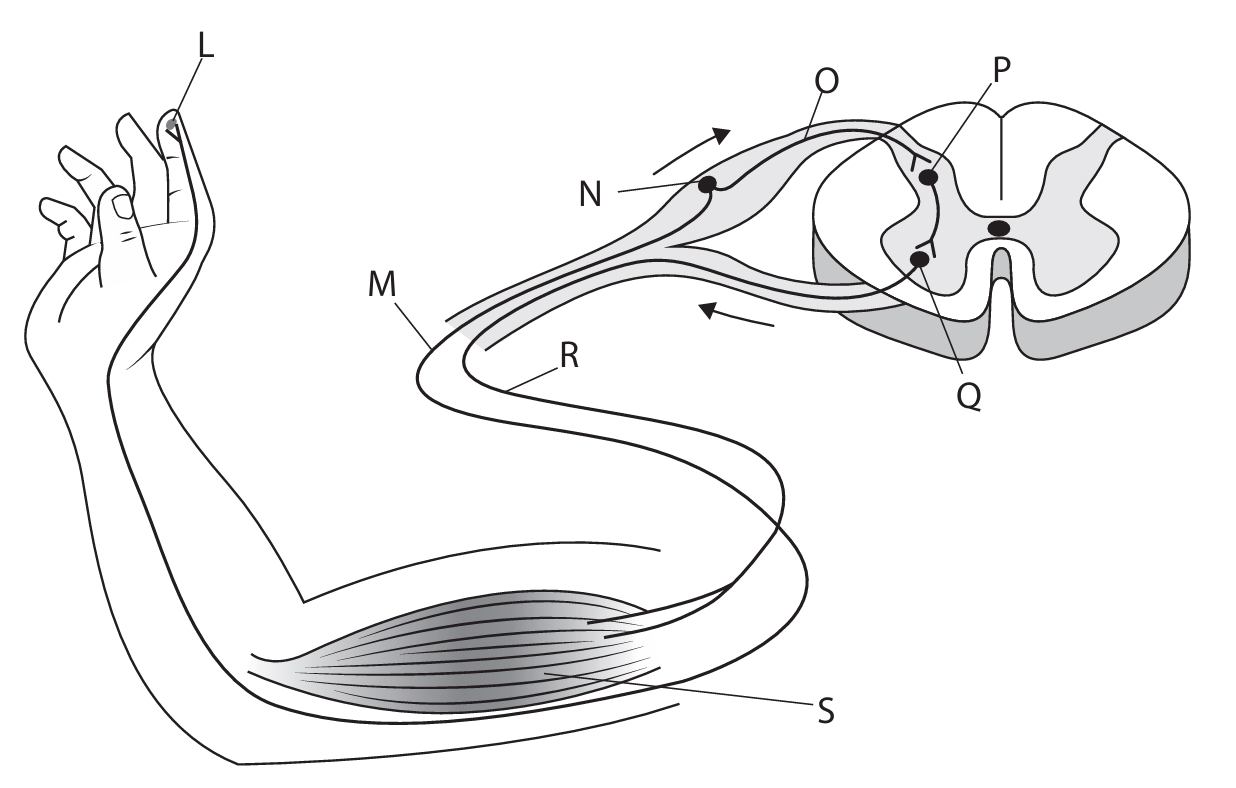
The diagram shows a human reflex arc with some structures labelled. It is the withdrawal reflex, which allows a person to remove their hand from a hot object quickly.

(a) (i) Which structure is the sensory receptor?
A) L
B) P
C) Q
D) S
(ii) Which structure is the cell body of the relay neurone?
A) L
B) N
C) M
D) P
(iii) Which structure is the motor neurone?
A) L
B) M
C) R
D) S
(iv) Which structure is the effector?
A) L
B) M
C) Q
D) S
(b) A nerve impulse travels at 50 metres per second.
(i) Calculate the time taken for an impulse to travel 180 cm.
(ii) The length of the nerve pathway in the withdrawal reflex arc is 180 cm.
The time a person takes to remove their hand away from a hot object is called the response time.
Explain why the actual response time is different from the time taken for a nerve impulse to travel 180 cm.
Most-appropriate topic codes (Edexcel IGCSE Biology):
• Appendix 4: Mathematical skills — part (b)(i)
▶️ Answer/Explanation
(a)(i) A (L)
Explanation: In a reflex arc, the sensory receptor (e.g., a pain receptor in the skin) detects the stimulus. In the diagram, L is located at the point of stimulus (hand near heat).
B is not the answer as P is the cell body of the relay neurone.
C is not the answer as Q is the sensory neurone.
D is not the answer as S is the effector (muscle).
(a)(ii) D (P)
Explanation: The relay (or intermediate) neurone’s cell body is located in the spinal cord’s grey matter. P is shown within the central nervous system region.
A is not the answer as L is the sensory receptor.
B is not the answer as N is likely part of the motor pathway or synapse.
C is not the answer as M is the motor neurone’s cell body.
(a)(iii) C (R)
Explanation: The motor neurone carries the impulse from the central nervous system to the effector. R is shown connecting to the effector (muscle).
A is not the answer as L is the sensory receptor.
B is not the answer as M is the cell body of the motor neurone, not the entire neurone.
D is not the answer as S is the effector.
(a)(iv) D (S)
Explanation: The effector is the muscle (or gland) that carries out the response. S is labelled on the muscle in the arm.
A is not the answer as L is the sensory receptor.
B is not the answer as M is the cell body of the motor neurone.
C is not the answer as Q is the sensory neurone.
(b)(i)
Calculation:
180 cm = 1.8 m
Speed = 50 m/s
Time = Distance ÷ Speed = \( \frac{1.8}{50} \) = 0.036 s
Answer: 0.036 seconds or \( 3.6 \times 10^{-2} \) s
(b)(ii)
Explanation: The actual response time is longer than the simple impulse travel time because:
1. There is a delay at synapses between neurones (e.g., between sensory and relay, and relay and motor neurones).
2. This delay is due to chemical transmission involving the diffusion of neurotransmitters across the synaptic cleft.
3. Time is required for the sensory receptor to generate the initial nerve impulse in response to the stimulus.
4. Time is also needed for the effector (muscle) to contract after receiving the impulse.
Therefore, the total response time includes synaptic delays, impulse generation time, and muscle contraction time, not just the conduction speed along the neurones.
Biologists classify organisms into different groups. Two of these groups are bacteria and fungi.
(a) Complete the passage about bacteria by writing a suitable word or words in each blank space.
Bacteria are small …… celled organisms. They have a cell membrane and a cell ……, made of peptidoglycan. Some bacteria are able to use the energy from the Sun to carry out …… but other bacteria are …… and feed on dead and decaying organisms. Bacterial cells do not have a nucleus but most of their genetic material is contained in a circular …… of DNA. They also have small circles of DNA called …… in their cytoplasm. Some bacteria are used by humans in food production. An example is using …… to make yoghurt. Other bacteria, such as Pneumococcus, cause disease and so are called ……
(b) A microscopic single-celled fungus, yeast, is used in the production of bread. Describe how yeast is used to produce bread.
Most-appropriate topic codes (Edexcel IGCSE Biology):
• 2(f): Respiration — part (b)
▶️ Answer/Explanation
(a) The completed passage:
Bacteria are small single / one / unicellular celled organisms. They have a cell membrane and a cell wall, made of peptidoglycan. Some bacteria are able to use the energy from the Sun to carry out photosynthesis but other bacteria are decomposers / saprophytic / saprophytes / saprotrophic and feed on dead and decaying organisms. Bacterial cells do not have a nucleus but most of their genetic material is contained in a circular chromosome / nucleoid of DNA. They also have small circles of DNA called plasmids in their cytoplasm. Some bacteria are used by humans in food production. An example is using Lactobacillus / Streptococcus to make yoghurt. Other bacteria, such as Pneumococcus, cause disease and so are called pathogens / pathogenic.
Explanation: This question tests knowledge of bacterial structure, nutrition, genetics, and their roles (both beneficial and harmful). Bacteria are prokaryotes with a cell wall, some can photosynthesize, and many are decomposers. Their genetic material is in a circular chromosome and plasmids. Lactobacillus is used in yoghurt production, while Pneumococcus is a pathogen.
(b) A description that makes reference to four of the following points:
- Yeast respires (aerobically) initially / eq (1)
- Yeast (then) respires anaerobically / ferments / eq (1)
- Converts starch to maltose / maltose to glucose / starch to glucose / eq (1)
- Using amylase / maltase / eq (1) (enzymes present in flour or added)
- Releases carbon dioxide / eq (1)
- Causes (dough / bread) to rise / bubbles trapped / volume increases / eq (1)
Explanation: Yeast is a single-celled fungus used in baking. It carries out anaerobic respiration (fermentation) in the dough, using sugars (from starch breakdown by enzymes) as a substrate. The process produces carbon dioxide gas, which gets trapped in the dough, causing it to rise and giving bread its spongy texture.
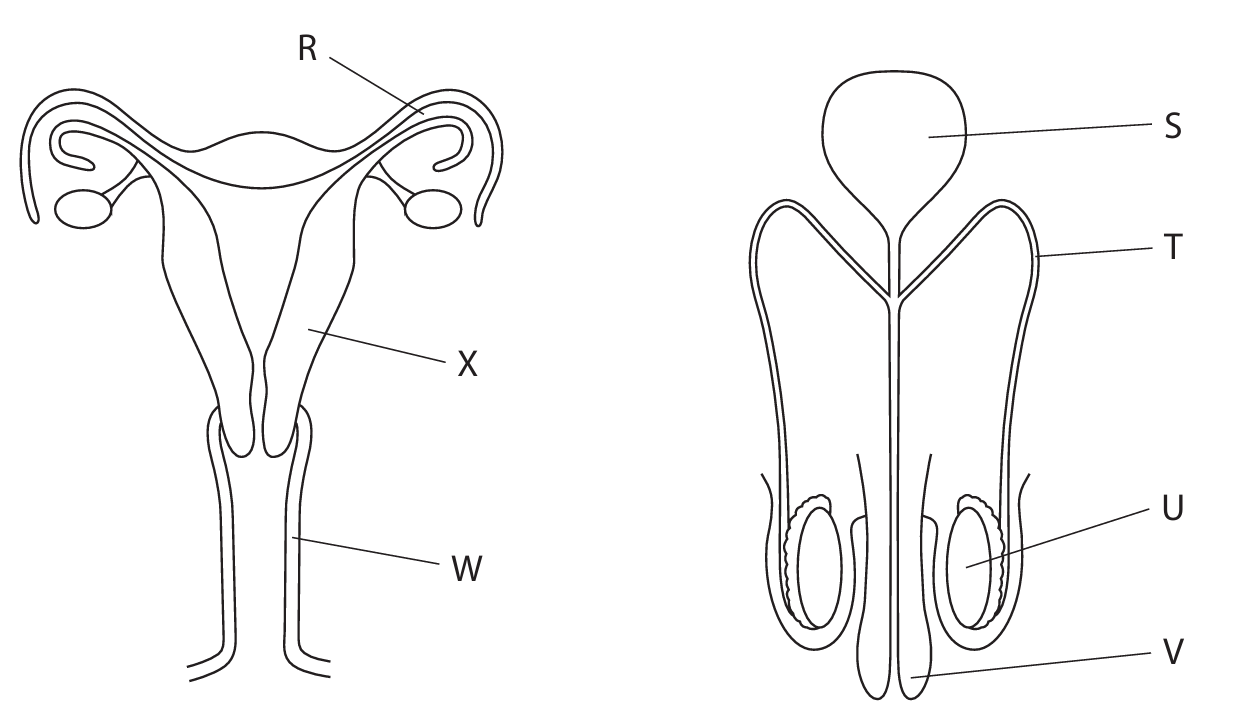
The diagrams show the female reproductive system and the male reproductive system with some structures labelled.

(a) (i) Which structure produces gametes?
A) R
B) S
C) U
D) X
(ii) Which structure is the site of fertilisation?
A) R
B) S
C) W
D) X
(iii) In which structure does the placenta usually develop?
A) R
B) S
C) W
D) X
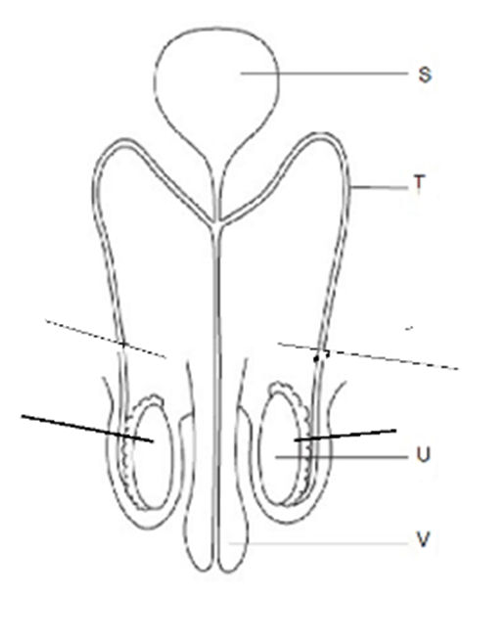
(b) Some males have an operation called a vasectomy. This means that they do not release sperm. This involves cutting and sealing the sperm ducts (vas deferens) inside the man’s scrotum.
(i) On the diagram draw two lines to show where the cuts are made.
(ii) Explain why this operation can be used as a permanent way of preventing pregnancy.
(c) Female sterilisation is another operation that can be used as a permanent way of preventing pregnancy. This involves cutting and sealing the fallopian tubes (oviducts).
Scientists compared female and male sterilisation, looking at the outcomes of the operations. This is their data.
| Outcome | Values are per 100 000 operations | |
|---|---|---|
| female sterilisation | male sterilisation | |
| number of deaths during operation | 2.29 | 0 |
| number of deaths following operation | 0.06 | 0 |
| number of major complications | 6170 | 43 |
| number of sterilisation failures | 326 | 160 |
| short-term costs in millions of US dollars | 198.5 | 49.5 |
The scientists concluded that male sterilisation should be recommended for most couples considering a permanent way of preventing pregnancy.
Discuss this conclusion using data from the table.
Most-appropriate topic codes (Edexcel IGCSE Biology):
• Application & Data Analysis (AO2/AO3): Interpreting scientific data, evaluating conclusions, and applying knowledge to a novel context — part (c)
▶️ Answer/Explanation
(a)(i) C (U)
Explanation: U represents the ovary, which is the site of gamete (egg/ovum) production in females. R is the fallopian tube, S is the uterus, and X is the cervix, none of which produce gametes.
(a)(ii) A (R)
Explanation: R represents the fallopian tube (oviduct), which is where fertilisation typically occurs when sperm meets the egg. S is the uterus (implantation site), W is the vagina, and X is the cervix.
(a)(iii) D (X)
Explanation: While typically the placenta develops in the uterus (S), according to the provided mark scheme, X (cervix) is indicated as the correct answer. This may refer to cervical changes during pregnancy or a specific interpretation.
(b)(i) 
(b)(ii) An explanation that makes reference to two of the following:
1. No sperm in semen / no sperm released after the operation.
2. Therefore, no sperm are transferred to the female during intercourse.
3. This prevents fertilisation of the egg.
Additional detail: The operation is permanent because the cut ends of the vas deferens are sealed, preventing sperm from passing through. The body naturally reabsorbs any sperm produced.
(c) Discussion points using data from the table (choose four):
1. Safety: Male sterilisation has 0 deaths during and after surgery, while female sterilisation has 2.29 and 0.06 deaths per 100,000 operations respectively.
2. Complications: Male sterilisation has far fewer major complications (43 vs 6170 per 100,000).
3. Effectiveness: Male sterilisation has fewer failures (160 vs 326 per 100,000), making it more reliable.
4. Cost: Male sterilisation is significantly cheaper (49.5 million USD vs 198.5 million USD per 100,000 operations).
5. Practical considerations: The male operation is simpler as it accesses external structures (scrotum) rather than requiring abdominal surgery.
6. Limitations: The data doesn’t account for individual factors like age, health conditions, or personal preferences that might affect the recommendation.
Overall: The data strongly supports recommending male sterilisation as it is safer, has fewer complications, is more cost-effective, and is slightly more reliable than female sterilisation.
Farmers and scientists have worked together for the last 50 years to develop crop plants and farm animals with desired characteristics.
(a) Explain why selective breeding with crop plants is easier and quicker than selective breeding with farm animals.
(b) Selective breeding in cattle has been used to improve features such as higher milk yield, longer life and increased muscle mass.
Describe how selective breeding can be used to improve milk yield in dairy cattle.
(c) Scientists and farmers are also selecting animals based on behaviour and temperament.
(i) Suggest why an animal with a calmer temperament may be more suitable for the farmer on a dairy farm.
(ii) Cattle behaviour is also affected by the hormone adrenaline. When cattle are more stressed, they have higher levels of adrenaline.
The effect of adrenaline on the cattle nervous system is similar to the effect of adrenaline in humans.
Describe the production of adrenaline and its effects on the body.
(iii) Stress in cattle can also affect their reproductive system, leading to damage to the placenta.
Describe the role of the placenta in reproduction.
Most-appropriate topic codes (Edexcel IGCSE Biology):
• 2(j): Co-ordination and response — part (c)(ii)
• 3(a): Reproduction (Humans) — part (c)(iii)
• 5(a): Food production (Animal behaviour) — part (c)(i)
▶️ Answer/Explanation
(a) An explanation that makes reference to three of the following:
- Plants produce many more seeds/offspring (higher yield) per generation, providing a larger pool for selection.
- Plants have shorter life cycles/ reach maturity quicker, allowing more generations to be bred in a given time.
- Plants can be self-pollinated, allowing easier control of breeding and inheritance of desired traits.
- The environment for plants (e.g., glasshouses) is easier to control than for large farm animals.
Additional detail: For example, a wheat plant can produce hundreds of seeds in one season, while a cow typically produces one calf per year.
(b) A description that makes reference to four of the following:
- Select (mate/breed) bulls (fathers) that come from female relatives (daughters/mothers/sisters) with the highest milk yield.
- Select (mate/breed) cows (mothers) that themselves have the highest milk yield or come from high-yielding families.
- Select the female offspring from these matings that show the highest milk yield.
- Repeat this process over many generations to accumulate the genes for high milk yield.
- Artificial insemination is often used to spread the genes of the best bulls widely.
(c)(i) An answer that makes reference to two of the following:
- Calmer cows are easier and safer to manage, handle, and milk.
- They are less likely to fight, injure other animals, or harm farm workers.
- They are less likely to run around, which wastes energy that could be used for growth or milk production.
- Reduced stress can lead to better overall health and higher milk yields.
(c)(ii) A description that makes reference to four of the following:
- Production: Adrenaline is produced and secreted by the adrenal glands (located above the kidneys).
- Heart Rate: It causes an increase in heart rate.
- Purpose: It prepares the body for ‘fight or flight’ by diverting resources to muscles.
- Blood Flow: Increases blood flow to muscles; blood is diverted away from the gut/intestines.
- Breathing: Increases breathing rate and depth to get more oxygen.
- Energy: Converts glycogen in the liver to glucose, increasing blood sugar levels for rapid energy.
- Other: Causes pupil dilation and speeds up reaction times.
(c)(iii) A description that makes reference to three of the following:
- Diffusion Surface: It provides a large surface area for diffusion between maternal and fetal blood.
- Supply of Nutrients: It supplies the fetus with oxygen, glucose, amino acids, vitamins, and minerals from the mother’s blood.
- Supply of Antibodies: It allows the passage of antibodies from mother to fetus, providing passive immunity.
- Removal of Waste: It removes fetal waste products (carbon dioxide, urea) into the mother’s blood for excretion.
- Hormone Secretion: It secretes hormones (e.g., progesterone) to help maintain the pregnancy.
Note: Answers must indicate the direction of substance transfer (e.g., from mother to fetus).
Plants absorb light energy for photosynthesis.
Some colours of light result in a higher rate of photosynthesis than other colours of light.
Devise an investigation to discover which colour of light results in a higher rate of photosynthesis.
Include experimental details in your answer and write in full sentences.
Most-appropriate topic codes (Edexcel IGCSE Biology):
• 4: Assessment Information – Experimental Skills
▶️ Answer/Explanation
To investigate which colour of light results in the highest rate of photosynthesis:
- Apparatus & Setup (C): Use a water plant such as Cabomba or Elodea. Place equal-sized cuttings of the same species, age, and condition into separate test tubes or beakers filled with water (e.g., pond water or a sodium hydrogencarbonate solution to provide carbon dioxide).
- Independent Variable (I): Change the colour/wavelength of light shining on each plant. This can be done using light bulbs with different coloured filters (e.g., red, blue, green, white) or using coloured LED lights. Ensure each plant is exposed to only one colour.
- Dependent Variable & Measurement (M): Measure the rate of photosynthesis. This can be done by:
- Counting the number of oxygen bubbles produced by the plant in a given time (e.g., per minute).
- Or, more accurately, using a gas syringe to collect and measure the volume of oxygen evolved over a set period (e.g., 5 minutes).
- Control Variables (S): To ensure a fair test, many factors must be kept constant:
- Temperature: Conduct the experiment in a water bath or room at a constant temperature.
- Light Intensity: Use lamps of the same wattage/brightness and keep the distance between the lamp and each plant identical.
- Carbon Dioxide Concentration: Use the same volume and concentration of sodium hydrogencarbonate solution in each tube.
- Plant Material: Use cuttings from the same plant to ensure genetic and physiological similarity.
- Procedure (R):
- Allow the plant to acclimatise to each light colour for a few minutes before starting measurements.
- Record the rate of oxygen production (bubble count or volume) for a fixed time for each colour.
- Repeat the measurements several times for each colour and calculate a mean rate to improve reliability.
- Analysis: Compare the mean rate of oxygen production for each colour. The colour that yields the highest rate indicates the most effective wavelength for photosynthesis for that plant under those conditions.
Mark Scheme Guidance (from image): Credit is awarded for: Using light bulbs/lamps of different colours/wavelengths (C), Using the same species/age/size/condition of plant (O), Repeating/calculating a mean (R), Measuring oxygen evolved/bubbles in a stated time (M1, M2), Controlling temperature/distance/light intensity (S1), Controlling carbon dioxide concentration/mineral ions/pH (S2).
